Ch.6 - Alkyl Halides; Nucleophilic Substitution
Wade - Organic Chemistry 9th Edition
Wade9th EditionOrganic ChemistryISBN: 9780135213728당신이 사용하는 게 아니라요?교과서 변경
6장, 문제 13a

Under certain conditions, the reaction of 0.5 M 1-bromobutane with 1.0 M sodium methoxide forms 1-methoxybutane at a rate of 0.05 mol/L per second. What would be the rate if 0.1 M 1-bromobutane and 2.0 M NaOCH3 were used?

검증된 단계별 안내
1
Identify the type of reaction: The reaction involves 1-bromobutane (an alkyl halide) and sodium methoxide (a strong nucleophile). This suggests an SN2 reaction, which is second-order overall, meaning the rate depends on the concentrations of both reactants.
Write the rate law for the reaction: The rate law for an SN2 reaction is given by \( \text{Rate} = k[\text{1-bromobutane}][\text{NaOCH}_3] \), where \( k \) is the rate constant.
Determine the rate constant \( k \): Using the initial conditions provided, substitute \( \text{Rate} = 0.05 \ \text{mol/L/s} \), \( [\text{1-bromobutane}] = 0.5 \ \text{M} \), and \( [\text{NaOCH}_3] = 1.0 \ \text{M} \) into the rate law to solve for \( k \). Rearrange the equation to \( k = \frac{\text{Rate}}{[\text{1-bromobutane}][\text{NaOCH}_3]} \).
Substitute the new concentrations into the rate law: Once \( k \) is determined, use the new concentrations \( [\text{1-bromobutane}] = 0.1 \ \text{M} \) and \( [\text{NaOCH}_3] = 2.0 \ \text{M} \) in the rate law \( \text{Rate} = k[\text{1-bromobutane}][\text{NaOCH}_3] \).
Calculate the new rate: Multiply the value of \( k \) by the new concentrations of 1-bromobutane and sodium methoxide to find the new rate of the reaction.

비슷한 문제에 대한 검증된 영상 답변:

이 영상 해법은 위 문제에 도움이 된다고 튜터들이 추천한 것입니다.
영상 길이:
6m

주요 개념

질문에 올바르게 답하기 위해 반드시 이해해야 하는 핵심 개념들은 다음과 같습니다.

Reaction Rate

The reaction rate is a measure of how quickly reactants are converted into products in a chemical reaction. It is typically expressed in terms of concentration change over time, such as mol/L per second. Understanding how concentration affects the rate is crucial, as it can be influenced by factors like reactant concentration, temperature, and the presence of catalysts.
추천 영상:
가이드 코스
5:07
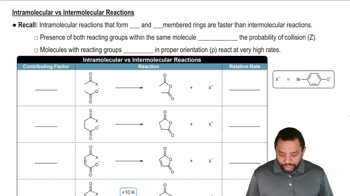
Rates of Intramolecular Reactions Concept 2

Concentration and Stoichiometry

Concentration refers to the amount of a substance in a given volume of solution, usually expressed in molarity (M). In this reaction, the stoichiometry dictates how the concentrations of 1-bromobutane and sodium methoxide will affect the formation of 1-methoxybutane. Adjusting the concentrations of reactants can lead to different reaction rates, which is essential for predicting outcomes in chemical reactions.
추천 영상:
가이드 코스
2:36
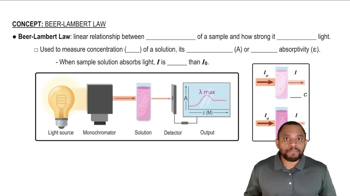
The Beer-Lambert Law Concept 1

Rate Law

The rate law is an equation that relates the rate of a reaction to the concentration of its reactants, typically expressed as rate = k[A]^m[B]^n, where k is the rate constant, and m and n are the reaction orders with respect to each reactant. Understanding the rate law allows chemists to predict how changes in concentration will affect the reaction rate, which is key to solving the given problem.
추천 영상:
가이드 코스
5:07
Rates of Intramolecular Reactions Concept 2