Ch.6 - Alkyl Halides; Nucleophilic Substitution
Wade - Organic Chemistry 9th Edition
Wade9th EditionOrganic ChemistryISBN: 9780135213728당신이 사용하는 게 아니라요?교과서 변경
6장, 문제 10d

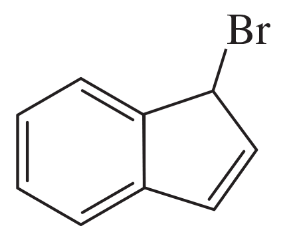
Show how free-radical halogenation might be used to synthesize the following ­compounds. In each case, explain why we expect to get a single major product.
(d)

검증된 단계별 안내
1
Step 1: Identify the target compound and analyze its structure. The compound shown is a brominated bicyclic structure with a bromine atom attached to the benzylic position of the bicyclic ring system. This position is particularly reactive due to the stability of the benzylic radical formed during the reaction.
Step 2: Understand the mechanism of free-radical halogenation. Free-radical halogenation involves three steps: initiation, propagation, and termination. In the initiation step, a halogen molecule (e.g., Br2) is split into two bromine radicals by heat or light. These radicals are highly reactive and initiate the reaction.
Step 3: Determine the most reactive site for halogenation. In this case, the benzylic position is the most reactive due to the resonance stabilization of the benzylic radical. When a hydrogen atom is abstracted from this position, the resulting radical is stabilized by delocalization of electrons into the aromatic ring.
Step 4: Predict the major product. Since the benzylic radical is highly stabilized, bromination will predominantly occur at this position, leading to the formation of the single major product shown in the image. Other positions on the bicyclic ring system are less reactive and unlikely to undergo halogenation.
Step 5: Explain why a single major product is expected. The regioselectivity of the reaction is driven by the stability of the intermediate radical. The benzylic radical is significantly more stable than radicals formed at other positions, ensuring that bromination occurs exclusively at this site under typical free-radical halogenation conditions.

비슷한 문제에 대한 검증된 영상 답변:

이 영상 해법은 위 문제에 도움이 된다고 튜터들이 추천한 것입니다.
영상 길이:
7m

주요 개념

질문에 올바르게 답하기 위해 반드시 이해해야 하는 핵심 개념들은 다음과 같습니다.

Free-Radical Halogenation

Free-radical halogenation is a reaction where alkanes react with halogens (like bromine) in the presence of heat or light to form alkyl halides. This process involves the generation of free radicals, which are highly reactive species with unpaired electrons. The reaction proceeds through three main steps: initiation, propagation, and termination, leading to the substitution of hydrogen atoms with halogen atoms.
추천 영상:
12:11
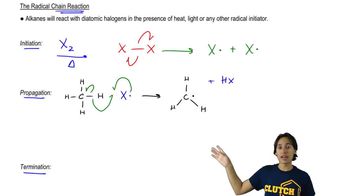
Radical Chain Reaction Mechanism.

Selectivity in Free-Radical Reactions

Selectivity in free-radical halogenation refers to the preference for the formation of certain products over others. This is influenced by the stability of the free radicals formed during the reaction. More stable radicals (like tertiary radicals) are favored, leading to a single major product when the substrate has a clear preference for one site of substitution, as seen in the provided compound.
추천 영상:
10:08
Radical selectivity: Food Analogy

Mechanism of Bromination

The mechanism of bromination involves the formation of a bromine radical that abstracts a hydrogen atom from the substrate, creating a new radical. This radical can then react with another bromine molecule to form the brominated product. The specific structure of the compound in the image suggests that bromination will occur at a position that leads to a stable radical, thus resulting in a single major product due to the lack of competing sites for substitution.
추천 영상:
00:54
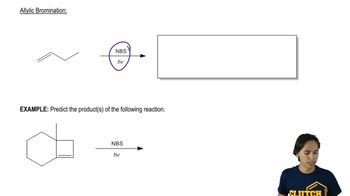
Mechanism of Allylic Bromination.