Ch.6 - Alkyl Halides; Nucleophilic Substitution
Wade - Organic Chemistry 9th Edition
Wade9th EditionOrganic ChemistryISBN: 9780135213728당신이 사용하는 게 아니라요?교과서 변경
6장, 문제 10c

Show how free-radical halogenation might be used to synthesize the following ­compounds. In each case, explain why we expect to get a single major product.
(c)

검증된 단계별 안내
1
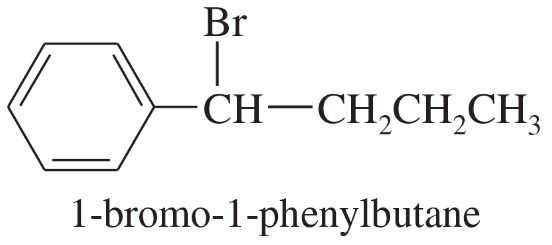
Step 1: Identify the target compound, 1-bromo-1-phenylbutane, and recognize that it is formed via free-radical halogenation. The bromine atom is attached to the carbon adjacent to the phenyl group, which is the benzylic position.
Step 2: Understand the mechanism of free-radical halogenation. This reaction involves three steps: initiation, propagation, and termination. The initiation step generates bromine radicals (Br•) by homolytic cleavage of Br₂ under UV light or heat.
Step 3: Recognize that the benzylic position is highly reactive in free-radical halogenation due to the stability of the benzylic radical. The phenyl group stabilizes the radical through resonance, making this position the preferred site for bromination.
Step 4: During the propagation step, the bromine radical abstracts a hydrogen atom from the benzylic position of 1-phenylbutane, forming a benzylic radical. This radical then reacts with another Br₂ molecule to form the desired product, 1-bromo-1-phenylbutane, and regenerates the bromine radical.
Step 5: Explain why a single major product is expected. The benzylic position is the most reactive site due to radical stability, and there are no other competing positions with similar stability. This ensures selective bromination at the benzylic position, yielding 1-bromo-1-phenylbutane as the major product.

비슷한 문제에 대한 검증된 영상 답변:

이 영상 해법은 위 문제에 도움이 된다고 튜터들이 추천한 것입니다.
영상 길이:
4m

주요 개념

질문에 올바르게 답하기 위해 반드시 이해해야 하는 핵심 개념들은 다음과 같습니다.

Free-Radical Halogenation

Free-radical halogenation is a reaction where alkanes react with halogens (like bromine) in the presence of heat or light to form alkyl halides. This process involves the generation of free radicals, which are highly reactive species that can initiate a chain reaction. The reaction typically proceeds through three steps: initiation, propagation, and termination, leading to the substitution of hydrogen atoms with halogen atoms.
추천 영상:
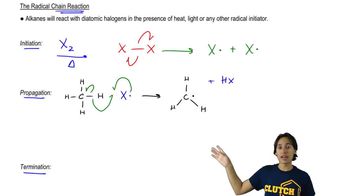
12:11
Radical Chain Reaction Mechanism.

Selectivity in Free-Radical Reactions

Selectivity in free-radical reactions refers to the preference for the formation of certain products over others. In the case of halogenation, the stability of the resulting radical intermediates plays a crucial role. More stable radicals (like tertiary radicals) are formed preferentially, leading to a single major product when the structure allows for minimal competition among possible sites for substitution.
추천 영상:
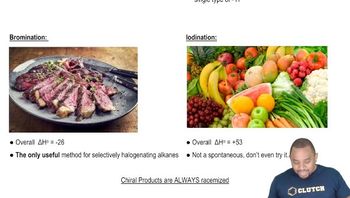
10:08
Radical selectivity: Food Analogy

Stability of Radicals

The stability of radicals is a key factor in determining the outcome of free-radical reactions. Radicals can be classified as primary, secondary, or tertiary based on the number of carbon atoms attached to the carbon bearing the unpaired electron. Tertiary radicals are the most stable due to hyperconjugation and inductive effects from adjacent carbon atoms, which influences the selectivity of the halogenation process and explains why a single major product is expected.
추천 영상:
03:43
The radical stability trend.