 뒤로
뒤로Chapter 4: Forces and Newton’s Laws of Motion – Study Guide
스터디 가이드 - 스마트 노트
 자료에 맞춘 맞춤형 노트, 핵심 정의, 예시, 맥락을 확장해 제공합니다.
Forces and Newton’s Laws of Motion
Introduction
This chapter explores the fundamental connection between force and motion, introducing Newton’s Laws and the various types of forces encountered in physics. Understanding these concepts is essential for analyzing the motion of objects and solving dynamics problems.
Section 4.1: Motion and Forces
What Causes Motion?
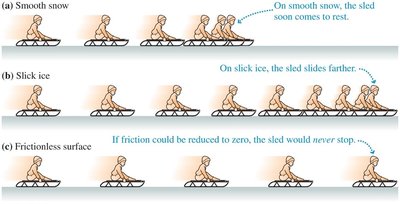
Objects change their motion when forces are applied. Everyday experiences suggest that continuous force is needed to keep objects moving, but experiments show that friction is responsible for slowing objects down. In the absence of friction, objects will continue moving indefinitely.
Key Point: Friction determines how quickly objects slow down.
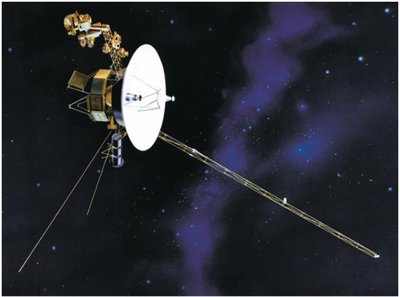
Example: The Voyager space probe continues its motion in space for billions of years due to negligible friction.
Newton’s First Law
Newton’s first law states that an object with no forces acting on it will remain at rest or move in a straight line at constant speed. This law explains why objects continue their motion unless acted upon by an external force.
Key Point: Objects only change their state of motion when a force acts on them.
Example: In a car crash, the car stops due to a force, but the crash dummy continues moving until it hits the dashboard.

Section 4.2: Types of Forces
What Is a Force?
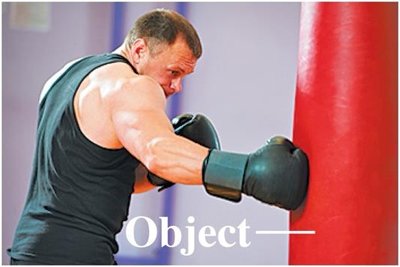
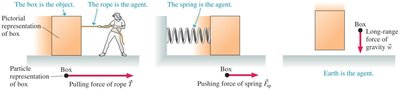
A force is a push or a pull that acts on an object. Every force has an agent (the source of the force) and acts at a point of contact or at a distance. Forces are vectors, meaning they have both magnitude and direction.
Key Point: Forces can be contact (require physical touch) or long-range (act without contact).
Example: Throwing a ball, pushing a box, or gravity acting on a falling object.


Force as a Vector
Forces are represented by vectors, typically denoted as . The magnitude of the force is . Contact forces act at the point of contact, while long-range forces (like gravity) act without physical contact.
Key Point: Forces must be added vectorially to determine the net force.

Drawing Force Vectors
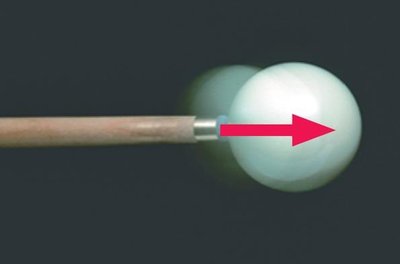
Force vectors are drawn as arrows from the object, with the tail at the object and the arrow pointing in the direction of the force. The length of the arrow represents the magnitude.
Key Point: Use diagrams to visualize forces acting on objects.
Combining Forces
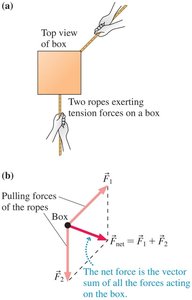
When multiple forces act on an object, the net force is the vector sum of all individual forces:
Equation:
Key Point: The net force determines the object's acceleration.
Section 4.2: A Short Catalog of Forces
Weight
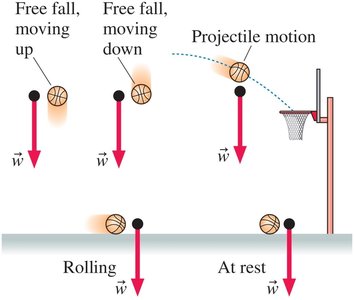
Weight is the gravitational pull of the Earth on an object. It always acts vertically downward.
Equation:
Key Point: The agent is the entire Earth.
Spring Force
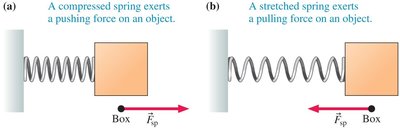
Springs exert forces when compressed or stretched. The force can be a push or a pull, depending on the spring's state.
Equation: (Hooke's Law)
Tension Force
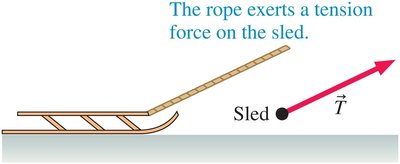
Tension is the force exerted by a string, rope, or wire when it pulls on an object. The direction of tension is always along the string.
Key Point: Tension is a contact force.
Normal Force
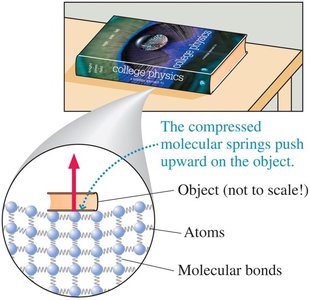
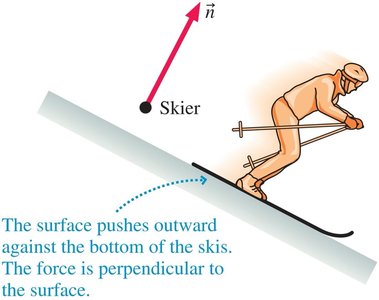
The normal force is exerted by a surface perpendicular to the object pressing against it. It is responsible for the "solidness" of solids.
Key Point: Normal force acts perpendicular to the surface.
Friction
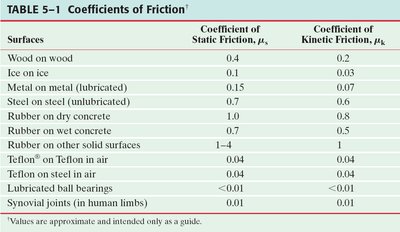
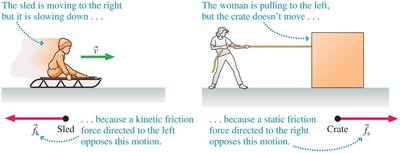
Friction is a force exerted by a surface, always parallel to the surface. It opposes motion and comes in two types: kinetic (sliding) and static (preventing motion).
Equation for kinetic friction:
Equation for static friction:
Key Point: Static friction adjusts to match applied force up to a maximum value.
Drag
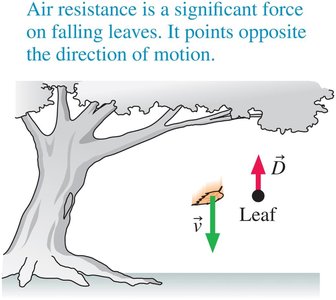
Drag is the resistive force of a fluid (air or water) on a moving object. It acts opposite to the direction of motion.
Key Point: Drag is similar to kinetic friction but occurs in fluids.
Thrust
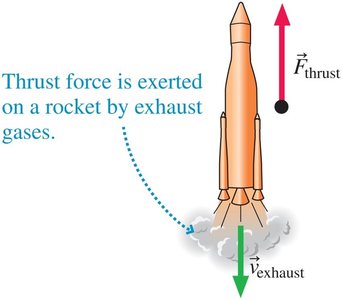
Thrust is the force produced when a jet or rocket engine expels gas molecules at high speed. It acts opposite to the direction of the expelled gas.
Key Point: Thrust is essential for rocket propulsion.
Section 4.3: Identifying Forces
Identifying Forces in Problems
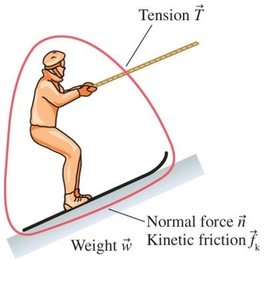
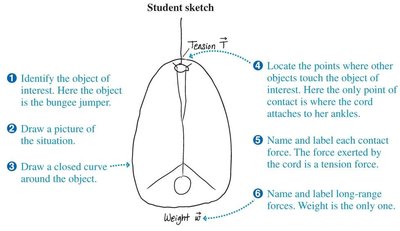
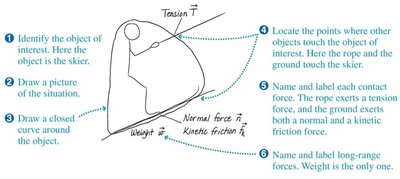
To analyze motion, first identify all forces acting on the object. Draw a picture, isolate the object, and locate points of contact for contact forces. Also, identify any long-range forces (like gravity).
Key Point: Only include forces that actually exist; avoid imaginary forces.
Common Forces and Notation
Force | Notation |
|---|---|
General force | |
Weight | |
Spring force | |
Tension | |
Normal force | |
Static friction | |
Kinetic friction | |
Drag | |
Thrust |
Examples: Identifying Forces
Bungee Jumper: Forces are tension (from the cord) and weight (gravity).
Skier: Forces are tension (from the rope), normal force (from the ground), kinetic friction, and weight.
Section 4.4: What Do Forces Do?
Force and Acceleration
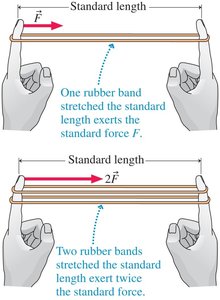
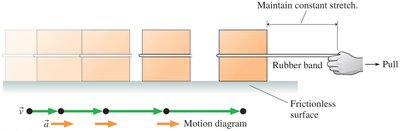
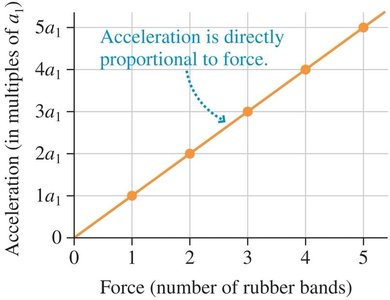
Experiments show that a constant force causes a constant acceleration. Acceleration is directly proportional to force and inversely proportional to mass.
Equation:
Key Point: The direction of acceleration is the same as the direction of the net force.
Inversely Proportional Relationships
When two quantities are inversely proportional, increasing one decreases the other. For force and mass:
Equation:
Key Point: Doubling mass halves acceleration for the same force.
Section 4.5: Newton’s Second Law
Newton’s Second Law
Newton’s second law quantifies the relationship between force, mass, and acceleration:
Equation:
Key Point: The net force is the vector sum of all forces acting on the object.
Units of Force
SI Unit: Newton (N)
Definition:
Conversion:
Section 4.6: Free-Body Diagrams
Free-Body Diagrams
A free-body diagram is a visual tool to represent all forces acting on an object. The object is shown as a dot, and force vectors are drawn from it.
Key Point: Free-body diagrams help solve dynamics problems by organizing forces.
Steps for Drawing Free-Body Diagrams
Identify all forces acting on the object.
Draw a coordinate system.
Represent the object as a dot at the origin.
Draw and label each force vector.
Draw and label the net force vector beside the diagram.
Section 4.7: Newton’s Third Law
Newton’s Third Law
Newton’s third law states that every force occurs as one member of an action/reaction pair. The two forces act on different objects, are equal in magnitude, and point in opposite directions.
Equation:
Key Point: Action/reaction pairs exist together or not at all.
Examples of Action/Reaction Pairs
Hammer and nail
Bat and ball
Earth and moon
Rocket and exhaust gases
Summary of General Principles
Newton’s First Law: Objects remain at rest or in uniform motion unless acted upon by a force.
Newton’s Second Law: Net force causes acceleration; .
Newton’s Third Law: Forces always occur in equal and opposite pairs.
Force: Push or pull, vector quantity, requires an agent.
Net Force: Vector sum of all forces.
Mass: Resistance to acceleration; for constant force.
Identifying Forces: Locate contact points and long-range forces.
Free-Body Diagrams: Visualize all forces acting on an object.
Table: Common Forces and Their Notation
Force | Notation |
|---|---|
General force | |
Weight | |
Spring force | |
Tension | |
Normal force | |
Static friction | |
Kinetic friction | |
Drag | |
Thrust |
