 뒤로
뒤로Chapter 6: Circular Motion, Orbits, and Gravity – Study Notes
스터디 가이드 - 스마트 노트
 자료에 맞춘 맞춤형 노트, 핵심 정의, 예시, 맥락을 확장해 제공합니다.
Chapter 6: Circular Motion, Orbits, and Gravity
Introduction
This chapter explores the physics of objects moving in circles, the forces that govern such motion, and the universal law of gravitation. Applications include planetary orbits, satellites, and everyday phenomena such as cars turning corners and amusement park rides.
Uniform Circular Motion
Velocity and Acceleration in Circular Motion
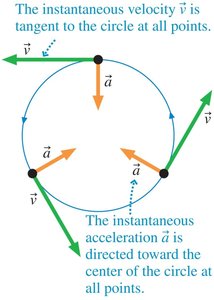
When an object moves in a circle at constant speed, its velocity is constantly changing direction, meaning it is always accelerating even if its speed remains unchanged. This acceleration is called centripetal acceleration and always points toward the center of the circle.
Velocity (\(\vec{v}\)): Tangent to the circle at every point.
Acceleration (\(\vec{a}\)): Directed toward the center of the circle.
Period, Frequency, and Speed
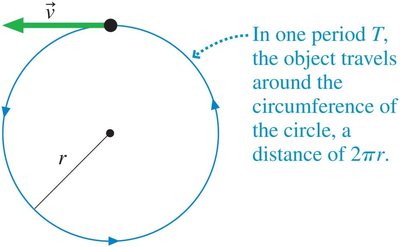
The period (T) is the time for one complete revolution. The frequency (f) is the number of revolutions per second. The speed (v) of an object in uniform circular motion is related to the radius (r) and period (T):
\( f = \frac{1}{T} \)
\( v = \frac{2\pi r}{T} = 2\pi f r \)
\( a_c = \frac{v^2}{r} = 4\pi^2 f^2 r \)
Example: Spinning Table Saw Blade
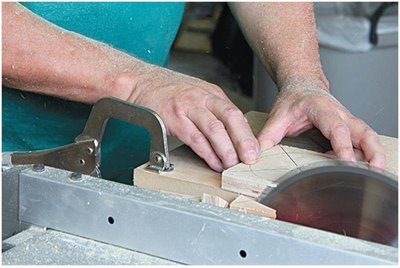
A table saw blade of diameter 0.25 m spins at 3600 rpm. The period, speed, and acceleration of a tooth at the edge can be found using the above equations. For example, the speed is \( v = 2\pi r f \), and the centripetal acceleration is \( a_c = 4\pi^2 f^2 r \).
Dynamics of Uniform Circular Motion
Forces in Circular Motion
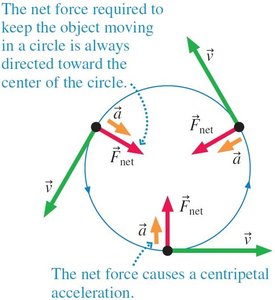
According to Newton's second law, a net force is required to keep an object moving in a circle. This force, called the centripetal force, is not a new type of force but is provided by tension, friction, gravity, or the normal force, depending on the situation.
\( F_{net} = m a_c = m \frac{v^2}{r} \)
Example: Car Rounding a Corner
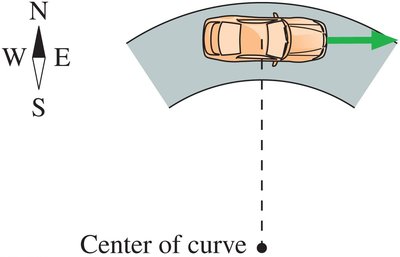
When a car turns a corner, the friction between the tires and the road provides the centripetal force. If the road is icy and friction is reduced, the car cannot turn and will move in a straight line.
Example: Forces on a Car in a Dip
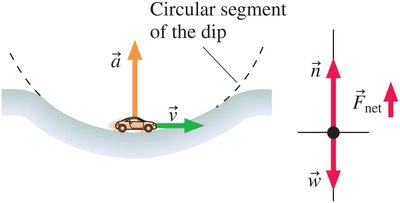
At the bottom of a dip, the normal force from the road is greater than the car's weight, making passengers feel heavier. The net force points upward, toward the center of the circular path.
Example: Maximum Speed on a Curve
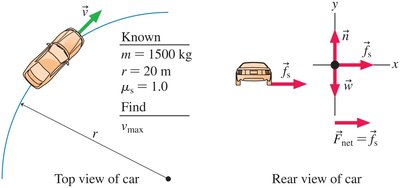
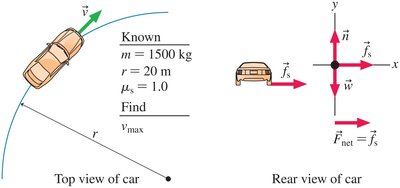
The maximum speed a car can take a curve without sliding is determined by the coefficient of static friction (\(\mu_s\)) and the radius (r):
\( v_{max} = \sqrt{\mu_s g r} \)
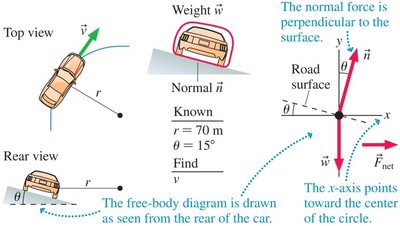
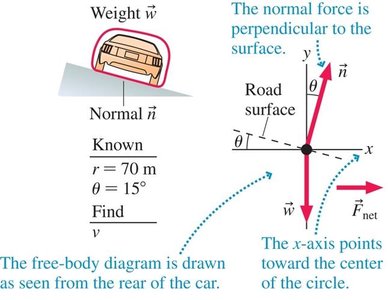
Banked Curves
On a banked curve, the normal force provides the required centripetal force even without friction. The ideal speed for a banked curve of angle \(\theta\) and radius r is:
\( v = \sqrt{g r \tan \theta} \)
Apparent Forces and Weight in Circular Motion
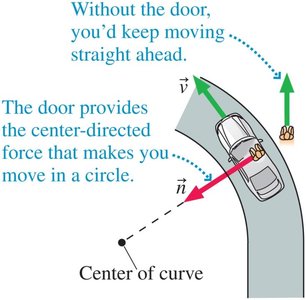
Centrifugal Force (Fictitious Force)
In a rotating reference frame, you may feel as if you are pushed outward, but this is not a real force. The real force is always directed toward the center (centripetal force).
Apparent Weight
Your sensation of weight (apparent weight) changes in circular motion, such as on a roller coaster. At the bottom of a loop, the normal force (apparent weight) is greater than your true weight; at the top, it can be less or even zero at the critical speed.
At bottom: \( n = w + \frac{m v^2}{r} \)
At top: \( n = w - \frac{m v^2}{r} \)
Critical speed: \( v_c = \sqrt{g r} \) (when n = 0)
Gravity and Orbits
Orbital Motion
Gravity provides the centripetal force for satellites and planets in orbit. For a satellite of mass m orbiting a planet of mass M at radius r:
\( F_{gravity} = \frac{G M m}{r^2} \)
\( F_{gravity} = m \frac{v^2}{r} \implies v = \sqrt{\frac{G M}{r}} \)
Period: \( T = 2\pi \sqrt{\frac{r^3}{G M}} \)
Weightlessness
Astronauts in orbit are in free fall, experiencing weightlessness because both they and their spacecraft are accelerating toward Earth at the same rate.
Newton's Law of Universal Gravitation
Newton's law states that every pair of masses attracts each other with a force proportional to the product of their masses and inversely proportional to the square of the distance between them:
\( F = G \frac{m_1 m_2}{r^2} \)
\( G = 6.67 \times 10^{-11} \; \mathrm{N \cdot m^2 / kg^2} \)
Gravity on Other Worlds
The acceleration due to gravity on a planet depends on its mass and radius:
\( g_{planet} = \frac{G M_{planet}}{R_{planet}^2} \)
Summary Tables
Quantity | Symbol | Equation |
|---|---|---|
Period | T | |
Frequency | f | |
Speed in circle | v | |
Centripetal acceleration | ||
Centripetal force | ||
Gravitational force | F | |
Orbital speed | v | |
Orbital period | T |
Key Concepts and Applications
Uniform circular motion requires a net inward (centripetal) force.
Apparent weight changes in non-inertial (accelerating) frames, such as in circular motion.
Gravity is a universal force, following an inverse-square law.
Satellites and planets move in orbits determined by the balance of gravitational and centripetal forces.
Critical speeds and forces can be calculated for various circular motion scenarios, including amusement rides, cars on curves, and planetary orbits.
