 뒤로
Chapter 8: Equilibrium and Elasticity – Study Notes
스터디 가이드 - 스마트 노트
 자료에 맞춘 맞춤형 노트, 핵심 정의, 예시, 맥락을 확장해 제공합니다.
Equilibrium and Elasticity
Introduction
This chapter explores the principles of static equilibrium for extended objects and the fundamental properties of springs and elastic materials. Understanding these concepts is essential for analyzing the stability of structures and the behavior of materials under force.
Torque and Static Equilibrium
Static Equilibrium of Particles and Extended Objects
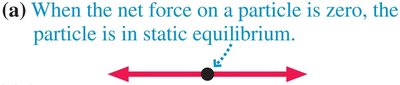
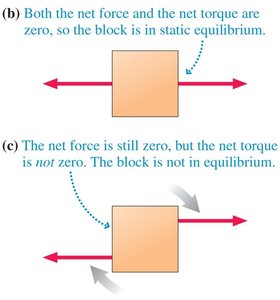
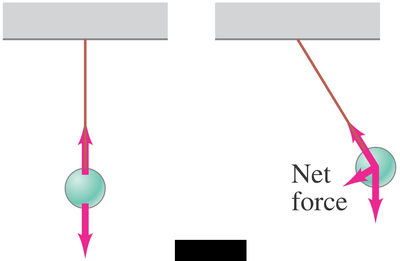
Static equilibrium occurs when an object is at rest and remains at rest under the action of forces. For a particle, static equilibrium is achieved when the net force is zero. For extended objects, both the net force and the net torque must be zero.
Net Force: The sum of all forces acting on the object must be zero.
Net Torque: The sum of all torques acting on the object must be zero.
Static Equilibrium Conditions: , ,
Torque (): The tendency of a force to rotate an object about a pivot point.
Example: A block with equal and opposite forces is in static equilibrium. If the net force is zero but the net torque is not, the object is not in equilibrium.
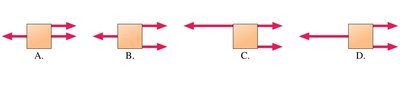
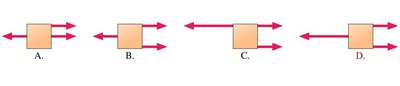
QuickCheck: Identifying Static Equilibrium
Objects in static equilibrium have balanced forces and torques. Visual representations help identify which objects are in equilibrium.
Example: Lifting a Load
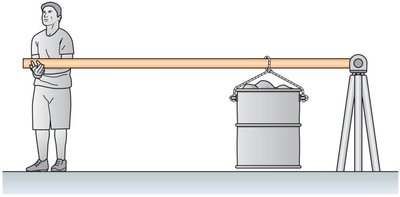
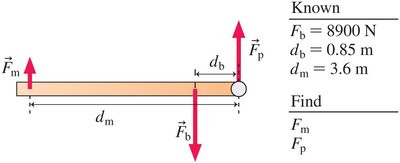
In static equilibrium problems, select the object of interest and identify all forces and their points of application. For a beam lifting a heavy load, forces include the weight of the load, the force applied by a person, and the force at the pivot.
Force of the bucket:
Torque calculation:
Force at the pivot:
Choosing the Pivot Point
Pivot Point Selection
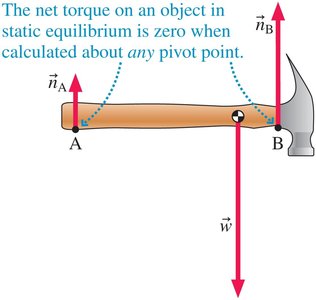
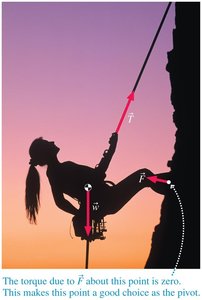
The net torque must be zero about every point for static equilibrium. Choosing a pivot point where forces are poorly specified can simplify calculations, especially when some forces are unknown or complex.
Natural axis: The axis about which rotation would occur if not in equilibrium.
Eliminating unknown torques: Choose the pivot at the location of unknown or complex forces.
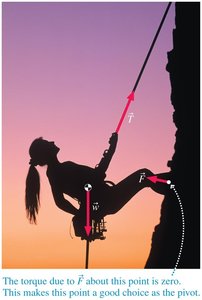
Problem-Solving Approach: Static Equilibrium
Steps for Solving Static Equilibrium Problems
Strategize: Choose the object and pivot point.
Prepare: Identify forces, their points of application, and distances from the pivot.
Solve: Write equations for net force and net torque, then solve for unknowns.
Assess: Check if the solution is reasonable and answers the question.
Stability and Balance
Stable and Unstable Equilibrium
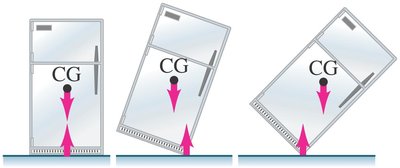
An object is in stable equilibrium if forces tend to return it to its equilibrium position. If forces move it away, it is in unstable equilibrium. Stability depends on the position of the center of gravity relative to the base of support.
Stable equilibrium: Center of gravity over base of support.
Unstable equilibrium: Center of gravity outside base of support.
Critical angle (): , where is track width and is height of center of gravity.
Human Stability and Balance
Humans adjust their posture to keep their center of mass over their feet, especially when carrying heavy loads or moving. A wider base and lower center of gravity improve stability.
Springs and Hooke’s Law
Elasticity and Restoring Force
Elastic materials return to their original shape after being deformed by a force. The restoring force in springs is proportional to the displacement from equilibrium, described by Hooke’s law.
Hooke’s Law:
Spring constant (): Measures stiffness, units N/m.
Elastic limit: Maximum stretch before permanent deformation.
Stretching and Compressing Materials
Young’s Modulus and Material Properties
Solid materials can be modeled as atoms connected by spring-like bonds. The spring constant for a rod depends on its cross-sectional area, length, and material, characterized by Young’s modulus ().
Young’s modulus ():
Stress: (force per unit area)
Strain: (relative change in length)
Tensile strength: Maximum stress before breaking.
Material | Young’s Modulus (1010 N/m2) |
|---|---|
Cast iron | 20 |
Steel | 20 |
Silicon | 13 |
Copper | 11 |
Aluminum | 7 |
Glass | 7 |
Concrete | 3 |
Wood (Douglas Fir) | 1 |
Forces and Torques in the Body
Biomechanics and Mechanical Advantage
Muscles and tendons apply forces and torques to maintain equilibrium in the body. Mechanical advantage allows large forces to be applied with smaller input forces, as seen in levers and joints.
Mechanical advantage: Ratio of output force to input force.
Example: Nutcracker applies 3 times the force to the nut as the hand applies.
Summary of Key Concepts
Static equilibrium: , ,
Stability: Center of gravity must be over base of support.
Hooke’s law:
Young’s modulus:
Mechanical advantage: Leverage increases force output.
