뒤로
뒤로Continuous Charge Distributions and Gauss’s Law
스터디 가이드 - 스마트 노트
 자료에 맞춘 맞춤형 노트, 핵심 정의, 예시, 맥락을 확장해 제공합니다.
Continuous Charge Distributions and Gauss’s Law
Electric Field of a Continuous Charge Distribution
The electric field produced by a continuous charge distribution can be calculated by dividing the distribution into infinitesimal charge elements and summing their contributions using Coulomb’s Law. This approach is essential for understanding the behavior of electric fields generated by objects with non-point-like charge distributions.
Step 1: Divide the charge distribution into small elements, dq.
Step 2: Use Coulomb’s Law to calculate the electric field due to each element at a point P.
Step 3: Integrate (sum) the contributions from all elements to find the total electric field at P.
The general expression for the electric field is:
Depending on the geometry, charge density is described as:
Volume charge density:
Surface charge density:
Linear charge density:
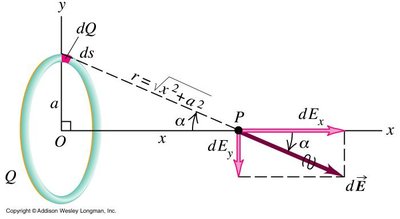
Electric Field of a Ring of Charge
Consider a ring of radius a carrying a uniformly distributed charge Q. The electric field at a point P on the axis perpendicular to the plane of the ring and a distance x from its center is calculated using symmetry and integration.
Result:
For : (field behaves like a point charge)
For (small displacement of a negative charge at the center): , leading to simple harmonic motion (SHM) for the charge.
Electric Field of a Line of Charge
A uniformly charged rod of length and total charge lies along the y-axis. The electric field at a point on the x-axis a distance from the origin is found by integrating the contributions from each infinitesimal segment.
General result:
For (far from the rod):
For (very long rod): , where
Key steps involve expressing and integrating using the geometry of the problem.
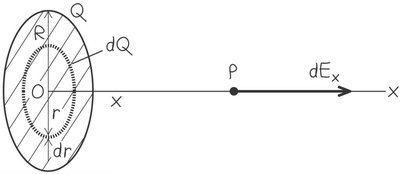
Electric Field of a Disk or Sheet of Charge
A disk of radius with uniform surface charge density produces an electric field along its central perpendicular axis at a distance from the center. The field is calculated by integrating over concentric rings.
Near field ():
For an infinite plane (): everywhere above or below the plane
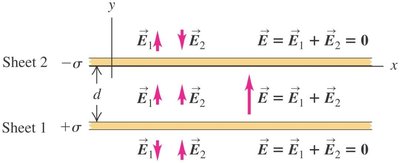
Electric Field Between Two Parallel Sheets of Charge
Two infinite plane sheets, one with surface charge density and the other with , are placed parallel to each other. The electric field in the regions between and outside the sheets is determined by superposition.
Between the sheets: (from positive to negative sheet)
Outside the sheets: (fields cancel)
Charge Distribution in Solid Conductors
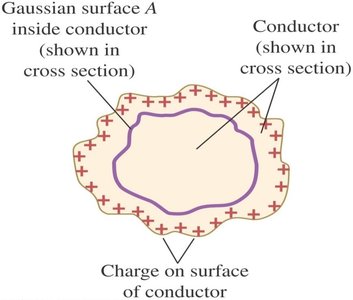
In electrostatics, any excess charge placed on a solid conductor resides entirely on its surface. The electric field inside the conductor is zero, and the field just outside is perpendicular to the surface.
Key properties:
Electric field inside a conductor:
Excess charge resides on the surface
Field just outside:
Charge accumulates at sharp points (small radius of curvature)
Cylindrically Symmetric Charge Distribution
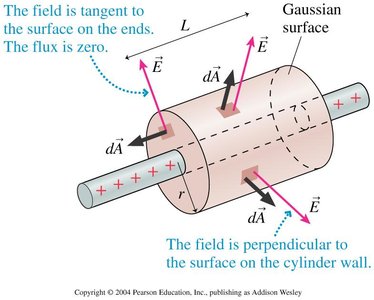
The electric field a distance from an infinite line of charge with linear charge density is found using Gauss’s Law and cylindrical symmetry.
Result:
Electric Field of an Infinite Plane of Charge (Gauss’s Law)
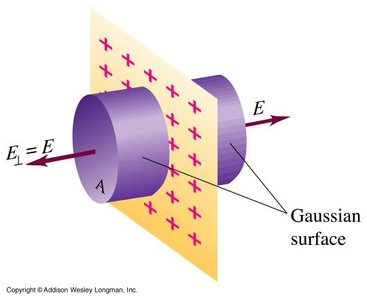
For a thin, flat, infinite non-conducting sheet with uniform charge density , the electric field is calculated using Gauss’s Law.
Result: (on either side of the sheet)
Charges on Conductors (Electrostatic Equilibrium)
At electrostatic equilibrium, the following properties hold for conductors:
The electric field is zero everywhere inside the conductor.
Any excess charge resides on the surface.
The field just outside is perpendicular to the surface and has magnitude .
Charge accumulates at sharp points.
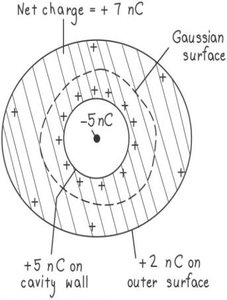
Conductors with Cavities and Internal Charges
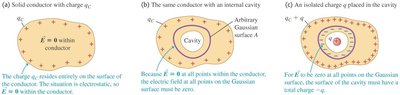
When a conductor contains a cavity with an internal charge, the distribution of charge on the inner and outer surfaces is determined by the requirement that the electric field inside the conductor remains zero.
If a point charge is placed inside the cavity, the inner surface acquires a charge to cancel the field inside the conductor.
The outer surface carries the remainder of the total charge.
Experimental Tests of Gauss’s Law
Faraday’s ice pail experiment is a classic demonstration of Gauss’s Law, showing that charge placed inside a conductor redistributes itself so that the field inside the conductor is zero and all excess charge resides on the outer surface.
When a charged object is placed inside a conducting container, the charge induces an equal and opposite charge on the inner surface and the same sign charge on the outer surface.