 뒤로
뒤로Electrostatics: Forces, Fields, and Flux – Step-by-Step Physics with Algebra Guidance
스터디 가이드 - 스마트 노트
 자료에 맞춘 맞춤형 노트, 핵심 정의, 예시, 맥락을 확장해 제공합니다.
Q1. Three charged particles are placed in a line. The center one is 0.35 m from each of the others. Calculate the net force on each charge due to the other two.
Background
Topic: Coulomb's Law and Superposition Principle
This question tests your understanding of how to calculate the electric force between point charges using Coulomb's Law and how to use vector addition (superposition) to find the net force on each charge.
Key Terms and Formulas
Coulomb's Law:
(Coulomb's constant)
Superposition Principle: The net force on a charge is the vector sum of the forces exerted by all other charges.
Step-by-Step Guidance
Label the charges as , , and , with $q_2$ in the center and $q_1$, $q_3$ on either side, each 0.35 m from $q_2$.
Calculate the force between and using Coulomb's Law. Remember to consider the direction (attractive or repulsive) based on the sign of the charges.
Calculate the force between and in the same way.
For the center charge (), add the forces from and as vectors (since they are along the same line, this is a 1D addition).
For the end charges ( and ), remember each experiences forces from both the center and the other end charge. Set up the equations for these forces, considering their directions.
Try solving on your own before revealing the answer!
Final Answer:
The net force on the center charge is the sum of the forces from the two outer charges, and the net force on each outer charge is the vector sum of the forces from the center and the other outer charge. Plugging in the values and using the correct directions, you will find the net forces for each charge. (Exact values depend on the specific charges given in your figure.)
Q2. Three positive particles of equal charge are located at the corners of an equilateral triangle of side 15.0 cm. Calculate the magnitude and direction of the net force on each particle due to the other two.
Background
Topic: Coulomb's Law and Vector Addition in Two Dimensions
This question tests your ability to calculate the net electrostatic force on a charge due to two other charges arranged in a triangle, requiring vector addition at an angle.
Key Terms and Formulas
Coulomb's Law:
(since all charges are equal and positive)
Vector Addition: Forces from each charge must be added as vectors, considering the 60° angle between them in an equilateral triangle.
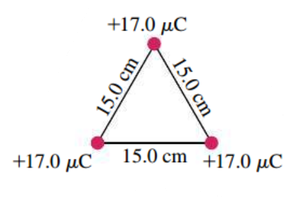
Step-by-Step Guidance
Choose one charge to analyze (the symmetry means the result will be the same for each).
Calculate the magnitude of the force between this charge and one of the other charges using Coulomb's Law, with m.
Repeat for the force from the other charge (it will have the same magnitude).
Draw the two force vectors at a 60° angle to each other (since the triangle is equilateral).
Set up the vector addition (using components or the law of cosines) to find the net force's magnitude and direction. Do not compute the final value yet—write the setup for the resultant.
Try solving on your own before revealing the answer!
Final Answer:
The net force on each charge is , where is the magnitude of the force between any two charges. Plug in with and m to find the numeric value. The direction is away from the center of the triangle, bisecting the angle between the two forces.
Q3. Determine the magnitude and direction of the electric field at a point midway between a and a charge 6.0 cm apart. Assume no other charges are nearby.
Background
Topic: Electric Field Due to Point Charges
This question tests your ability to calculate the electric field at a point due to multiple point charges, using the principle of superposition.
Key Terms and Formulas
Electric Field of a Point Charge:
Superposition Principle: The net electric field is the vector sum of the fields from each charge.
Step-by-Step Guidance
Find the distance from each charge to the midpoint (half of 6.0 cm = 3.0 cm = 0.03 m).
Calculate the electric field at the midpoint due to the charge (direction: toward the negative charge).
Calculate the electric field at the midpoint due to the charge (direction: away from the positive charge).
Set up the net electric field as the algebraic sum of the two fields, considering their directions (they point in opposite directions).
Try solving on your own before revealing the answer!
Final Answer:
The net electric field at the midpoint is (or vice versa, depending on your sign convention), with for each charge. The direction is toward the negative charge, since its field is stronger.
Q4. Two point-charges and are separated by a distance of 12 cm. The electric field at point P is zero. How far from is P?
Background
Topic: Electric Field Zero Point Between Two Charges
This question tests your understanding of where the electric field cancels between two charges of opposite sign and how to set up the equation for the zero field location.
Key Terms and Formulas
Electric Field of a Point Charge:
Set the sum of the fields from both charges equal to zero at point P.
Step-by-Step Guidance
Let the distance from to point P be , and from to P be meters.
Write the equation for the electric field at P due to both charges and set their sum to zero: .
Substitute the expressions for each field: and , with correct signs for direction.
Set up the equation and solve for (do not compute the final value yet).
Try solving on your own before revealing the answer!
Final Answer:
Solving gives m (5.1 cm) from . The zero field point is closer to the smaller-magnitude charge.
Q5. Use Coulomb’s law to determine the magnitude and direction of the electric field at points A and B in the figure below due to the two positive charges () shown. Draw the electric field vectors for each charge and the net electric field, at both points.
Background
Topic: Electric Field from Multiple Point Charges in 2D
This question tests your ability to calculate the electric field at specific points due to multiple charges, using vector addition in two dimensions.
Key Terms and Formulas
Electric Field of a Point Charge:
Decompose the electric field vectors into and components for vector addition.
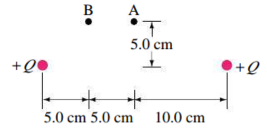
Step-by-Step Guidance
Calculate the distance from each charge to points A and B using the Pythagorean theorem.
Find the electric field at A due to each charge, determining both magnitude and direction (use symmetry and geometry).
Break each field into and components.
Add the components from both charges to find the net electric field at A. Repeat for point B.
Draw the vectors for each field and the net field at both points (as requested).
Try solving on your own before revealing the answer!
Final Answer:
The net electric field at A and B is found by vector addition of the fields from each charge. For A, the net field points upward (along the -axis) due to symmetry; for B, the field has both and $y$ components. Plug in the distances and charges to get the numeric values.
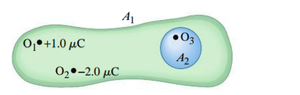
Q6. In the following figure, two objects, and have charges as shown, and a third object, is electrically neutral. a) What is the electric flux through the surface that encloses all three objects? b) What is the electric flux through the surface that encloses the third object only?
Background
Topic: Gauss's Law and Electric Flux
This question tests your understanding of electric flux and how to apply Gauss's Law to closed surfaces.
Key Terms and Formulas
Gauss's Law:
is the total charge enclosed by the surface.
Step-by-Step Guidance
For part (a), sum the charges inside (, , and ) to find .
Apply Gauss's Law to calculate the flux through .
For part (b), note that encloses only , which is neutral.
Apply Gauss's Law for using .
Try solving on your own before revealing the answer!
Final Answer:
a) The flux through is . b) The flux through is zero, since it encloses no net charge.
Q7. A cube of side 8.50 cm is placed in a uniform field with edges parallel to the field lines. a) What is the net flux through the cube? b) What is the flux through each of its six faces?
Background
Topic: Electric Flux in Uniform Fields
This question tests your understanding of electric flux through a closed surface in a uniform electric field, especially when the field is parallel to the faces of the cube.
Key Terms and Formulas
Electric Flux:
For a closed surface in a uniform field, the net flux is zero if no charge is enclosed.
Step-by-Step Guidance
For part (a), recall that the net flux through a closed surface in a uniform field is zero if there is no charge inside.
For part (b), calculate the flux through one face: , where is the area of one face and is the angle between the field and the normal to the face.
Determine which faces have nonzero flux (those perpendicular to the field) and which have zero flux (those parallel to the field).
Set up the calculation for the flux through each face, but do not compute the final value yet.
Try solving on your own before revealing the answer!
Final Answer:
a) The net flux through the cube is zero, since the number of field lines entering equals the number leaving (no charge enclosed). b) The flux through each face perpendicular to the field is (positive for the face where the field exits, negative where it enters); the other four faces have zero flux. .
