 뒤로
Momentum, Impulse, and Conservation Laws: Study Notes for Physics with Algebra
스터디 가이드 - 스마트 노트
 자료에 맞춘 맞춤형 노트, 핵심 정의, 예시, 맥락을 확장해 제공합니다.
Chapter 9: Momentum
Introduction to Momentum and Impulse
Momentum and impulse are fundamental concepts in physics that describe how objects move and interact during collisions. This chapter introduces the definitions, mathematical relationships, and conservation laws associated with these quantities.
Impulse
Definition and Physical Meaning
Impulse (\( \vec{J} \)) is the product of the average force applied to an object and the time interval over which it acts.
Impulse changes an object's momentum.
Impulse is a vector quantity, sharing the direction of the force.
Units: Newton-seconds (N·s) or kilogram-meter per second (kg·m/s).
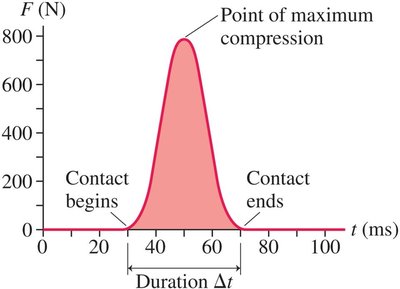
Impulse can be visualized as the area under a force vs. time graph.

Impulse in Collisions
Collisions involve large forces acting over short time intervals.
The effect of an impulsive force is proportional to the area under the force-time curve.
Impulse can be calculated as:
For a constant force:
Impulse-Momentum Theorem
The impulse delivered to an object equals the change in its momentum:
This is an alternative statement of Newton's second law for variable forces.
Momentum
Definition and Properties
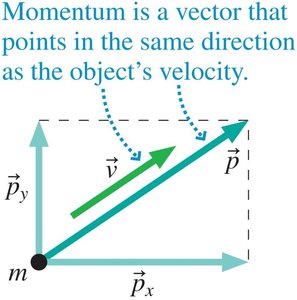
Momentum (\( \vec{p} \)) is the product of an object's mass and velocity:
Momentum is a vector quantity, pointing in the same direction as velocity.
Units: kg·m/s.
Impulse-Momentum Applications
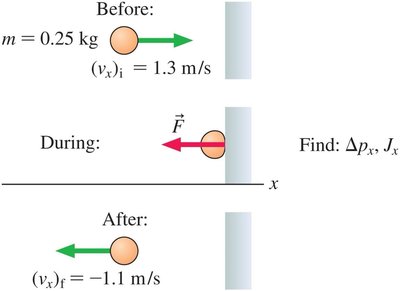
Impulse can be used to calculate the change in velocity after a force acts over a time interval.
Example: A ball rebounding from a wall experiences a change in momentum equal to the impulse delivered by the wall.
Conservation of Momentum
Newton's Third Law and Conservation Principle
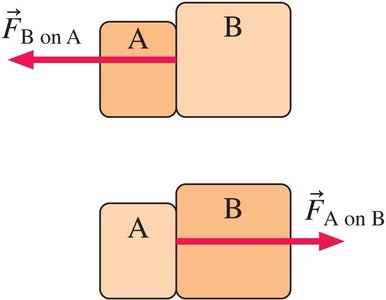
Newton's third law: For every action, there is an equal and opposite reaction.
In a collision, the forces two objects exert on each other are equal in magnitude and opposite in direction.
Therefore, the total momentum of a system is conserved if no external forces act on it.
Mathematical Statement
For an isolated system (no net external force):
For two objects:
Problem-Solving Strategy
Draw before-and-after diagrams to visualize the system.
Define the system and identify internal and external forces.
Apply conservation of momentum to solve for unknowns.
Types of Collisions
Elastic and Inelastic Collisions
Elastic collision: Both momentum and kinetic energy are conserved.
Inelastic collision: Momentum is conserved, but kinetic energy is not. Some energy is transformed into other forms (e.g., thermal energy).
Perfectly inelastic collision: Colliding objects stick together and move with a common velocity after the collision.
Explosions
In an explosion, objects move apart after a brief, intense interaction.
If the system is isolated, the total momentum is conserved.
Momentum in Two Dimensions
Component Analysis
For collisions in two dimensions, momentum is conserved separately in the x- and y-directions:
Use vector components to solve for unknown velocities and directions after the collision.
Chapter 10: Energy and Work
Forms of Energy
Kinetic Energy (K): Energy of motion.
Potential Energy (U): Stored energy due to position (gravitational, elastic/spring).
Thermal Energy (Eth): Energy due to microscopic motion and interactions.
Chemical and Nuclear Energy: Energy stored in molecular bonds and atomic nuclei.
Work and Energy Transfer
Work (W): The mechanical transfer of energy by a force acting over a distance.
Work is a scalar quantity:
Units: Joules (J).
Work can increase or decrease the energy of a system.
Work-Energy Theorem
The net work done on an object equals its change in kinetic energy:
Potential Energy
Gravitational Potential Energy:
Elastic (Spring) Potential Energy:
Only changes in potential energy are physically meaningful.
Conservation of Energy
The total energy of an isolated system remains constant:
Energy can be transformed between kinetic, potential, and thermal forms, but the total remains unchanged in an isolated system.
Power
Power (P): The rate at which work is done or energy is transferred.
Formula:
Units: Watts (W), where 1 W = 1 J/s.
Summary Table: Key Quantities in Momentum and Energy
Quantity | Symbol | Formula | Units |
|---|---|---|---|
Momentum | \( \vec{p} \) | kg·m/s | |
Impulse | \( \vec{J} \) | N·s or kg·m/s | |
Kinetic Energy | K | J | |
Gravitational Potential Energy | Ug | J | |
Elastic Potential Energy | Us | J | |
Work | W | J | |
Power | P | W |
Key Takeaways
Impulse changes momentum; the area under a force-time graph gives impulse.
Momentum is always conserved in isolated systems, regardless of the type of collision.
Energy can be transformed but is conserved in isolated systems; work and heat are mechanisms for energy transfer.
Collisions can be analyzed using conservation laws for both momentum and energy.
