 뒤로
뒤로Physics with Algebra: Forces, Electric Fields, and Resistivity Study Guidance
스터디 가이드 - 스마트 노트
 자료에 맞춘 맞춤형 노트, 핵심 정의, 예시, 맥락을 확장해 제공합니다.
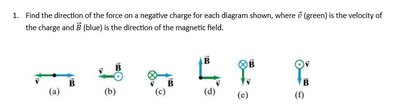
Q1. Find the direction of the force on a negative charge for each diagram shown, where \( \vec{v} \) (green) is the velocity of the charge and \( \vec{B} \) (blue) is the direction of the magnetic field.
Background
Topic: Magnetic Force on Moving Charges
This question tests your understanding of the direction of the magnetic force on a moving charge in a magnetic field, specifically using the right-hand rule and considering the sign of the charge.
Key Terms and Formulas:
Magnetic force on a charge: \( \vec{F} = q\vec{v} \times \vec{B} \)
Right-hand rule: Point your fingers in the direction of \( \vec{v} \), curl toward \( \vec{B} \), thumb points in the direction of force for a positive charge. For a negative charge, the force is in the opposite direction.
\( q \): charge (Coulombs), \( \vec{v} \): velocity (m/s), \( \vec{B} \): magnetic field (Tesla)
Step-by-Step Guidance
For each diagram, identify the direction of \( \vec{v} \) (velocity) and \( \vec{B} \) (magnetic field).
Use the right-hand rule for a positive charge: fingers in the direction of \( \vec{v} \), curl toward \( \vec{B} \), thumb gives the force direction.
Since the charge is negative, reverse the direction found in step 2 for each case.
Draw or visualize the force direction for each diagram, but do not write the final answer yet.
Try solving on your own before revealing the answer!
Final Answer:
(a) Down, (b) Left, (c) Into the page, (d) Up, (e) Out of the page, (f) Right.
For each, the force direction is opposite to the right-hand rule result because the charge is negative.
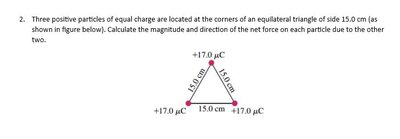
Q2. Three positive particles of equal charge are located at the corners of an equilateral triangle of side 15.0 cm. Calculate the magnitude and direction of the net force on each particle due to the other two.
Background
Topic: Electric Force (Coulomb's Law) and Vector Addition
This question tests your ability to calculate the net electrostatic force on a charge due to other point charges, using vector addition and symmetry in an equilateral triangle.
Key Terms and Formulas:
Coulomb's Law: \( F = k_e \frac{|q_1 q_2|}{r^2} \)
\( k_e = 8.99 \times 10^9 \; \text{N} \cdot \text{m}^2/\text{C}^2 \)
Vector addition: Forces are vectors and must be added using components.
Equilateral triangle symmetry: The net force will be along the bisector away from the center.
Step-by-Step Guidance
Calculate the force between any two charges using Coulomb's Law. Use \( q = 17.0 \; \mu\text{C} = 17.0 \times 10^{-6} \; \text{C} \) and \( r = 0.150 \; \text{m} \).
Draw the force vectors acting on one charge due to the other two. Each force will be equal in magnitude but at a 60° angle to each other.
Resolve the two forces into x and y components. Use trigonometry: \( F_x = F \cos(30^\circ) \), \( F_y = F \sin(30^\circ) \).
Add the components to find the net force vector. Do not calculate the final magnitude or direction yet.
Try solving on your own before revealing the answer!
Final Answer:
Magnitude: \( F_{\text{net}} \approx 3.34 \; \text{N} \)
Direction: Away from the center of the triangle, along the bisector of the angle at each charge.
Each charge experiences a net force of about 3.34 N directed outward, due to the symmetry of the configuration.
Q5. A 100-W lightbulb has a resistance of about 12.0 Ω when cold (20°C) and 140.0 Ω when on (hot). Estimate the temperature of the filament when hot, assuming an average temperature coefficient of resistivity \( \alpha = 0.0045 \, (°C)^{-1} \).
Background
Topic: Temperature Dependence of Resistance
This question tests your understanding of how the resistance of a material changes with temperature, using the temperature coefficient of resistivity.
Key Terms and Formulas:
Temperature dependence of resistance: \( R = R_0 [1 + \alpha (T - T_0)] \)
\( R_0 \): resistance at reference temperature (Ω)
\( T_0 \): reference temperature (°C)
\( \alpha \): temperature coefficient of resistivity (per °C)
Step-by-Step Guidance
Write the equation relating hot and cold resistance: \( R = R_0 [1 + \alpha (T - T_0)] \).
Plug in the known values: \( R = 140.0 \; \Omega \), \( R_0 = 12.0 \; \Omega \), \( T_0 = 20^\circ \text{C} \), \( \alpha = 0.0045 \; (\circ \text{C})^{-1} \).
Rearrange the equation to solve for \( T \): \( T = T_0 + \frac{R/R_0 - 1}{\alpha} \).
Set up the calculation but do not compute the final temperature yet.
Try solving on your own before revealing the answer!
Final Answer:
\( T \approx 2,600^\circ \text{C} \)
The filament reaches a very high temperature when hot, which is typical for incandescent bulbs.
