 뒤로
Physics with Algebra Mid-Term II Study Guidance
스터디 가이드 - 스마트 노트
 자료에 맞춘 맞춤형 노트, 핵심 정의, 예시, 맥락을 확장해 제공합니다.
Q1. A 0.5 kg cart moving at 2 m/s collides elastically with a stationary 0.5 kg cart on a frictionless track. After the collision, the first cart comes to rest. What is the velocity of the second cart after the collision?
Background
Topic: Elastic Collisions and Conservation of Momentum
This question tests your understanding of elastic collisions, where both momentum and kinetic energy are conserved.
Key Terms and Formulas:
Elastic collision: Both momentum and kinetic energy are conserved.
Conservation of momentum:
Conservation of kinetic energy:
Step-by-Step Guidance
Identify the initial and final velocities: m/s, m/s, m/s (after collision).
Write the conservation of momentum equation for the system.
Write the conservation of kinetic energy equation for the system.
Substitute the known values and solve for the unknown final velocity of the second cart, .
Try solving on your own before revealing the answer!
Final Answer: 2 m/s
The second cart moves at 2 m/s after the collision. This result comes from applying both conservation of momentum and kinetic energy for equal masses in an elastic collision.
Q2. A force of 10 N acts on a 2 kg object for 3 s. What is the change in the object’s momentum?
Background
Topic: Impulse and Momentum
This question tests your ability to calculate the change in momentum (impulse) when a force acts over a period of time.
Key Terms and Formulas:
Impulse:
Change in momentum:
Step-by-Step Guidance
Identify the force ( N) and the time interval ( s).
Use the impulse formula: .
Multiply the force by the time interval to find the change in momentum.
Try solving on your own before revealing the answer!
Final Answer: 30 kg·m/s
The change in momentum is kg·m/s.
Q3. A 5.0 kg object is pulled horizontally across a frictionless surface by a constant force of 20 N. If the object moves 4.0 m, what is the work done by the force?
Background
Topic: Work and Energy
This question tests your understanding of the concept of work done by a force over a distance.
Key Terms and Formulas:
Work: (for force parallel to displacement)
Frictionless surface: No energy lost to friction.
Step-by-Step Guidance
Identify the force ( N) and the distance ( m).
Use the formula for work: .
Multiply the force by the distance to find the work done.
Try solving on your own before revealing the answer!
Final Answer: 80 J
The work done is J.
Q4. Which of the following statements correctly expresses the Work–Energy Theorem?
Background
Topic: Work–Energy Theorem
This question tests your understanding of the relationship between net work and changes in kinetic energy.
Key Terms and Formulas:
Work–Energy Theorem:
Net work: Total work done by all forces.
Kinetic energy:
Step-by-Step Guidance
Recall the definition of the Work–Energy Theorem.
Compare each statement to the theorem: Does it relate net work to kinetic energy?
Identify the statement that matches .
Try solving on your own before revealing the answer!
Final Answer: C. The net work done on an object equals the change in its kinetic energy.
This is the correct expression of the Work–Energy Theorem.
Q5. Two ice skaters, initially at rest, push off each other on a frictionless surface. Which of the following statements is true?
Background
Topic: Conservation of Momentum
This question tests your understanding of momentum conservation in a system with no external forces.
Key Terms and Formulas:
Conservation of momentum:
Frictionless surface: No external forces act on the system.
Step-by-Step Guidance
Recall that the total momentum of the system is zero before the skaters push off.
After they push off, the momentum of each skater must be equal and opposite.
Identify which statement correctly describes the conservation of momentum.
Try solving on your own before revealing the answer!
Final Answer: B. The total momentum of the system remains zero after they push apart.
Momentum is conserved, so the total remains zero.
Q6. A 10 kg box is pulled on a frictionless horizontal surface by a 20 N horizontal force. What is the acceleration of the box?
Background
Topic: Newton's Second Law
This question tests your ability to apply Newton's Second Law to find acceleration.
Key Terms and Formulas:
Newton's Second Law:
Acceleration:
Step-by-Step Guidance
Identify the mass ( kg) and the net force ( N).
Use Newton's Second Law to set up the equation for acceleration.
Divide the net force by the mass to find the acceleration.
Try solving on your own before revealing the answer!
Final Answer: 2.0 m/s²
The acceleration is m/s².
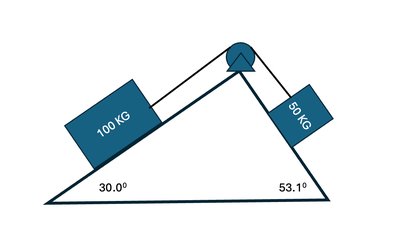
Q7. Two Blocks connected by a cord passing over a small, frictionless pulley rest on frictionless planes as shown in figure below.
Background
Topic: Newton's Laws and Forces on Inclined Planes
This question tests your understanding of forces, acceleration, and tension in a system involving inclined planes and pulleys.
Key Terms and Formulas:
Newton's Second Law:
Components of gravity along the incline:
Tension in the cord:
Step-by-Step Guidance
Draw free-body diagrams for each block, identifying forces parallel and perpendicular to the incline.
Write Newton's Second Law for each block along the direction of motion.
Set up equations for the net force and acceleration, considering the tension and gravitational components.
Combine the equations to solve for acceleration and tension, but stop before plugging in the numbers.
Try solving on your own before revealing the answer!
Final Answer:
a) The system will move in the direction where the net force is greater (compare and ).
b) The acceleration can be found using .
c) The tension in the cord is or .
Q8. Consider the system shown in figure. Block A weighs 45.0 N, and block B weighs 25.0 N. Once block B is set into downward motion, it descends at a constant speed. Calculate the coefficient of kinetic friction block A and tabletop. A cat also a 45.0 N falls asleep on top of the block A. If block B is set into downward motion, what is the acceleration (magnitude and direction)?
Background
Topic: Friction and Forces in Connected Systems
This question tests your understanding of friction, forces, and acceleration in a system with connected blocks.
Key Terms and Formulas:
Kinetic friction:
Newton's Second Law:
Constant speed: Net force is zero.
Step-by-Step Guidance
For constant speed, set up the force balance: for block A, for block B.
Calculate the normal force for block A (including the cat).
Set up the equation for kinetic friction and solve for .
For the second part, use Newton's Second Law to find the acceleration after the cat is added.
Try solving on your own before revealing the answer!
Final Answer:
The coefficient of kinetic friction is for the first scenario. After the cat is added, the acceleration is .
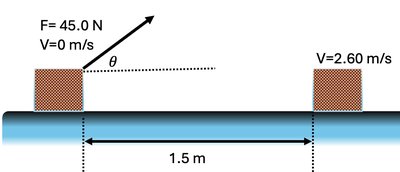
Q9. A block rests on a horizontal frictionless surface. A string is attached to the block and pulled with a force of 45.0 N at an angle θ above the horizontal, as shown in figure. After the block is pulled through a distance of 1.5 m, its speed is 2.60 m/s, and 50.0 J work has been done on it. What is the angle θ? What is the mass of the block?
Background
Topic: Work, Energy, and Forces at an Angle
This question tests your understanding of work done by a force at an angle and energy concepts.
Key Terms and Formulas:
Work:
Kinetic energy:
Conservation of energy: Work done = change in kinetic energy
Step-by-Step Guidance
Set up the work equation: and solve for using the given work.
Use the kinetic energy formula to relate the work done to the change in speed.
Set up the equation and solve for the mass of the block.
Stop before plugging in the final values for and .
Try solving on your own before revealing the answer!
Final Answer:
The angle is found using , and the mass is .
Q10. A 1100 kg car coasts on a horizontal road with speed of 19 m/s. After crossing an unpaved, sandy stretch of the road 32 m long, its speed decreases to 12 m/s.
Background
Topic: Work and Energy, Forces
This question tests your understanding of work, energy, and forces acting on a moving object.
Key Terms and Formulas:
Work:
Net force:
Kinetic energy:
Step-by-Step Guidance
Calculate the change in kinetic energy as the car slows down.
Determine if the net work is positive, negative, or zero based on the change in speed.
Set up the equation for the net force using .
Stop before plugging in the final values for net force.
Try solving on your own before revealing the answer!
Final Answer:
11. The net work done on the car is negative (since the car loses kinetic energy).
12. The magnitude of the average net force is .
Q11. A 6.60 kg block slides with an initial speed of 2.24 m/s up a ramp inclined at an angle of 18.4° with the horizontal. The coefficient of kinetic friction between the block and the ramp is 0.44. Use energy conservation to find the distance the block slides before coming to rest.
Background
Topic: Energy Conservation and Friction
This question tests your ability to use energy conservation, including work done by friction, to solve for distance.
Key Terms and Formulas:
Kinetic energy:
Potential energy:
Work done by friction:
Friction force:
Step-by-Step Guidance
Set up the energy conservation equation: initial kinetic energy = work done against gravity + work done against friction.
Express the height gained in terms of distance along the ramp: .
Write the equation: .
Stop before solving for .
Try solving on your own before revealing the answer!
Final Answer:
The distance is .
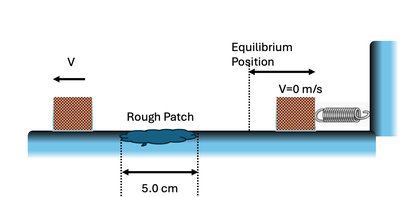
Q12. A 1.2 kg block is held at rest against a spring with a force constant k = 730 N/m. Initially the spring is compressed a distance. When the block is released, it slides across the surface that is frictionless except for a rough patch of width 5.0 cm that has the coefficient of friction μk = 0.44. Find d such that the block’s speed after crossing the rough patch is 2.3 m/s.
Background
Topic: Energy Conservation with Springs and Friction
This question tests your understanding of energy conservation involving springs and friction.
Key Terms and Formulas:
Spring potential energy:
Kinetic energy:
Work done by friction:
Step-by-Step Guidance
Set up the energy conservation equation: initial spring energy = work done by friction + final kinetic energy.
Write the equation: .
Stop before solving for the initial compression .
Try solving on your own before revealing the answer!
Final Answer:
The required compression is found from .
Q13. A small wooden block with mass 0.800 kg is suspended from the lower end of a light cord that is 1.60 m long. The block is initially at rest. A bullet with mass 12.0 g is fired at the block with the horizontal velocity v0. The bullet strikes the block and embeds in it. After collision the combined object swings on the end of the cord. When the block has risen a vertical height of 0.800 m, the tension in the cord is 4.80 N. What is the initial speed of the bullet?
Background
Topic: Conservation of Momentum and Energy
This question tests your understanding of inelastic collisions and energy conservation in a pendulum system.
Key Terms and Formulas:
Conservation of momentum:
Energy conservation:
Step-by-Step Guidance
Use conservation of momentum to find the velocity just after collision.
Use energy conservation to relate this velocity to the height gained.
Set up the equations and stop before solving for .
Try solving on your own before revealing the answer!
Final Answer:
The initial speed of the bullet is , where is found from energy conservation.
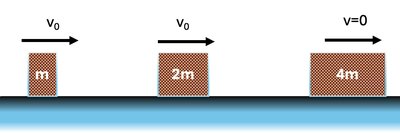
Q14. The three air carts shown in figure have masses, reading from left to right, of m, 2m and 4m, respectively. Initially the right is at rest, whereas other two are moving to the right with speed v0. All carts are equipped with putty bumper that gives completely inelastic collision.
Background
Topic: Inelastic Collisions and Conservation of Momentum
This question tests your understanding of completely inelastic collisions and kinetic energy changes.
Key Terms and Formulas:
Conservation of momentum:
Kinetic energy:
Step-by-Step Guidance
Set up the conservation of momentum equation for all three carts.
Solve for the final speed after collision.
Calculate the initial and final kinetic energies and set up the ratio.
Stop before plugging in the final values.
Try solving on your own before revealing the answer!
Final Answer:
a) The final speed is .
b) The ratio of final to initial kinetic energy is .
Q15. Two particles are placed on the x-axis. Particle A has a mass of 2.0 kg and is located at x = 0 m, Particle B has a mass of 3.0 kg and is located at x = 4.0 m. A third particle, Particle C (mass = 5.0 kg), is added to the system so that the center of mass of all three particles lies at x = 2.0 m. (a) Find the x-coordinate of particle C. (b) If all three particles are moving along the x-axis with velocities vA = 2.0 m/s, vB = −1.0 m/s, and vC = 0 m/s, determine the velocity of the center of mass.
Background
Topic: Center of Mass and Velocity of Center of Mass
This question tests your understanding of calculating the center of mass and its velocity for a system of particles.
Key Terms and Formulas:
Center of mass:
Velocity of center of mass:
Step-by-Step Guidance
Set up the center of mass equation and solve for .
Set up the velocity of center of mass equation and solve for .
Stop before plugging in the final values.
Try solving on your own before revealing the answer!
Final Answer:
a) m
b)
