 뒤로
뒤로Projectile Motion: Water Polo Ball Throw
스터디 가이드 - 스마트 노트
 자료에 맞춘 맞춤형 노트, 핵심 정의, 예시, 맥락을 확장해 제공합니다.
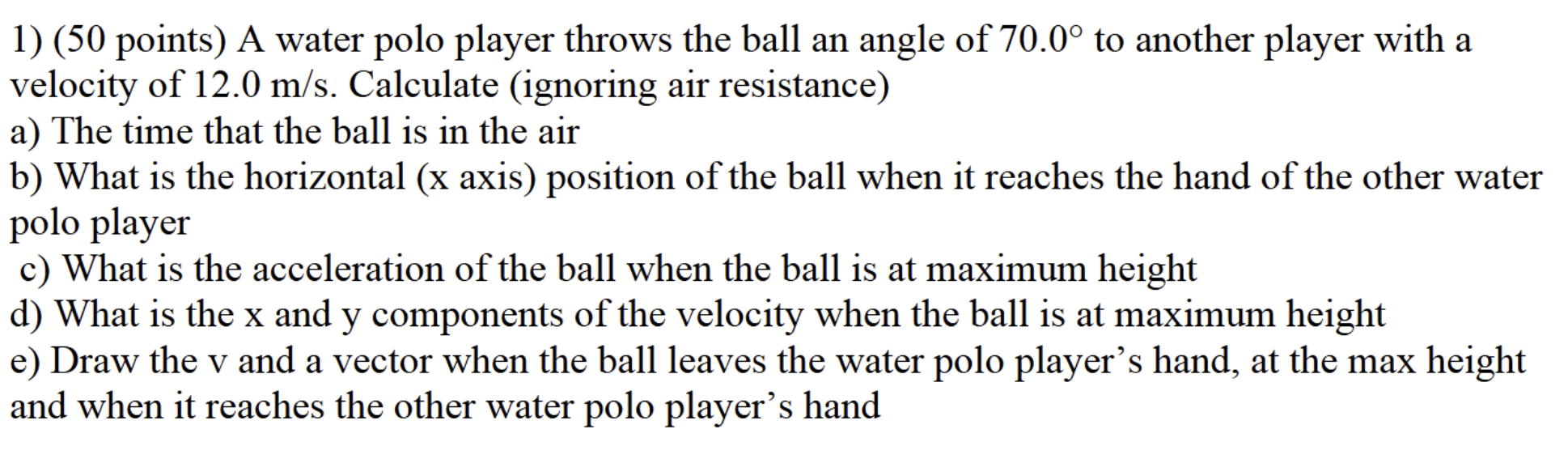
Q1. A water polo player throws a ball at an angle of 70.0° with a velocity of 12.0 m/s. Calculate (ignoring air resistance):
a) The time that the ball is in the air
b) The horizontal (x axis) position of the ball when it reaches the hand of the other water polo player
c) The acceleration of the ball when the ball is at maximum height
d) The x and y components of the velocity when the ball is at maximum height
e) Draw the velocity (v) and acceleration (a) vectors when the ball leaves the water polo player’s hand, at the max height, and when it reaches the other water polo player’s hand
Background
Topic: Projectile Motion
This question tests your understanding of projectile motion, including how to break down initial velocity into components, calculate time of flight, horizontal range, acceleration at different points, and vector diagrams for velocity and acceleration.
Key Terms and Formulas
Initial velocity ($v_0$): 12.0 m/s
Launch angle ($\theta$): 70.0°
Acceleration due to gravity ($g$): 9.8 m/s² (downward)
Horizontal velocity: $v_{0x} = v_0 \cos \theta$
Vertical velocity: $v_{0y} = v_0 \sin \theta$
Time of flight: $t = \frac{2 v_{0y}}{g}$
Horizontal range: $x = v_{0x} \cdot t$
Step-by-Step Guidance
Break the initial velocity into horizontal and vertical components: $v_{0x} = v_0 \cos \theta$ $v_{0y} = v_0 \sin \theta$
Calculate the time the ball is in the air using the vertical component: $t = \frac{2 v_{0y}}{g}$
Find the horizontal position (range) by multiplying the horizontal velocity by the time of flight: $x = v_{0x} \cdot t$
Determine the acceleration at maximum height. Remember, gravity acts downward throughout the flight.
At maximum height, the vertical velocity is zero, but the horizontal velocity remains constant. Calculate these components: $v_x = v_{0x}$ $v_y = 0$
For the vector diagrams, sketch the velocity and acceleration vectors at three points: launch, maximum height, and landing. Use arrows to indicate direction and relative magnitude.
Try solving on your own before revealing the answer!
Final Answers:
a) Time in the air: $t \approx 2.24$ s
b) Horizontal position: $x \approx 9.2$ m
c) Acceleration at max height: $a = -9.8$ m/s² (downward, due to gravity)
d) Velocity components at max height: $v_x \approx 4.11$ m/s, $v_y = 0$ m/s
e) Vector diagrams: - At launch: $v$ points up and right, $a$ points down - At max height: $v$ points right, $a$ points down - At landing: $v$ points down and right, $a$ points down
These answers use the projectile motion equations and vector analysis. The time and range are calculated using the velocity components and gravity, and the acceleration is always downward due to gravity.
