 뒤로
Rotational Motion: Physics with Algebra Study Notes
스터디 가이드 - 스마트 노트
 자료에 맞춘 맞춤형 노트, 핵심 정의, 예시, 맥락을 확장해 제공합니다.
Rotational Motion
Introduction to Rotational Motion
Rotational motion describes the movement of objects around a fixed axis. This chapter explores the kinematics and dynamics of rotational motion, drawing analogies to linear motion and introducing new physical quantities such as rotational inertia, torque, and rotational momentum. Understanding these concepts is essential for analyzing the behavior of rigid bodies in rotation.
Describing Rotational Motion with Kinematic Variables
Rotational kinematics uses angular quantities to describe the motion of objects around an axis. The main variables are rotational position, rotational velocity, and rotational acceleration.
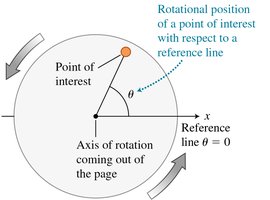
Rotational (Angular) Position (θ): The angle between a reference line and a line drawn from the axis of rotation to a point of interest. Measured in radians or degrees.
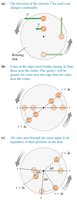
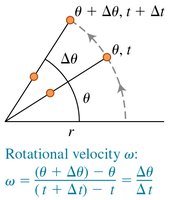
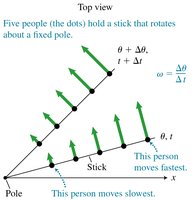
Rotational (Angular) Velocity (ω): The rate of change of rotational position. All points on a rigid body rotate through the same angle in the same time, so each point has the same rotational velocity.
Rotational (Angular) Acceleration (α): The rate of change of rotational velocity. Nonzero rotational acceleration occurs when the rotation rate increases or decreases.
Example: Coins placed at different locations on a rotating disk move at different speeds, but all turn through the same angle in a given time interval.
Units and Measurement
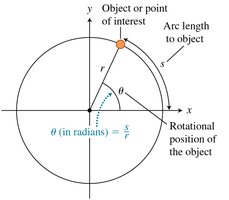
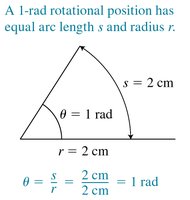
Radians: The standard unit for rotational position in physics. Defined as the ratio of arc length (s) to radius (r):
Rotational Velocity:
Rotational Acceleration:
Sign Conventions
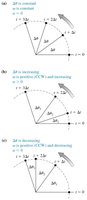
Positive values for counterclockwise rotation, negative for clockwise rotation.
Rotational velocity and acceleration follow these conventions.
Relating Translational and Rotational Quantities
Translational quantities for motion along a circular path can be obtained by multiplying the corresponding angular quantities by the radius of the circle.
Rotational Motion at Constant Acceleration
Rotational kinematics equations for constant acceleration are analogous to those for linear motion:
Additional info: These equations are used to solve problems involving rotational motion with constant angular acceleration.
Physical Quantities Affecting Rotational Acceleration
Rotational Inertia and Net Torque
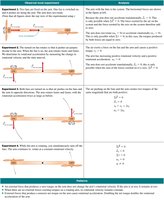
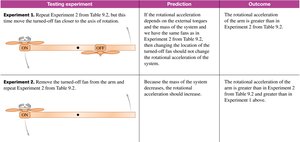
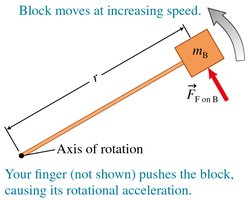
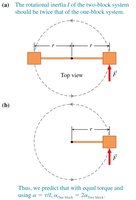
Rotational acceleration depends on two main factors: the net torque exerted on the object and its rotational inertia. Rotational inertia characterizes how mass is distributed relative to the axis of rotation.
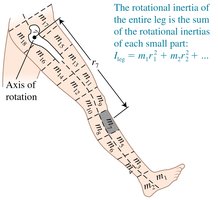
Rotational Inertia (I): The resistance of an object to changes in its rotational motion. Depends on both the mass and its distribution.
Net Torque (τ): The sum of all torques acting on the object. Greater net torque results in greater rotational acceleration.

Newton’s Second Law for Rotational Motion
Quantitative Relation
Newton’s second law for rotational motion relates rotational acceleration to net torque and rotational inertia:
Where is the net torque, is rotational inertia, and is rotational acceleration.
Expressions for Rotational Inertia
Standard shapes have specific formulas for rotational inertia, depending on mass and geometry.
Shape | Rotational Inertia (I) |
|---|---|
Solid Cylinder | |
Thin Rod (about center) | |
Sphere | |
Additional info: … | Other shapes have unique expressions based on mass distribution. |
Rotational Momentum
Conservation of Rotational Momentum
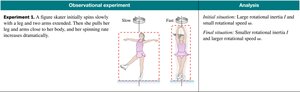
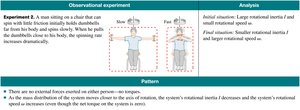
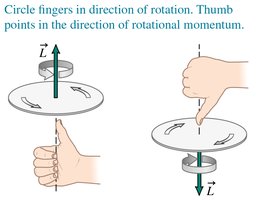
Rotational momentum (also called angular momentum) is conserved in isolated systems where net external torque is zero.
Rotational Momentum (L):
For an isolated system:
When rotational inertia decreases, rotational speed increases, and vice versa.
Rotational Kinetic Energy
Energy in Rotational Motion
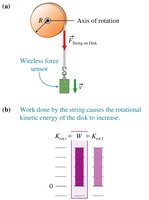
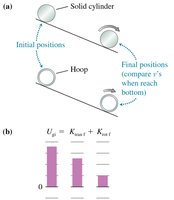
Rotational kinetic energy is the energy due to the rotation of an object about a particular axis. It is analogous to translational kinetic energy.
Rotational Kinetic Energy:
Where is rotational inertia and is rotational speed.
Applications
Flywheels are used in vehicles to store and provide energy, converting translational kinetic energy into rotational kinetic energy.
Summary Table: Rotational vs. Translational Quantities
Translational Quantity | Rotational Quantity |
|---|---|
Position (x) | Angular Position (θ) |
Velocity (v) | Angular Velocity (ω) |
Acceleration (a) | Angular Acceleration (α) |
Mass (m) | Rotational Inertia (I) |
Force (F) | Torque (τ) |
Momentum (p) | Rotational Momentum (L) |
Kinetic Energy () | Rotational Kinetic Energy () |
Key Equations
Additional info: These notes provide a comprehensive overview of rotational motion, suitable for exam preparation in a Physics with Algebra course.
