 뒤로
Vibrational Motion and Simple Harmonic Motion: Study Guide
스터디 가이드 - 스마트 노트
 자료에 맞춘 맞춤형 노트, 핵심 정의, 예시, 맥락을 확장해 제공합니다.
Vibrational Motion
Qualitative Description of Vibrational Motion
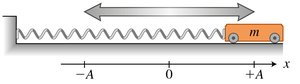
Vibrational motion refers to the repetitive back-and-forth movement of an object about an equilibrium position. This type of motion is characterized by the object passing through the same positions in opposite directions, driven by a restoring force that acts to return the object to equilibrium.
Equilibrium Position: The position where the sum of forces on the object is zero.
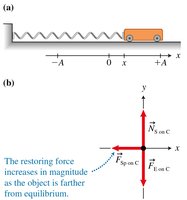
Restoring Force: A force that acts opposite to the displacement from equilibrium, pulling the object back toward equilibrium.
Amplitude (A): The maximum displacement from equilibrium.
Period (T): The time for one complete vibration; SI unit is seconds.
Frequency (f): Number of complete vibrations per second; SI unit is hertz (Hz).
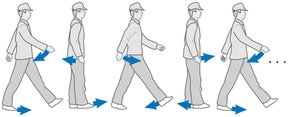
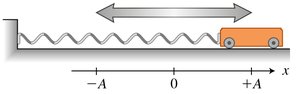
Observational Features of Vibrational Motion
Vibrational motion can be observed in everyday phenomena such as walking, swinging, and carrying liquids. The restoring force and energy transformations are key features.
Restoring Force: Always points opposite to displacement.
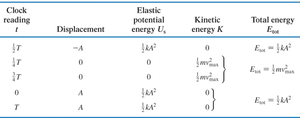
Energy Transformation: Maximum potential energy at extreme positions; maximum kinetic energy at equilibrium.
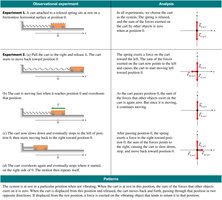
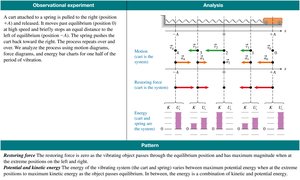
Kinematics of Vibrational Motion
Position, Velocity, and Acceleration
The kinematics of vibrational motion can be described using position, velocity, and acceleration as functions of time. All three quantities exhibit periodic behavior with the same period.
Position Function: or
Velocity Function:
Acceleration Function:
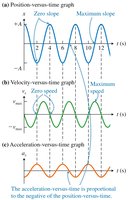
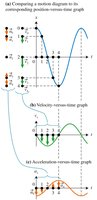
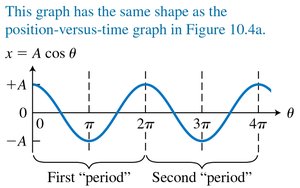
Simple Harmonic Motion (SHM)
Mathematical Model
Simple harmonic motion is a specific type of vibrational motion where the restoring force is directly proportional to the negative displacement. The motion can be modeled mathematically:
SHM Equation: , where is the angular frequency and is the phase constant.
Velocity and Acceleration: Derived from the position function as shown above.
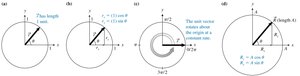
Dynamics of Simple Harmonic Motion
Hooke's Law and Newton's Second Law
The dynamics of SHM are governed by Hooke's law and Newton's second law. The force exerted by a spring is proportional to the displacement:
Hooke's Law:
Newton's Second Law:
Period of a Spring-Mass System:
Energy in Vibrational Systems
Energy Transformations
In vibrational systems, energy continuously transforms between kinetic and potential forms. For a spring-mass system:
Elastic Potential Energy:
Kinetic Energy:
Total Energy: (constant)
The Simple Pendulum
Model and Forces
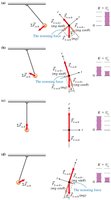
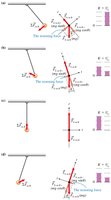
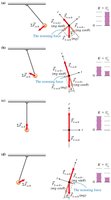
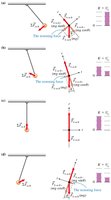
A simple pendulum consists of a mass (bob) attached to a massless string. For small amplitudes, its motion approximates SHM.
Forces: Tension in the string (perpendicular to motion) and gravity (downward).
Restoring Force: Tangential component of gravity.
Period of Pendulum: (independent of mass and amplitude for small angles)
Skills for Analyzing Vibrational Motion
Problem-Solving Steps
To analyze vibrational motion, follow these steps:
Sketch and Translate: Draw the process and label known/unknown quantities.
Simplify and Diagram: Identify assumptions and represent with force diagrams/bar charts.
Represent Mathematically: Use kinematics, Newton's laws, or energy principles as needed.
Solve and Evaluate: Solve for unknowns and check reasonableness.
Including Friction in Vibrational Motion
Damping
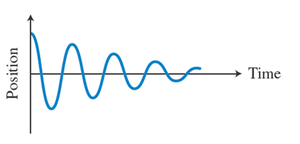
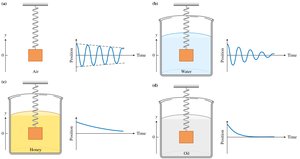
Friction causes the amplitude of vibration to decrease over time, a phenomenon known as damping. Damping is important in engineering to prevent excessive vibrations.
Underdamped: Oscillates with decreasing amplitude.
Overdamped: Returns to equilibrium without oscillating.
Critically Damped: Returns to equilibrium in the shortest time without oscillating.

Vibrational Motion with an External Driving Force
Resonance and Energy Transfer
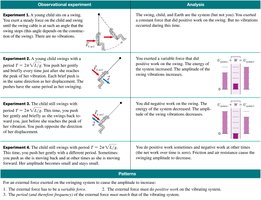
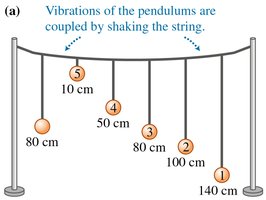
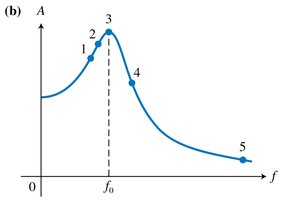
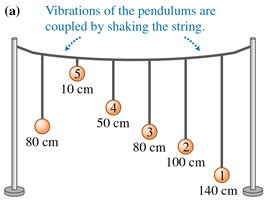
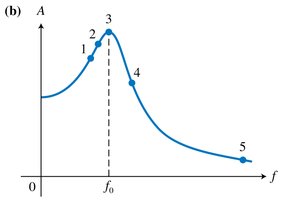
External forces can sustain vibrations by adding energy to the system. Resonance occurs when the frequency of the external force matches the system's natural frequency, resulting in large amplitude vibrations.
Resonance: Net positive work increases amplitude when frequencies match.
Energy Transfer: Requires close natural frequencies and a mechanism for positive work.

Summary of Key Equations
Frequency and Period:
Spring-Mass System Period:
Simple Pendulum Period:
SHM Position:
Hooke's Law:
Elastic Potential Energy:
Total Energy:
Applications and Examples
Determining Mass: Vibrations can be used to measure mass (e.g., in space experiments).
Swinging: Pumping legs on a swing increases amplitude via resonance.
Carrying Liquids: Avoiding resonance prevents splashing.

Additional info:
Energy transformations in vibrational systems are fundamental to understanding mechanical and thermal processes.
Damping and resonance are critical concepts in engineering, climate science, and everyday life.
