 뒤로
Applications of Newton’s Laws: Friction, Strings, Equilibrium, Connected Objects, and Circular Motion
스터디 가이드 - 스마트 노트
 자료에 맞춘 맞춤형 노트, 핵심 정의, 예시, 맥락을 확장해 제공합니다.
Applications of Newton’s Laws
Overview
This chapter explores practical applications of Newton’s Laws, focusing on frictional forces, tension in strings and springs, translational equilibrium, connected objects, and circular motion. These concepts are foundational for analyzing real-world systems in classical mechanics.
Frictional Forces
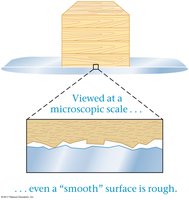
Microscopic Origin of Friction
Friction arises due to the microscopic roughness of surfaces, even those that appear smooth to the naked eye. This roughness causes resistance when two surfaces slide or attempt to slide across each other.
Friction is a force that opposes relative motion between two surfaces in contact.
It is present in both static and kinetic situations.
Types of Friction
Kinetic friction (sliding friction): The force opposing the motion of two surfaces sliding past each other.
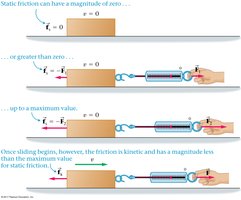
Static friction: The force that prevents the initiation of sliding motion between two surfaces.
Frictional Force Equations
The kinetic frictional force is given by: where is the coefficient of kinetic friction and is the normal force.
The static frictional force can vary up to a maximum value: where is the coefficient of static friction.
The coefficients of friction depend on the materials in contact and are independent of the area of contact and the relative speed of the surfaces.
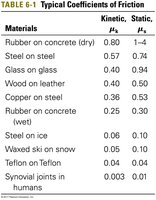
Typical Coefficients of Friction
The following table lists typical values for the coefficients of kinetic and static friction for various material pairs:
Materials | Kinetic, | Static, |
|---|---|---|
Rubber on concrete (dry) | 0.80 | 1.0 |
Steel on steel | 0.57 | 0.74 |
Glass on glass | 0.40 | 0.94 |
Wood on leather | 0.40 | 0.50 |
Copper on steel | 0.36 | 0.53 |
Rubber on concrete (wet) | 0.25 | 0.30 |
Steel on ice | 0.06 | 0.10 |
Waxed ski on snow | 0.05 | 0.10 |
Teflon on Teflon | 0.04 | 0.04 |
Synovial joints in humans | 0.003 | 0.01 |
Dependence on Normal Force
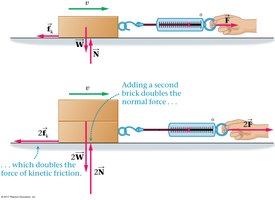
The frictional force is directly proportional to the normal force. Doubling the normal force doubles the frictional force.
Behavior of Static and Kinetic Friction
Static friction adjusts to match the applied force up to its maximum value.
Once motion begins, kinetic friction takes over and remains constant (for a given normal force and material).
Strings and Springs
Tension in Strings
When a string, rope, or wire is pulled taut, it transmits a force known as tension. In idealized problems, strings are considered massless and inextensible unless otherwise stated.
Tension acts equally at both ends of a massless string.
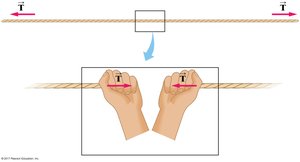
Variation of Tension in Real Ropes
In real ropes with mass, tension can vary along the length due to the rope's weight. For most introductory problems, this effect is neglected.
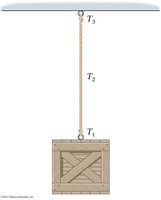
Pulleys and Direction of Tension
An ideal pulley changes only the direction of the tension force, not its magnitude.
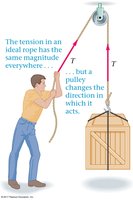
Hooke’s Law for Springs
The force exerted by a spring is proportional to its displacement from equilibrium, described by Hooke’s Law:
Where is the spring constant (a measure of stiffness) and is the displacement from equilibrium.
Translational Equilibrium
Definition and Condition
An object is in translational equilibrium if the vector sum of all forces acting on it is zero. This means the object is either at rest or moving with constant velocity.
Mathematically:
This principle allows us to solve for unknown forces in static or steady-motion problems.
Connected Objects
Analysis of Connected Systems
When objects are connected (e.g., by a string), they share the same acceleration. Each object can be analyzed separately using free-body diagrams, and the forces of tension and gravity are considered for each mass.
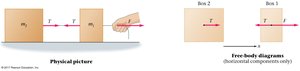
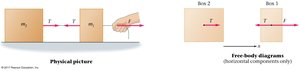
Coordinate Systems with Pulleys
When pulleys are involved, it is often helpful to align the coordinate system along the direction of the string to simplify calculations.
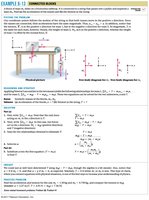
Circular Motion
Forces in Circular Motion
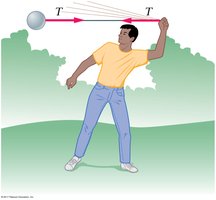
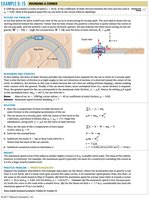
An object moving in a circle requires a net force directed toward the center of the circle, called the centripetal force. Without this force, the object would move in a straight line due to inertia.
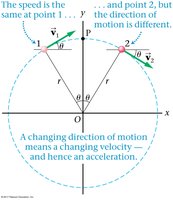
Centripetal Force Equation
The magnitude of the centripetal force required to keep an object of mass moving at speed in a circle of radius is:
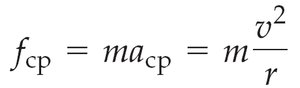
Sources of Centripetal Force
The required centripetal force can be provided by tension, friction, the normal force, or other forces, depending on the situation.
Changing Speed in Circular Motion
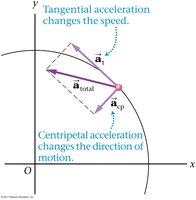
If an object’s speed changes as it moves in a circle, it experiences both tangential and centripetal (radial) acceleration. The total acceleration is the vector sum of these two components.
Summary Table: Key Equations and Concepts
Concept | Equation |
|---|---|
Kinetic friction | |
Static friction (max) | |
Tension (ideal string) | Same magnitude throughout |
Hooke’s Law (spring) | |
Translational equilibrium | |
Centripetal force |
Example Applications:
Calculating the force needed to keep a car on a curved road (circular motion).
Determining the tension in a rope supporting a hanging mass.
Finding the frictional force required to prevent slipping.
