 뒤로
Ch 5: Applying Newton’s Laws: Equilibrium, Dynamics, Friction, Circular Motion, and Fundamental Forces
스터디 가이드 - 스마트 노트
 자료에 맞춘 맞춤형 노트, 핵심 정의, 예시, 맥락을 확장해 제공합니다.
Applying Newton’s Laws
Introduction
Newton’s three laws of motion form the foundation for analyzing forces and motion in classical mechanics. This chapter focuses on applying these laws to solve problems involving equilibrium, dynamics, friction, circular motion, and the fundamental forces of nature. Analytical skills and systematic problem-solving strategies are essential for understanding real-life physical situations.
Equilibrium and Newton’s First Law
Definition of Equilibrium
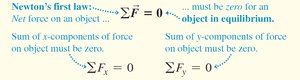
An object is in equilibrium when it is at rest or moving with constant velocity in an inertial frame of reference. Newton’s first law states that the net force on an object in equilibrium must be zero.
Key Principle: If an object is in equilibrium, the sum of all forces acting on it is zero.
Mathematical Formulation:
Application: Used to analyze forces on objects at rest or moving with constant velocity.
Problem-Solving Strategy for Equilibrium
Draw a sketch of the physical situation.
Draw a free-body diagram for each object in equilibrium.
Identify all forces acting on the object (e.g., weight, contact forces).
Choose coordinate axes and resolve forces into components.
Set the sum of force components along each axis to zero and solve for unknowns.
Dynamics and Newton’s Second Law
Definition of Dynamics
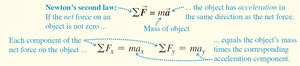
Dynamics deals with objects that are not in equilibrium, i.e., those experiencing acceleration due to a net force. Newton’s second law relates the net force to the acceleration of the object.
Key Principle: The net force on an object equals its mass times its acceleration.
Mathematical Formulation:
Application: Used to analyze forces on accelerating objects.
Problem-Solving Strategy for Dynamics
Draw a sketch and free-body diagram for each moving object.
Label all forces, including weight ().
Choose coordinate axes and resolve forces into components.
Write equations for each component of Newton’s second law.
Identify relationships among objects (e.g., ropes, pulleys).
Solve the equations for the target variables.
Free-Body Diagrams
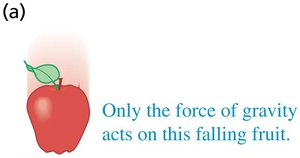
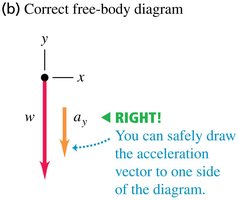
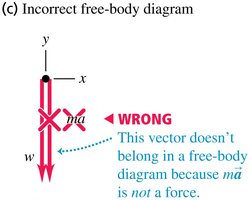
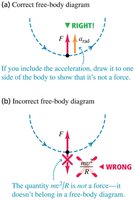
Free-body diagrams are essential tools for visualizing forces acting on an object. Only actual forces (not mass times acceleration) should be included.
Correct Diagram: Shows all forces acting on the object and may indicate acceleration separately.
Incorrect Diagram: Should not include as a force.
Apparent Weight and Weightlessness
Apparent Weight in Accelerating Systems
The apparent weight is the normal force measured by a scale, which can differ from the actual weight when the object is accelerating (e.g., in an elevator).
Formula:
Weightlessness: When (free fall), and the object appears weightless.
Application: Astronauts in orbit experience apparent weightlessness.

Frictional Forces
Nature of Friction
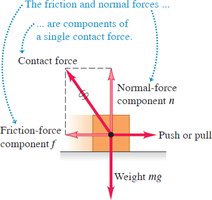
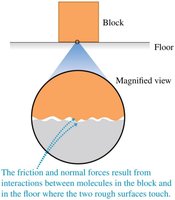
Friction is a force that opposes relative motion between surfaces in contact. It is essential for locomotion and many everyday phenomena.
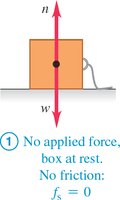
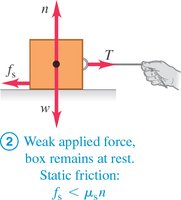
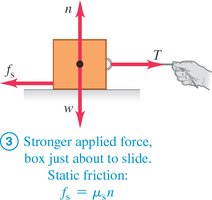
Static Friction: Acts when there is no relative motion; can vary up to a maximum value.
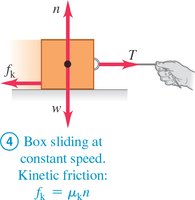
Kinetic Friction: Acts when an object slides over a surface; has a constant value.
Origin: Arises from molecular interactions at the contact surfaces.

Static and Kinetic Friction: Examples
Static Friction:
Kinetic Friction:
Transition: When applied force exceeds maximum static friction, object begins to slide and kinetic friction takes over.
Stick-Slip Phenomenon
The stick-slip phenomenon occurs when static friction alternates with kinetic friction, as seen in squeaking windshield wipers on dry glass.

Fluid Resistance and Terminal Speed
Fluid Resistance
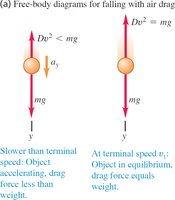
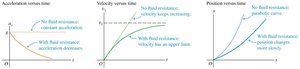
Fluid resistance (drag) opposes the motion of objects through fluids (air, water). The resisting force increases with speed and leads to a terminal speed when it balances the weight.
Terminal Speed: The speed at which drag force equals weight, resulting in zero net acceleration.
Free-Body Diagram: Shows weight and drag force acting in opposite directions.
Dynamics of Circular Motion
Uniform Circular Motion
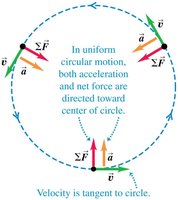
In uniform circular motion, both acceleration and net force are directed toward the center of the circle. The net force is called the centripetal force.
Formula:
Direction: Always points toward the center of the circle.
Velocity: Tangent to the circle.
Free-Body Diagrams in Circular Motion
Correct Diagram: Acceleration vector shown separately; only real forces included.
Incorrect Diagram: Do not include as a force.
Banked Curves
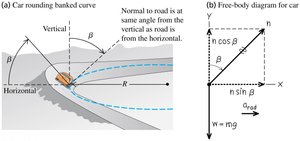
Banked curves are designed so that a car can round the curve without relying on friction. The normal force provides the necessary centripetal force.
Key Principle: The angle of banking is chosen so that the horizontal component of the normal force equals the required centripetal force.
The Fundamental Forces of Nature
Overview of Fundamental Forces
All forces in nature are manifestations of four fundamental interactions:
Gravitational: Attraction between masses.
Electromagnetic: Interaction between charged particles.
Strong Interaction: Holds atomic nuclei together.
Weak Interaction: Responsible for radioactive decay.
Physicists aim to unify these forces into a single theory of everything.
