 뒤로
Boltzmann Distribution and Microstates: Statistical Physics Foundations
스터디 가이드 - 스마트 노트
 자료에 맞춘 맞춤형 노트, 핵심 정의, 예시, 맥락을 확장해 제공합니다.
Boltzmann Distribution and Microstates
Introduction to Microstates and Macrostates
In statistical physics, a microstate refers to a specific detailed configuration of a system, while a macrostate is defined by macroscopic properties such as energy, pressure, or magnetization. The probability of a macrostate is determined by the number and likelihood of its constituent microstates.
Microstate: A unique arrangement of all particles in the system (e.g., the outcome of each coin in a series of coin flips).
Macrostate: A collection of microstates that share the same macroscopic property (e.g., total number of heads in coin flips).
Equally Probable Microstates: If all microstates are equally likely, the probability of a macrostate is proportional to the number of microstates it contains.
Example: For three coin flips, the probability of getting two heads (macrostate) is the sum of the probabilities of all microstates with two heads.
Microstates with Different Energies
When microstates have different energies, they are not equally probable. The probability of a system being in a particular microstate depends on its energy and the temperature of the system.
For two gas molecules, each arrangement (microstate) is equally likely if energy is not considered.
When energy differences exist, the probability of a microstate is determined by the Boltzmann distribution.
The Boltzmann Distribution
Mathematical Formulation
The Boltzmann distribution describes the probability of a system occupying a state with energy E at temperature T:
P(E): Probability of the system being in a state with energy E
kB: Boltzmann constant
T: Absolute temperature (in Kelvin)
The ratio of probabilities for two states with energies E1 and E2 is:
Temperature Dependence
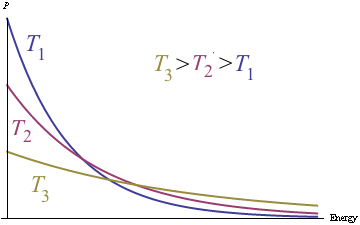
The Boltzmann distribution shows that higher energy states become more probable as temperature increases. At low temperatures, the system is more likely to be found in lower energy states.
At low temperature, the probability drops off rapidly with increasing energy.
At high temperature, higher energy states are more accessible.
Example Calculation
Consider two microstates with energies J and J at room temperature ( J):
Interpretation: The system is about 2.78 times more likely to be found in the lower energy state at room temperature.
Applications of the Boltzmann Distribution
Physical and Biological Systems
The Boltzmann distribution is fundamental in understanding the behavior of particles in gases, the distribution of molecular speeds, and the energetics of biological systems such as ion channels in cell membranes.
Statistical Mechanics: Predicts the distribution of particles among energy states in a system.
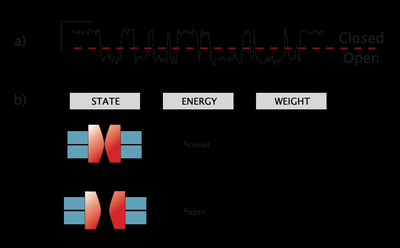
Biological Systems: Explains the probability of ion channels being open or closed, which is crucial for nerve signaling and cellular function.
Boltzmann Factor in Ion Channel Gating
The probability that an ion channel is open or closed can be described using the Boltzmann factor:
where , and are the energies of the open and closed states, respectively.
Summary Table: Microstates, Macrostates, and Probabilities
System | Microstates | Probability (Equal Energy) | Probability (Boltzmann) |
|---|---|---|---|
Coin Flips (3 coins) | HHH, HHT, HTH, THH, HTT, THT, TTH, TTT | 1/8 each | 1/8 each |
Gas Molecules (2 molecules) | Both left, 1 left/1 right, Both right | 1/4, 1/2, 1/4 | Depends on energy difference |
Ion Channel (open/closed) | Open, Closed | Depends on configuration |
Importance of the Boltzmann Factor
The Boltzmann factor is crucial for predicting the likelihood of a system occupying a particular energy state. It underpins the statistical mechanics of gases, the behavior of electrons in solids, and the energetics of biological molecules.
Determines equilibrium properties of thermodynamic systems.
Explains temperature dependence of reaction rates and molecular conformations.
