 뒤로
Chapter 1: Units, Physical Quantities, and Vectors – Study Notes
스터디 가이드 - 스마트 노트
 자료에 맞춘 맞춤형 노트, 핵심 정의, 예시, 맥락을 확장해 제공합니다.
Units, Physical Quantities, and Vectors
Introduction
This chapter introduces the foundational concepts of physical quantities, units, and vectors, which are essential for understanding and solving problems in physics with calculus. Mastery of these topics is crucial for all subsequent chapters in university-level physics.
Scalars and Vectors
Definitions and Distinctions
Scalar Quantity: A physical quantity described by a single number (magnitude) and appropriate units. Examples: mass, temperature, time.
Vector Quantity: A physical quantity that has both magnitude and direction. Examples: displacement, velocity, force.
Vectors are typically represented in boldface with an arrow, e.g., \( \vec{A} \). The magnitude is written as A or |\( \vec{A} \)|.
Drawing and Types of Vectors
Graphical Representation
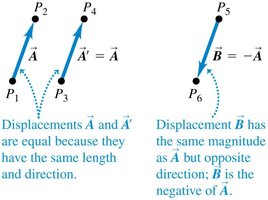
Vectors are drawn as arrows: the length represents magnitude, and the arrowhead indicates direction.
Types of Vectors
Unit Vector: A vector with magnitude 1, indicating direction only.
Equal Vectors: Vectors with the same magnitude and direction.
Negative Vector: A vector with the same magnitude but opposite direction.
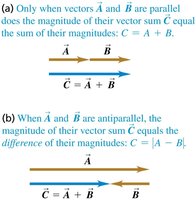
Parallel Vectors: Vectors that have the same or exactly opposite direction.
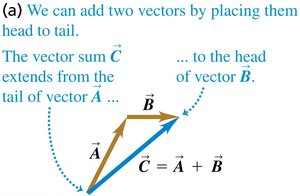
Resultant Vector: The vector sum of two or more vectors.
Equilibrant Vector: The vector that balances other vectors to produce equilibrium.
Addition and Subtraction of Vectors
Graphical Methods
Triangle Law: Place vectors head-to-tail; the resultant is from the tail of the first to the head of the last.
Parallelogram Method: Place vectors tail-to-tail and complete the parallelogram; the diagonal is the resultant.
Properties of Vector Addition
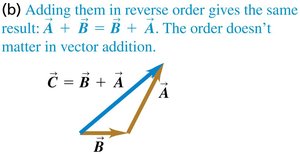
Vector addition is commutative: \( \vec{A} + \vec{B} = \vec{B} + \vec{A} \).
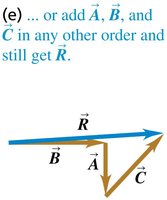
Vector addition is associative: \( (\vec{A} + \vec{B}) + \vec{C} = \vec{A} + (\vec{B} + \vec{C}) \).
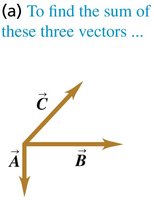
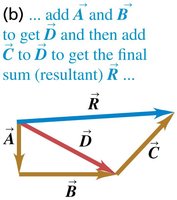
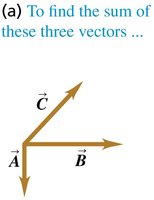
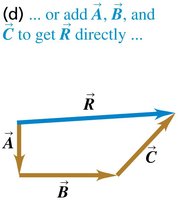
Adding More Than Two Vectors
Use the head-to-tail method for multiple vectors; the resultant is independent of the order of addition.
Subtracting Vectors
Subtracting \( \vec{B} \) from \( \vec{A} \) is equivalent to adding \( -\vec{B} \) to \( \vec{A} \).

Multiplying a Vector by a Scalar
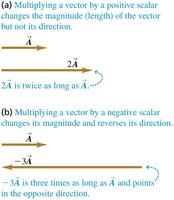
Multiplying by a positive scalar changes the magnitude but not the direction.
Multiplying by a negative scalar reverses the direction.
Addition of Two Vectors at Right Angles
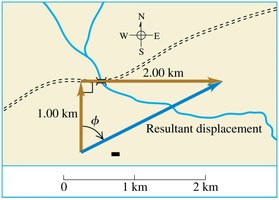
When vectors are perpendicular, use the Pythagorean theorem to find the resultant magnitude:
The direction is found using trigonometry:
Components of a Vector
Resolving Vectors into Components
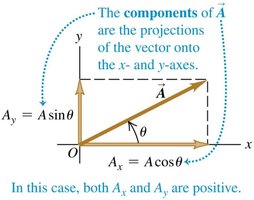
Any vector can be expressed as the sum of its x- and y-components:
Where and
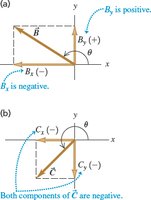
Positive and Negative Components
Components can be positive or negative depending on the vector's direction relative to the axes.
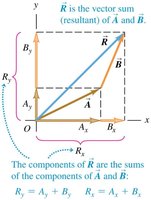
Calculations Using Components
To find the magnitude and direction from components:
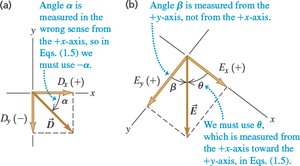
Finding Components with Angles
Be careful with the angle's reference direction; use the correct sign for each component.
Unit Vectors
Definition and Use
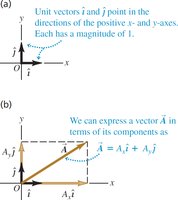
Unit vectors have magnitude 1 and indicate direction along coordinate axes: (x), (y), (z).
Any vector can be written as:
Scalar (Dot) Product of Vectors
Definition and Properties
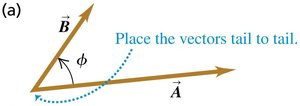
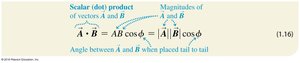
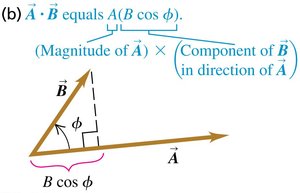
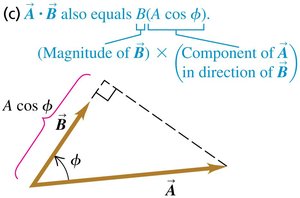
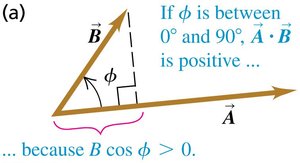
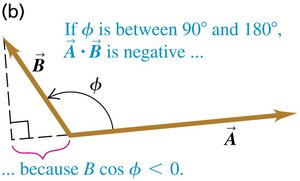
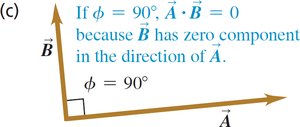
The scalar product (dot product) of two vectors is:
Where is the angle between the vectors.
The result is a scalar (not a vector).
Sign of the Scalar Product
Positive if
Negative if
Zero if
Calculating the Scalar Product Using Components
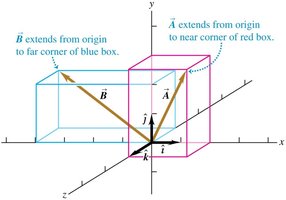
For vectors and :
Finding an Angle Using the Scalar Product
To find the angle between two vectors:
Vector (Cross) Product of Vectors
Definition and Properties
The vector product (cross product) of two vectors is:
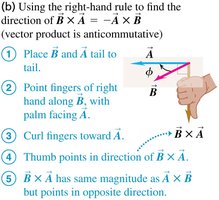
Where is the angle between the vectors and is a unit vector perpendicular to the plane of and (direction given by the right-hand rule).
The result is a vector.
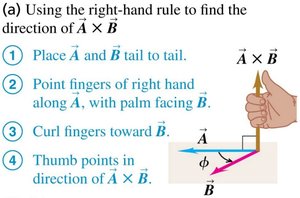
Anticommutativity of the Vector Product
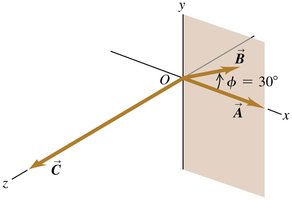
Calculating the Vector Product
For vectors and :
Summary Table: Vector Operations
Operation | Symbol | Result | Formula |
|---|---|---|---|
Addition | \( \vec{A} + \vec{B} \) | Vector | Head-to-tail or components |
Subtraction | \( \vec{A} - \vec{B} \) | Vector | Add \( -\vec{B} \) |
Scalar Product | \( \vec{A} \cdot \vec{B} \) | Scalar | |
Vector Product | \( \vec{A} \times \vec{B} \) | Vector |
Additional info: These notes provide a comprehensive overview of vectors, their properties, and operations, which are foundational for all topics in calculus-based physics. Mastery of these concepts is essential for understanding motion, forces, energy, and more in later chapters.
