 뒤로
뒤로Chapter 18: Temperature and the Macroscopic Description of Matter
스터디 가이드 - 스마트 노트
 자료에 맞춘 맞춤형 노트, 핵심 정의, 예시, 맥락을 확장해 제공합니다.
Temperature and the Zeroth Law of Thermodynamics
Thermal Equilibrium and the Zeroth Law
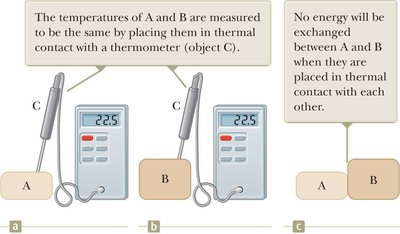
The concept of temperature is fundamental in thermodynamics and is closely related to the idea of thermal equilibrium. The Zeroth Law of Thermodynamics states that if two objects (A and B) are each in thermal equilibrium with a third object (C), then A and B are in thermal equilibrium with each other. This law provides the basis for temperature measurement.
Thermal equilibrium: No net energy exchange occurs between objects in thermal equilibrium.
Temperature: A property that determines whether or not energy will be transferred as heat between objects.
Temperature Scales and Thermometers
Physical Principles of Thermometers
Thermometers operate based on the principle that some physical property of a material changes with temperature. Common properties used include:
Volume of a liquid (e.g., mercury or alcohol thermometers)
Dimensions of a solid
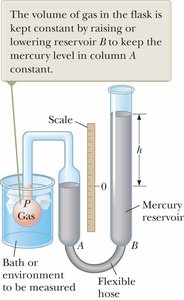
Pressure of a gas at constant volume
Volume of a gas at constant pressure
Electrical resistance of a conductor
Color of an object
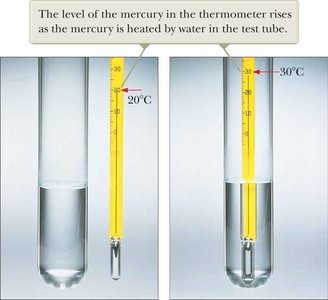
The Celsius Temperature Scale
The Celsius scale is defined by two fixed points: the ice point (0°C) and the steam point (100°C) of water at atmospheric pressure. The interval between these points is divided into 100 equal segments, each representing one degree Celsius.
Calibration: Achieved by placing the thermometer in thermal contact with systems at known temperatures (e.g., ice-water mixture and steam-water mixture).
The Constant-Volume Gas Thermometer and the Absolute Temperature Scale
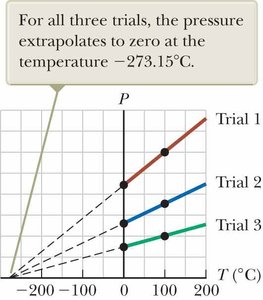
Gas thermometers are based on the pressure of a fixed volume of gas. They are nearly independent of the type of gas used, provided the pressure is low and the temperature is above the liquefaction point. The absolute zero of temperature is the point at which the pressure of an ideal gas extrapolates to zero.
Absolute zero: −273.15°C (0 K)
Triple point of water: 0.01°C, used as a reference point for the Kelvin scale
Kelvin scale: SI unit of temperature, where T(K) = T(°C) + 273.15
Comparison of Temperature Scales
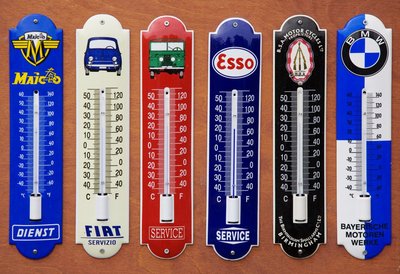
There are three commonly used temperature scales: Celsius, Fahrenheit, and Kelvin. The relationships between them are:
Example: Temperature Conversion
On a day when the temperature reaches 50°F, what is the temperature in degrees Celsius and in kelvins?
Thermal Expansion of Solids and Liquids
Thermal Expansion: Linear and Volume
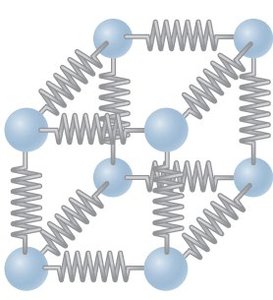
Most materials expand when heated due to increased average separation between atoms. This expansion can be described as linear (change in one dimension) or volumetric (change in three dimensions).
Linear expansion:
Volume expansion:
For isotropic solids,
Applications and Examples
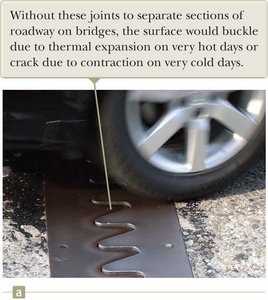
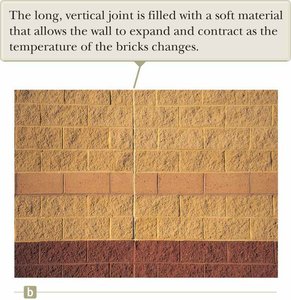
Expansion joints in bridges and buildings accommodate thermal expansion and contraction.
Thermal expansion must be considered in engineering design to prevent structural damage.
Example: Expansion of a Railroad Track
A steel rail of length 30.000 m at 0.0°C expands to 30.013 m at 40.0°C. If the temperature drops to −40.0°C, the length contracts to 29.987 m.
Formula:
Example: The Thermal Electrical Short
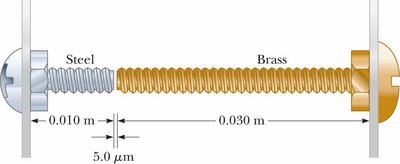
Two bolts (steel and brass) nearly touch inside a device. As temperature increases, both expand until they touch, causing a short circuit. The temperature at which this occurs can be calculated using the expansion coefficients and initial lengths.
The Unusual Behavior of Water
Density Anomaly Near 0°C
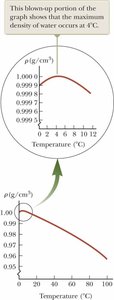
Water exhibits unique behavior near 0°C. As temperature increases from 0°C to 4°C, water contracts and its density increases, reaching a maximum at 4°C. Above 4°C, water expands normally with increasing temperature.
This anomaly explains why ice floats and why aquatic life can survive in cold climates.



Macroscopic Description of an Ideal Gas
Properties of Gases
Unlike solids and liquids, gases have weak interatomic forces and no fixed volume. The volume of a gas depends on the size of its container, and equations describing gases must treat volume as a variable.

The Ideal Gas Law
The ideal gas law relates the pressure, volume, and temperature of a gas sample. It is valid for low-density gases and is expressed as:
Where is the number of moles, is the number of molecules, is the universal gas constant, and is Boltzmann's constant ( J/K).
Special cases:
Boyle's Law: (at constant T)
Charles's Law: (at constant P)
Gay-Lussac's Law: (at constant V)
Example: Heating a Spray Can
A spray can at 202 kPa and 22°C is heated to 195°C. Assuming constant volume, the final pressure is calculated using the ideal gas law:
With K, K, kPa, kPa
If the can expands slightly, the effect on pressure is minimal due to the small volume change compared to the temperature change.
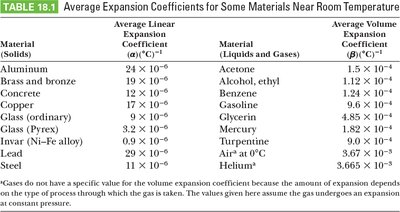
Table: Average Expansion Coefficients for Some Materials Near Room Temperature
Material (Solids) | Average Linear Expansion Coefficient (α) (°C−1) | Material (Liquids and Gases) | Average Volume Expansion Coefficient (β) (°C−1) |
|---|---|---|---|
Aluminum | 24 × 10−6 | Acetone | 1.5 × 10⁻³ |
Brass and bronze | 19 × 10−6 | Alcohol, ethyl | 1.12 × 10⁻³ |
Concrete | 12 × 10−6 | Benzene | 1.24 × 10⁻³ |
Copper | 17 × 10−6 | Gasoline | 9.6 × 10⁻⁴ |
Glass (ordinary) | 9 × 10⁻⁶ | Glycerin | 4.85 × 10⁻⁴ |
Glass (Pyrex) | 3.2 × 10⁻⁶ | Mercury | 1.82 × 10⁻⁴ |
Invar (Ni–Fe alloy) | 0.9 × 10⁻⁶ | Turpentine | 9.0 × 10⁻⁴ |
Lead | 29 × 10−6 | Air at 0°C | 3.67 × 10⁻³ |
Steel | 11 × 10−6 | Heliuma | 3.65 × 10⁻³ |
Additional info: Gases do not have a specific value for the volume expansion coefficient because the amount of expansion depends on the type of process through which the gas is taken. The values given here assume the gas undergoes an expansion at constant pressure.
