 뒤로
Chapter 20: Electric Fields and Forces – Study Notes
스터디 가이드 - 스마트 노트
 자료에 맞춘 맞춤형 노트, 핵심 정의, 예시, 맥락을 확장해 제공합니다.
Electric Fields and Forces
Introduction to Electric Phenomena
Electric phenomena arise from the presence and interaction of electric charges. This chapter introduces the fundamental concepts of electric charge, electric force, and electric field, which are foundational to understanding electricity and magnetism in physics.
Static Electricity and Charge Conservation
Nature of Electric Charge
Electric charge is a fundamental property of matter, existing in two types: positive and negative.
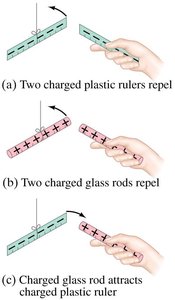
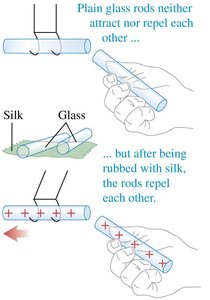
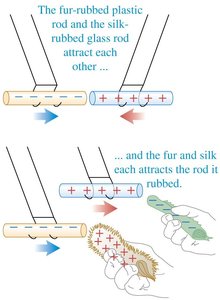
Like charges repel; opposite charges attract.
Objects can be charged by friction (rubbing), which transfers charge from one object to another.
Charge is quantized in units of the elementary charge .
The law of conservation of charge states that the total charge in an isolated system remains constant.
Charging by Friction and Contact
Rubbing a plastic rod with wool transfers electrons to the rod, making it negatively charged.
Rubbing a glass rod with silk removes electrons from the rod, making it positively charged.
Neutral objects contain equal numbers of positive and negative charges.
Visualizing Charge and Charge Diagrams
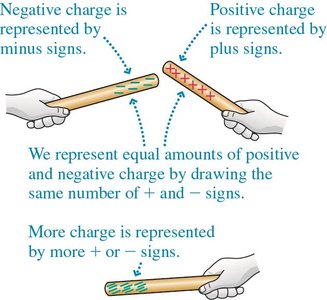
Charge diagrams use plus (+) and minus (−) signs to represent positive and negative charges, respectively.
More signs indicate a greater amount of charge.
Conservation and Quantization of Charge
Charge is transferred, not created or destroyed, during interactions.
All observable charge is an integer multiple of the elementary charge .
Conductors, Insulators, and Charging Methods
Conductors and Insulators
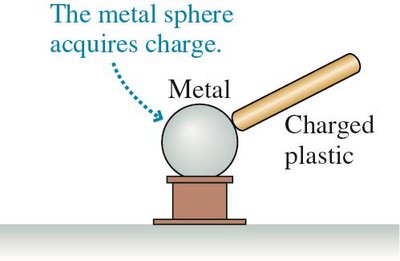
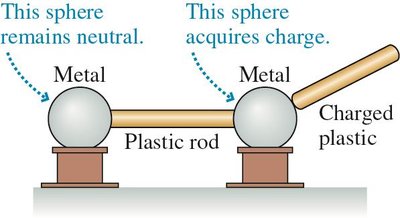
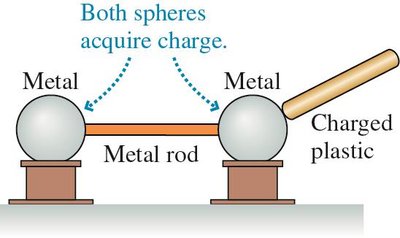
Conductors (e.g., metals) allow charges to move freely.
Insulators (e.g., glass, plastic) do not allow free movement of charge.
Charge can be transferred to conductors by contact; in insulators, charge remains localized.
Electrostatic Equilibrium
In a conductor at electrostatic equilibrium, charges are at rest and reside on the surface.
The electric field inside a conductor is zero.
Charging by Induction
Charging by induction involves redistributing charges in a conductor without direct contact.
A charged object brought near a conductor causes charge separation; grounding allows one type of charge to leave, leaving the conductor oppositely charged.
Atomic Structure and Charge
Electric Charge in Atoms
Atoms consist of a dense, positively charged nucleus (protons and neutrons) surrounded by a cloud of negatively charged electrons.
Atoms are electrically neutral when they have equal numbers of protons and electrons.
Ionization is the process of removing or adding electrons, creating ions.
Coulomb’s Law
Electric Force Between Point Charges
Coulomb’s Law quantifies the electric force between two point charges:
is the magnitude of the force (in newtons, N).
and are the charges (in coulombs, C).
is the distance between the charges (in meters, m).
is the electrostatic constant.
The force is attractive for opposite charges and repulsive for like charges.
Comparison with Gravitational Force
Coulomb’s law is similar in form to Newton’s law of gravitation but can be attractive or repulsive.
Electric forces are typically much stronger than gravitational forces for elementary particles.
Superposition Principle
The net electric force on a charge is the vector sum of the forces exerted by all other charges.
Electric Field Concept
Definition of Electric Field
The electric field at a point is the force per unit charge experienced by a small positive test charge placed at that point:
Units: newtons per coulomb (N/C).
The direction of is the direction of the force on a positive test charge.
Electric Field of a Point Charge
The electric field produced by a point charge at a distance is:
Points away from if $q$ is positive, toward $q$ if $q$ is negative.
Superposition of Electric Fields
The total electric field at a point is the vector sum of the fields due to all charges present:
Electric Field Lines
Visualizing Electric Fields
Electric field lines are imaginary lines that indicate the direction and strength of the electric field.
Field lines start on positive charges and end on negative charges.
The density of lines indicates the strength of the field (closer lines = stronger field).
Field lines never cross.
Conductors in Electric Fields
Properties of Conductors
In electrostatic equilibrium, the electric field inside a conductor is zero.
Any excess charge resides on the surface of the conductor.
The electric field at the surface is perpendicular to the surface.
Charge density and electric field are highest at sharp points.
Forces and Torques in Electric Fields
Force on a Charge in an Electric Field
The force on a charge in an electric field is:
Electric Dipoles
An electric dipole consists of two equal and opposite charges separated by a distance.
A dipole in a uniform electric field experiences no net force but does experience a torque that aligns it with the field.
Applications and Biological Context
Electrostatics in Technology and Biology
Electrostatic forces are used in photocopy machines and laser printers to manipulate toner particles.
Electric fields play a role in molecular biology, such as DNA structure and replication, and in techniques like gel electrophoresis.
Water molecules are electric dipoles, which is crucial for their solvent properties and for hydrogen bonding in DNA.
Summary Table: Properties of Protons and Electrons
Particle | Mass (kg) | Charge (C) |
|---|---|---|
Proton | ||
Electron |
Key Equations
Coulomb’s Law:
Electric Field (point charge):
Force in an Electric Field:
Permittivity of Free Space:
Summary of Main Concepts
There are two types of electric charge: positive and negative.
Charge is conserved and quantized.
Conductors allow free movement of charge; insulators do not.
Coulomb’s law describes the force between point charges.
The electric field is the force per unit charge and can be visualized with field lines.
In conductors, the electric field is zero inside and perpendicular to the surface outside.
Electric dipoles experience torque in electric fields and are important in chemistry and biology.
