 뒤로
Chapter 22: Electric Charges and Forces – Study Notes
스터디 가이드 - 스마트 노트
 자료에 맞춘 맞춤형 노트, 핵심 정의, 예시, 맥락을 확장해 제공합니다.
Electric Charges and Forces
Introduction to Electric Phenomena
Electric phenomena are fundamental to understanding the behavior of matter at the microscopic and macroscopic levels. These phenomena arise from the presence and interactions of electric charges, which produce forces and fields that govern a wide range of physical effects, from lightning in the atmosphere to the operation of electronic devices.

Nature of Electric Charge
Electric charge is a fundamental property of matter, carried by particles such as electrons (negative charge) and protons (positive charge).
Like charges repel each other, while opposite charges attract.
Electric charge is quantized (comes in discrete amounts) and conserved (cannot be created or destroyed).
Common units: Coulomb (C).
Detecting and Demonstrating Electric Charge
The Electroscope
An electroscope is a device used to detect the presence of electric charge. It typically consists of a metal knob connected to two thin metal leaves. When the electroscope is uncharged, the leaves hang straight down. When charged, the leaves repel each other and separate due to like charges.


Charging the electroscope causes the leaves to move apart.
The device cannot distinguish the sign of the charge, only its presence.
Electroscope Response to Nearby Charges
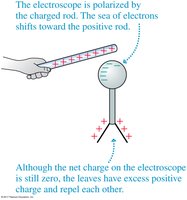
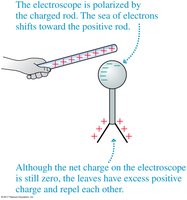
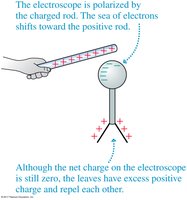
When a charged rod is brought near (but does not touch) the electroscope, the leaves can move due to charge polarization. For example, a positively charged rod attracts electrons toward the knob, leaving the leaves more positively charged and causing them to separate further.
Charge Polarization and Forces
Charge Polarization in Conductors
Charge polarization occurs when the positive and negative charges within a neutral object are slightly separated by the influence of an external electric field. This effect is especially pronounced in conductors, where electrons are free to move.
When a charged object is brought near a conductor, electrons shift within the conductor, creating regions of slight positive and negative charge.
The object as a whole remains neutral but is said to be polarized.
Polarization Force
The net force that arises due to polarization is called the polarization force. The side of the neutral object closer to the external charge experiences a stronger force due to the inverse-square law of electric forces, resulting in a net attraction.
Polarization in Insulators and Electric Dipoles
In insulators, atoms or molecules become slightly polarized in the presence of an external charge, forming electric dipoles. Each atom's negative charge shifts slightly toward the external positive charge, resulting in a net attractive force.
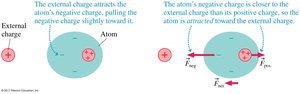
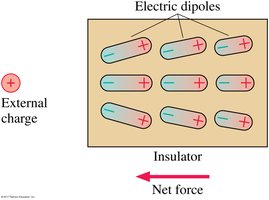
All atoms in the insulator become polarized, and the net force is toward the external charge.
Coulomb’s Law
Statement of Coulomb’s Law
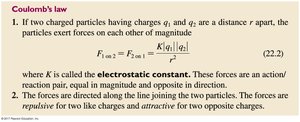
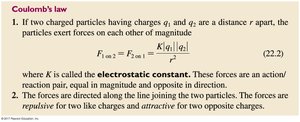
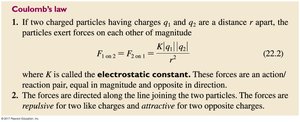
Coulomb’s Law quantifies the force between two point charges. The magnitude of the force is proportional to the product of the charges and inversely proportional to the square of the distance between them.
K is the electrostatic constant:
The force is repulsive for like charges and attractive for opposite charges.
The forces are equal in magnitude and opposite in direction (Newton’s third law).
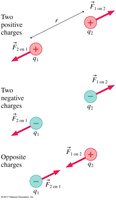
Examples of Coulomb’s Law
Two positive charges repel each other.
Two negative charges repel each other.
A positive and a negative charge attract each other.
Problem-Solving Strategy: Electrostatic Forces and Coulomb’s Law
Steps for Solving Problems
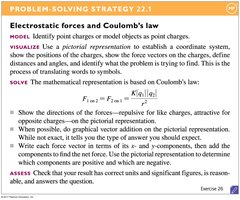
Model: Identify point charges or model objects as point charges.
Visualize: Draw a diagram showing the positions of charges and the forces acting on them.
Solve: Use Coulomb’s law to calculate the magnitude and direction of the forces.
Assess: Check that your answer is reasonable and has correct units and significant figures.
Worked Example: Lifting a Glass Bead
Example 22.3
A small plastic sphere charged to nC is held 1.0 cm above a small glass bead on a table. The bead has a mass of 0.10 g and a charge of nC. Will the glass bead "leap up" to the plastic sphere?

Calculate the electrostatic force using Coulomb’s law.
Compare the electrostatic force to the gravitational force on the bead.
If the electrostatic force is greater, the bead will accelerate upward.
In this example, the electrostatic force is found to be 60 times greater than the gravitational force, so the bead leaps upward.

Charging by Induction
Process of Charging by Induction
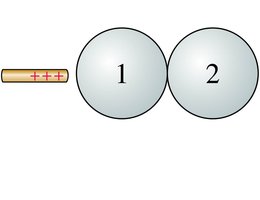
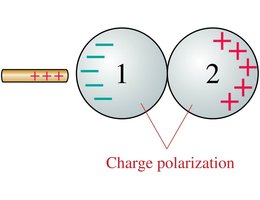
Charging by induction involves bringing a charged object near a neutral conductor, causing charge polarization. If the conductor is then separated while polarized, each part retains a net charge after the external object is removed.
Metal spheres initially neutral are polarized by a nearby charged rod.
Separating the spheres while polarized results in one sphere being positively charged and the other negatively charged.
Summary Table: Key Concepts in Electric Charges and Forces
Concept | Description | Key Equation |
|---|---|---|
Electric Charge | Property of matter causing electric phenomena; quantized and conserved | – |
Electroscope | Device to detect presence of charge via leaf separation | – |
Charge Polarization | Separation of charges within a neutral object due to external field | – |
Coulomb’s Law | Force between two point charges | |
Charging by Induction | Charging a conductor without direct contact | – |
