 뒤로
Electric Charge and Electric Field: Structured Study Notes
스터디 가이드 - 스마트 노트
 자료에 맞춘 맞춤형 노트, 핵심 정의, 예시, 맥락을 확장해 제공합니다.
Background: Scalar and Vector Fields
Definition and Examples
In physics, a field is a physical quantity that has a specific value at every point in space and time. Fields are fundamental to understanding how forces and interactions propagate in nature. Fields can be classified as scalar or vector fields:
Scalar Field: Assigns a single scalar value to each point in space. Example: Temperature distribution across the Earth's surface.
Vector Field: Assigns a vector (with magnitude and direction) to each point in space. Example: Wind velocity at different locations on Earth.
Most fields encountered in introductory physics are static, meaning they do not change with time.

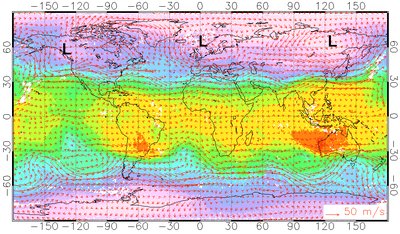
Mathematical Representation:
For a scalar field: f(\vec{r}, t)
For a vector field: \vec{A}(\vec{r}) = A_x(\vec{r}) \hat{i} + A_y(\vec{r}) \hat{j} + A_z(\vec{r}) \hat{k}
Additional info: Scalar fields are often used to describe quantities like pressure or potential, while vector fields describe quantities like force or velocity.
Introduction to Electric Charge and Electric Field
Electrostatics and Fundamental Forces
This chapter introduces electrostatics, the study of electric fields generated by static charge distributions and the resulting electric forces. The electric force is one of the four fundamental forces in nature:
Electromagnetic Force: Acts between charged particles; includes both electric and magnetic effects.
Gravity: Acts between masses; much weaker than electromagnetic force.
Strong Interaction: Binds quarks and nucleons; acts over very short distances (~10-15 m).
Weak Interaction: Responsible for certain nuclear processes; acts over even shorter distances (~10-18 m).
Additional info: Electromagnetic force is responsible for most everyday forces (friction, tension, etc.) at the atomic and molecular level.
Basic Properties of Electric Charge
Characteristics and Conservation
Electric charge is a fundamental property of elementary particles:
Measured in coulombs (C).
Quantized in integer multiples of the elementary charge e = 1.6 \times 10^{-19} C.
Electrons have charge -e; protons have charge +e.
Charge is a scalar quantity; it can be positive or negative.
Conservation of charge: The net charge in a closed system remains constant during all physical processes.
Like charges repel; opposite charges attract.
Additional info: Conservation of charge is a fundamental law in physics, similar to conservation of energy and momentum.
The Electric Field
Definition and Physical Reality
Charged particles generate an electric field at every point in the surrounding space. The electric field is a vector field, denoted as \vec{E}(\vec{r}), and measured in newtons per coulomb (N/C). The electric field is a real physical entity, carrying both energy and momentum.
The electric field is generated by static charges (electrostatic field).
Non-static (changing) electric fields can transfer energy wirelessly (e.g., electromagnetic waves).
The Field of a Point Charge
A point charge is an idealized object with charge but no volume. The electric field generated by a point charge q at position \vec{r} is:
Vector form:
Alternate form:
Magnitude:
Where
Direction: For positive q, field points away; for negative q, field points toward the charge.
Example: The electric field around a proton (positive charge) points radially outward; around an electron (negative charge), it points inward.
The Superposition Principle
For multiple point charges, the total electric field at a point is the vector sum of the fields from each charge:
This principle allows calculation of complex fields by adding simple radial fields.
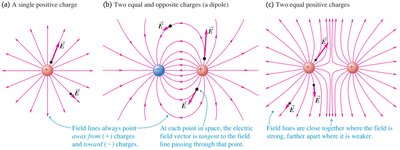
Example: The field lines for two equal and opposite charges (a dipole) show how the fields combine and interact.
The Electric Force
Force on a Charge in an Electric Field
A charged particle placed in an electric field experiences a force:
Direction: For positive q, force is parallel to the field; for negative q, force is antiparallel.
This formula applies to point charges and small charged objects.
Additional info: The electric field exists independently of whether a test charge is present.
Coulomb’s Law
The force between two point charges is given by Coulomb’s Law:
Vector form:
Alternate form:
Magnitude:
Direction: Repulsive if charges have same sign; attractive if opposite.
Newton’s Third Law:
Comparison: Coulomb’s Law is mathematically similar to Newton’s Law of Gravity, but acts between charges instead of masses.
Continuous Charge Distributions
Charge Density and Types
For macroscopic objects, charge is often distributed continuously. The charge density depends on the dimension:
Linear charge density (\lambda): Charge per unit length (e.g., thin rod).
Surface charge density (\sigma): Charge per unit area (e.g., plate or shell).
Volume charge density (\rho): Charge per unit volume (e.g., solid sphere).
Uniform density: Same throughout the object.
Non-uniform density: Varies from point to point.
Calculating the Field of a Continuous Charge Distribution
To find the electric field from a continuous charge distribution:
Divide the object into infinitesimal segments (e.g., resembling point charges).
Write the expression for the infinitesimal field d\vec{E} from each segment.
Integrate over all segments to find the total field:
Example: Calculating the field from a charged rod involves integrating the contributions from each infinitesimal segment along its length.
Additional info: This "chop up and integrate" approach is essential for handling complex charge distributions in electrostatics.
