 뒤로
Electric Forces, Fields, and Potential: Study Notes for Physics with Calculus
스터디 가이드 - 스마트 노트
 자료에 맞춘 맞춤형 노트, 핵심 정의, 예시, 맥락을 확장해 제공합니다.
Chapter 22: Electric Forces and Fields
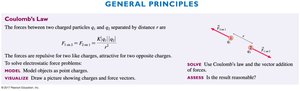
General Principles: Coulomb's Law
Coulomb's Law describes the force between two point charges. This law is foundational for understanding electric interactions in physics.
Coulomb's Law: The force between two charged particles, q_1 and q_2, separated by a distance r, is given by: where is Coulomb's constant ( N·m2/C2).
Force Direction: The force is repulsive for like charges and attractive for opposite charges.
Model: Charges are modeled as point charges for simplicity.
Visualization: Draw force vectors to represent the direction and magnitude of forces.
Vector Addition: When multiple charges are present, use vector addition to find the net force.
Important Concepts: The Charge Model and The Field Model
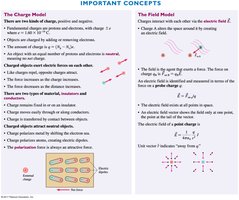
Understanding electric phenomena requires two conceptual models: the charge model and the field model.
The Charge Model:
There are two kinds of charge: positive and negative.
Fundamental charges are carried by protons (+e) and electrons (−e), where C.
Objects are charged by adding or removing electrons.
Charged objects exert electric forces on each other; like charges repel, unlike charges attract.
Materials are classified as conductors (allow charge to move freely) or insulators (do not allow charge to move freely).
The Field Model:
Charges interact with each other via the electric field E.
A charge creates an electric field in the space around it, which exerts a force on other charges.
The electric field due to a point charge is:
The force on a charge in an electric field is:
Chapter 23: Electric Fields
General Principles: Sources and Consequences of Electric Fields
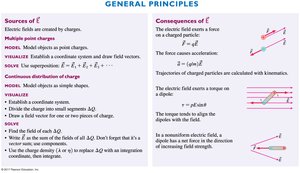
Electric fields are created by charges and have important effects on other charges in their vicinity.
Sources of Electric Field (E):
Electric fields are created by charges.
For multiple point charges, use superposition to add the fields vectorially.
For continuous charge distributions, integrate over the charge distribution.
Consequences of Electric Field (E):
The electric field exerts a force on a charged particle: .
Charged particles accelerate in the direction of the electric field (if positive) or opposite (if negative).
Dipoles in electric fields experience a torque that aligns them with the field.
Applications: Key Electric Field Models
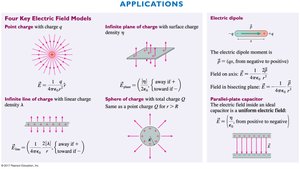
Several standard charge distributions are used to model electric fields in practical problems.
Point Charge: , radially outward (positive) or inward (negative).
Infinite Plane of Charge: , where is surface charge density.
Infinite Line of Charge: , where is linear charge density.
Sphere of Charge: For , is same as a point charge; for , use Gauss's Law.
Electric Dipole: The field on the axis is , where is the dipole moment.
Parallel-Plate Capacitor: , where is voltage and is plate separation.
Chapter 25: Electric Potential and Potential Energy
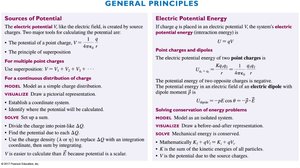
General Principles: Sources of Potential and Electric Potential Energy
The electric potential is a scalar quantity related to the electric field and is useful for energy calculations.
Sources of Potential (V):
The electric potential at a point is created by source charges.
For a point charge:
For multiple point charges, use superposition:
For continuous charge distributions, integrate:
Electric Potential Energy (U):
The potential energy of a system of two point charges is:
For a dipole in an electric field:
Conservation of energy applies: the sum of kinetic and potential energy is constant for isolated systems.
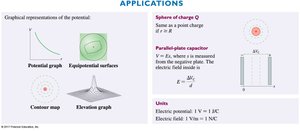
Applications: Graphical Representations and Capacitors
Electric potential can be represented graphically, and capacitors are practical devices that store electric energy.
Graphical Representations:
Potential graphs, equipotential surfaces, contour maps, and elevation graphs are used to visualize electric potential in space.
Sphere of Charge: The potential outside a sphere of charge is the same as for a point charge.
Parallel-Plate Capacitor: The potential difference is , and the electric field is .
Units: 1 volt (V) = 1 joule/coulomb (J/C); 1 newton/coulomb (N/C) for electric field.
Summary Table: Key Equations and Concepts
Concept | Equation | Description |
|---|---|---|
Coulomb's Law | Force between two point charges | |
Electric Field (Point Charge) | Field due to a point charge | |
Force in Electric Field | Force on charge in field | |
Electric Potential (Point Charge) | Potential due to a point charge | |
Potential Energy (Two Charges) | Potential energy of two charges | |
Parallel-Plate Capacitor | Field between plates |
Additional info: These notes are based on summary slides for Chapters 22, 23, and 25, which cover electric forces, fields, and potential. The content is directly relevant to college-level Physics with Calculus, specifically the sections on electric force, field, and potential (Chapters 24, 25, and 26 in many textbooks).
