 뒤로
Electric Potential and Capacitance: Study Notes for Physics with Calculus
스터디 가이드 - 스마트 노트
 자료에 맞춘 맞춤형 노트, 핵심 정의, 예시, 맥락을 확장해 제공합니다.
Electric Potential Energy and Electric Potential
Electric Potential Energy
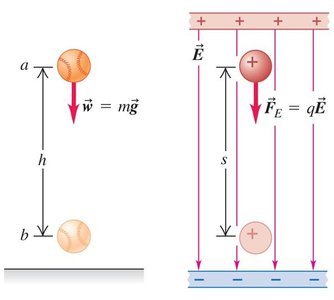
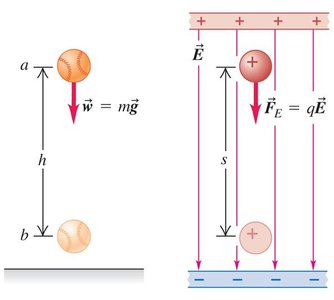
Electric potential energy is the energy stored due to the position of a charge in an electric field. It is analogous to gravitational potential energy, where the force is conservative and the work done is equal to the change in potential energy.
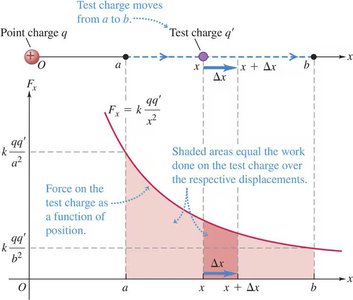
Definition: The work done by the electric field in moving a charge from point a to point b is equal to the negative change in electric potential energy:
Uniform Electric Field: For a charge q moving a distance s in a uniform electric field E:
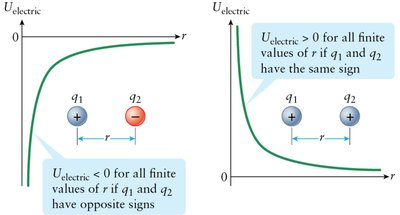
Potential Energy of Point Charges: For two point charges q and q', separated by distance r: where
Significance: U is positive for like charges (repulsion), negative for opposite charges (attraction).
Electric Potential (V)
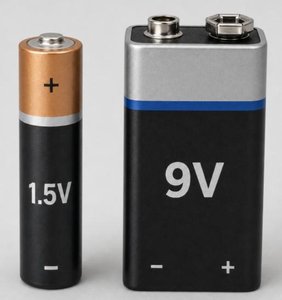
Electric potential at a point is the electric potential energy per unit charge at that point. It is a scalar quantity and can be positive or negative.
Definition: or
Units: Joules per coulomb (J/C), also called volts (V).
Potential Difference: Only differences in potential matter physically; the work per coulomb to move between two points is .
Potential of a Point Charge:
Superposition Principle: For several charges, potentials add algebraically:
Equipotential Surfaces
Definition and Properties
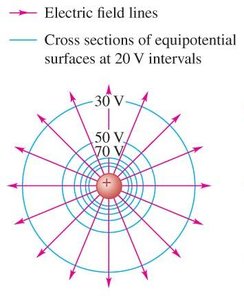
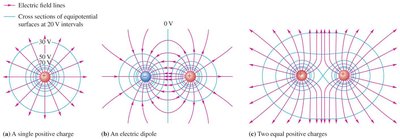
An equipotential surface is a surface on which the electric potential is the same at every point. Moving a charge along an equipotential surface requires no work, and electric field lines are always perpendicular to these surfaces.
Equipotentials in Uniform Fields: Parallel, evenly spaced planes.
Equipotentials for Point Charges: Concentric spheres around the charge.
Field Direction: The electric field points in the direction of decreasing potential.

Capacitors and Capacitance
Capacitors
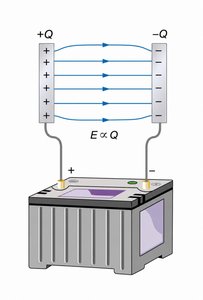
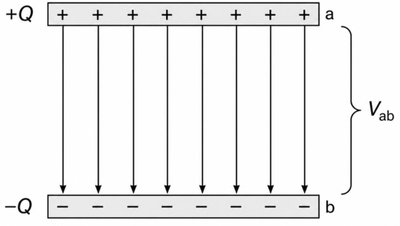
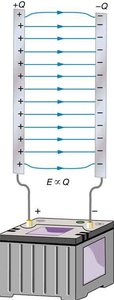
A capacitor is a device used to store electric charge and electric potential energy. It consists of two conductors separated by an insulator (dielectric).
Parallel-Plate Capacitor: Two plates of area A separated by distance d.
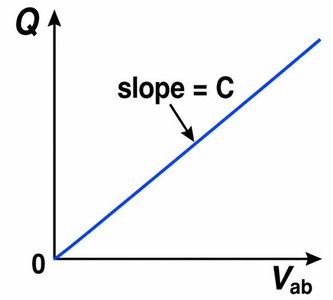
Capacitance (C): The ratio of charge Q on either plate to the potential difference V between them:
Units: Farads (F), where 1 F = 1 C/V.
For Parallel Plates: , where
Energy Stored in a Capacitor
The energy stored in a charged capacitor is the work required to charge it:
Formula:
Units: Joules (J)
Capacitors in Series and Parallel
Parallel Combination
When capacitors are connected in parallel, the total capacitance is the sum of individual capacitances:
Formula:
Voltage: Same across all capacitors.
Charge: Total charge is the sum of charges on each capacitor.
Series Combination
When capacitors are connected in series, the reciprocal of the total capacitance is the sum of reciprocals of individual capacitances:
Formula:
Charge: Same on all capacitors.
Voltage: Total voltage is the sum of voltages across each capacitor.
Configuration | Capacitance Formula | Voltage | Charge |
|---|---|---|---|
Series | Adds up | Same for all | |
Parallel | Same for all | Adds up |
Dielectrics in Capacitors
Role of Dielectrics
Inserting a dielectric material between the plates of a capacitor increases its capacitance by reducing the effective electric field. The dielectric constant κ quantifies this effect.
Formula: , where is the capacitance without the dielectric.
Dielectric Constant (κ): Always greater than 1 for any material.
Effect: For fixed voltage, inserting a dielectric increases Q and U; for fixed charge, it decreases V and U.
Material | Dielectric Constant κ |
|---|---|
Vacuum | 1 (exactly) |
Air | 1.00054 |
Teflon | 2.0 |
Paper | 3.0 |
Pyrex glass | 4.8 |
Cell membrane | 9.0 |
Ethanol | 24 |
Water | 80 |
Strontium titanate | 300 |
Energy Density in Electric Fields
The energy stored in a capacitor is actually stored in the electric field between the plates. The energy per unit volume (energy density) is given by:
Formula:
Application: This formula is valid for any electric field, not just parallel plates.
Applications and Examples
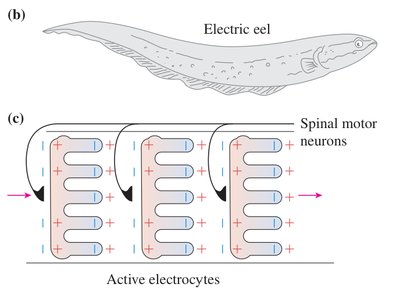
Electric Eel: Uses stacked electrocytes as biological capacitors to generate high voltages.
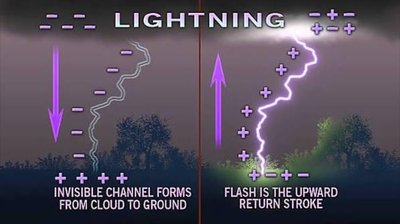
Lightning: Natural example of potential difference and charge separation.
Capacitive Touchscreen: Uses the principle of capacitance to detect touch.

Defibrillator: Stores energy in a capacitor and releases it rapidly to restore heart rhythm.
Summary Table: Key Equations
Concept | Equation | Units |
|---|---|---|
Potential Energy (point charges) | J | |
Electric Potential (point charge) | V | |
Capacitance (parallel plates) | F | |
Energy Stored in Capacitor | J | |
Energy Density | J/m3 |
Additional info: These notes expand on the provided slides by including definitions, formulas, and practical examples, ensuring a self-contained and comprehensive study guide for college-level Physics with Calculus students.
