 뒤로
뒤로Electric Potential, Energy, and Motion of Charged Particles in Electric Fields
스터디 가이드 - 스마트 노트
 자료에 맞춘 맞춤형 노트, 핵심 정의, 예시, 맥락을 확장해 제공합니다.
Q1. What is the maximum velocity () of an alpha particle () in an electric field with a potential difference of 100 V?
Background
Topic: Energy conservation in electric fields
This question tests your understanding of how a charged particle (here, an alpha particle) gains kinetic energy when accelerated through a potential difference. The work done by the electric field on the particle is converted into kinetic energy.
Key Terms and Formulas
Alpha particle (): Helium nucleus, charge , mass kg
Potential difference (): The voltage the particle moves through
Energy conservation:
Step-by-Step Guidance
Identify the charge of the alpha particle: C.
Write the energy conservation equation: .
Rearrange the equation to solve for : .
Plug in the known values for , , and (but do not calculate the final value yet).
Try solving on your own before revealing the answer!
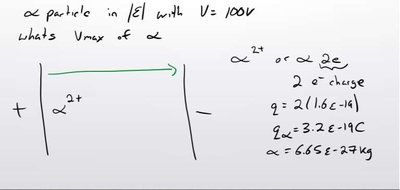
Final Answer: m/s
Using with C, V, and kg:
m/s$
The alpha particle reaches this maximum speed after being accelerated through the 100 V potential difference.
Q2. If an alpha particle moves from point A to point B between equipotential lines (A at 10 V, B at 30 V), how much energy is required?
Background
Topic: Work done by electric field and potential difference
This question tests your understanding of how the work required to move a charge between two points in an electric field depends on the potential difference and the charge.
Key Terms and Formulas
Work done ():
Alpha particle:
Step-by-Step Guidance
Determine the charge of the alpha particle: .
Calculate the potential difference: .
Use the formula to set up the calculation.
Substitute the values for and (but do not compute the final value yet).
Try solving on your own before revealing the answer!
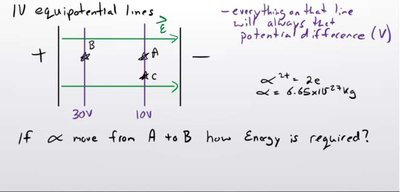
Final Answer: J
, C
J$
This is the energy required to move the alpha particle from A to B.
Q3. If a 7.0 μC charge is allowed to move from B to A (B at 30 V, A at 10 V), and the charge mass is 2 mg, what is (final velocity)?
Background
Topic: Conservation of energy in electric fields
This question tests your ability to relate the change in electric potential energy to the kinetic energy gained by a charge moving between two points of different potential.
Key Terms and Formulas
Potential energy change:
Kinetic energy:
Conservation:
Step-by-Step Guidance
Identify the charge ( C) and mass ( kg).
Calculate the potential difference: .
Set up the energy equation: .
Rearrange to solve for : .
Substitute the known values, but do not compute the final value yet.
Try solving on your own before revealing the answer!
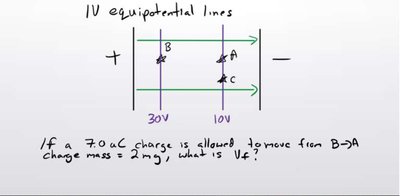
Final Answer: m/s
, C, kg
Since the charge is positive and moving to a lower potential, it gains kinetic energy. The final velocity is approximately 0.53 m/s.
Q4. A ion is accelerated through a 0.150 MV potential difference and reaches a final velocity of m/s. What is its mass?
Background
Topic: Energy conservation for ions in electric fields
This question tests your ability to use the relationship between electric potential energy and kinetic energy to solve for the mass of an ion.
Key Terms and Formulas
Charge of :
Potential difference: V
Final velocity: m/s
Energy conservation:
Step-by-Step Guidance
Identify the charge: C.
Write the energy equation: .
Rearrange to solve for : .
Substitute the known values for , , and (but do not calculate the final value yet).
Try solving on your own before revealing the answer!
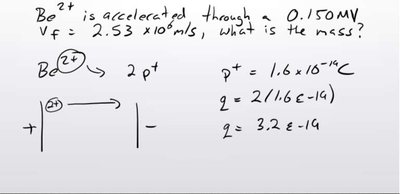
Final Answer: kg
Using with C, V, m/s:
kg$
This is the mass of the ion based on the given data.
Q5. A negatively charged particle is suspended between two plates 20 cm apart with a voltage of V. The electric force is N. What are the charge () and mass () of the particle?
Background
Topic: Forces on charges in electric fields and equilibrium
This question tests your understanding of the relationship between electric force, electric field, and the equilibrium of a charged particle in a uniform electric field.
Key Terms and Formulas
Electric field:
Electric force:
Equilibrium: (if the particle is suspended and not accelerating)
Step-by-Step Guidance
Calculate the electric field: , where V and m.
Use to solve for the charge .
If the particle is in equilibrium, set to solve for the mass .
Substitute the known values, but do not compute the final values yet.
Try solving on your own before revealing the answer!
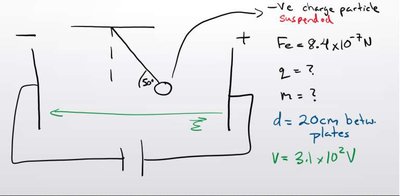
Final Answer: C, kg
First, V/m.
Then, C$
If , kg$
These are the charge and mass of the suspended particle.
