 뒤로
Electromagnetic Waves, Geometric Optics, and Wave Phenomena
스터디 가이드 - 스마트 노트
 자료에 맞춘 맞춤형 노트, 핵심 정의, 예시, 맥락을 확장해 제공합니다.
Waves and Sinusoidal Motion
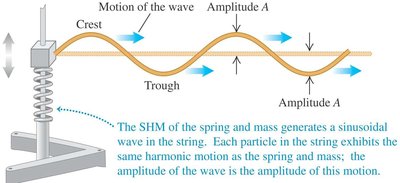
Sinusoidal Waves and Simple Harmonic Motion
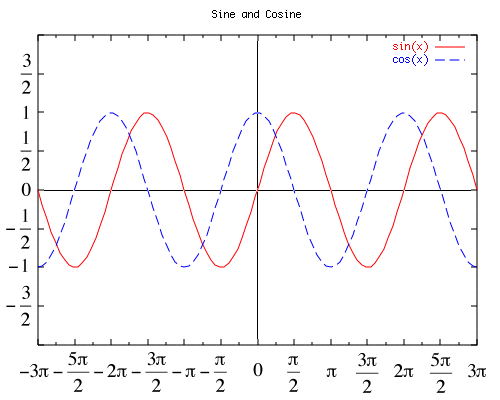
Sinusoidal waves are fundamental to understanding wave phenomena in physics. They are described mathematically by sine and cosine functions, which represent periodic oscillations.
Amplitude (A): The maximum displacement from equilibrium.
Crest and Trough: The highest and lowest points of the wave, respectively.
Wavelength (\(\lambda\)): The distance over which the wave's shape repeats.
Frequency (f): The number of cycles per second, measured in Hertz (Hz).
Angular Frequency (\(\omega\)): \(\omega = 2\pi f\), measured in radians per second.
Period (T): The time for one complete cycle, \(T = 1/f\).
Equation of a Sine Wave:
where \(A\) is amplitude, \(\omega\) is angular frequency, and \(\phi\) is phase.
Electromagnetic Waves
Nature and Properties of Electromagnetic Waves
Electromagnetic (EM) waves are oscillations of electric and magnetic fields that propagate through space. They do not require a medium and travel at the speed of light in a vacuum (\(c = 3 \times 10^8\) m/s).
Generation: Produced by accelerating electric charges.
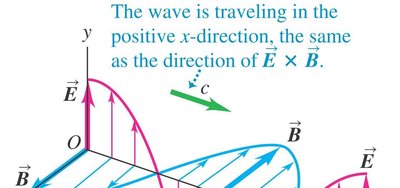
Components: Consist of perpendicular electric (\(\vec{E}\)) and magnetic (\(\vec{B}\)) fields, both perpendicular to the direction of propagation.
Speed in Vacuum:
Relationship:
Energy Transport: The energy carried by EM waves is described by the Poynting vector \(\vec{S}\).
The Electromagnetic Spectrum
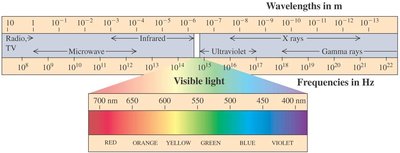
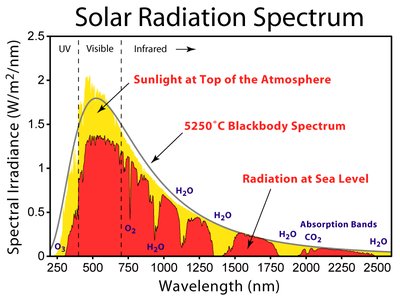
The EM spectrum encompasses all types of EM radiation, classified by wavelength or frequency:
Radio Waves (longest wavelength, lowest frequency)
Microwaves
Infrared
Visible Light (400–700 nm)
Ultraviolet
X-rays
Gamma Rays (shortest wavelength, highest frequency)
Visible light is only a small portion of the spectrum, ranging from violet (400 nm) to red (700 nm).
Plane Waves and Polarization
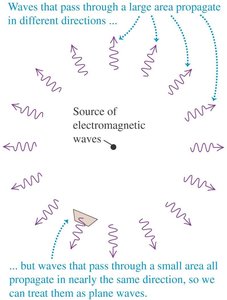
Far from a point source, EM waves can be approximated as plane waves. The electric and magnetic fields oscillate in fixed directions, and the wave can be linearly polarized.
Wave Intensity and the Inverse Square Law
Intensity and Power
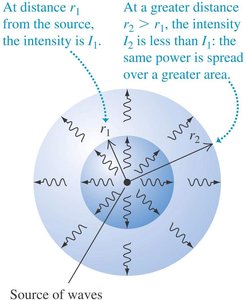
The intensity (I) of a wave is the average power transmitted per unit area perpendicular to the direction of propagation:
For a point source emitting isotropically, intensity decreases with the square of the distance (r):
Reflection and Refraction of Light
Laws of Reflection and Refraction
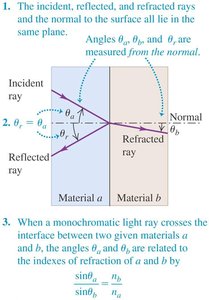
When light encounters a boundary between two media, it can be reflected and/or refracted. The laws governing these phenomena are:
Law of Reflection: The angle of incidence equals the angle of reflection (\(\theta_i = \theta_r\)).
Law of Refraction (Snell's Law):
Refraction and Index of Refraction
The index of refraction (n) of a material is the ratio of the speed of light in vacuum to that in the material:
When light passes from a lower to a higher index medium, it bends toward the normal; from higher to lower, it bends away.
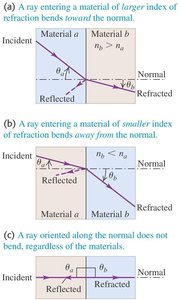
Apparent Depth and Real Depth
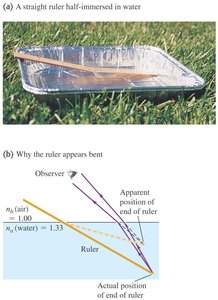
Refraction causes objects under water to appear closer to the surface than they actually are. This is due to the bending of light rays at the water-air interface.
Total Internal Reflection and Applications
Total Internal Reflection
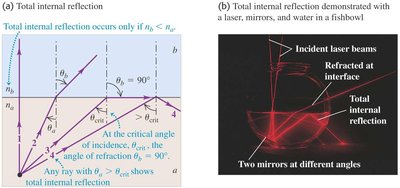
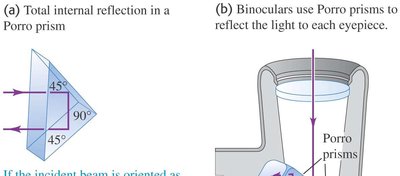
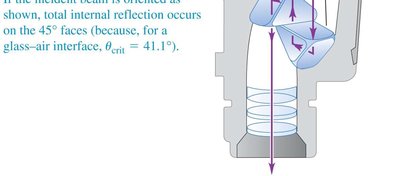
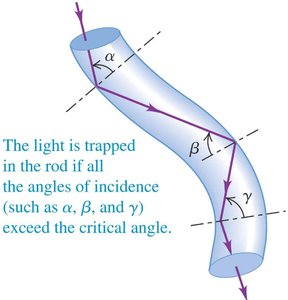
Total internal reflection occurs when light attempts to move from a medium with higher refractive index to one with lower refractive index at an angle greater than the critical angle (\(\theta_c\)).
(for \(n_1 > n_2\))
Applications: Optical Fibers and Prisms
Optical fibers use total internal reflection to transmit light over long distances with minimal loss. Prisms in binoculars and other optical devices also utilize this phenomenon.
Dispersion and the Nature of Light
Dispersion
Dispersion occurs because the refractive index of a material depends on the wavelength of light. Shorter wavelengths (blue/violet) are refracted more than longer wavelengths (red), leading to the separation of white light into its constituent colors (e.g., rainbows).
Polarization of Light
Polarization
Polarization refers to the orientation of the electric field vector in a light wave. Unpolarized light has electric fields in all directions perpendicular to propagation, while polarized light has a preferred direction.
Linear Polarization: Electric field oscillates in one direction.
Polarizing Filters: Allow only light polarized along a certain axis to pass through.
Geometric Optics and Image Formation
Plane Mirrors and Spherical Mirrors
Mirrors form images by reflecting light. The image formed by a plane mirror is virtual, upright, and the same size as the object. Spherical mirrors (concave or convex) can form real or virtual images depending on object position.
Lenses and Refraction
Lenses use refraction to converge or diverge light rays, forming real or virtual images. The thin lens equation relates object distance (s), image distance (s'), and focal length (f):
Wave Phenomena: Interference and Diffraction
Interference
When two or more waves overlap, they can interfere constructively (amplitudes add) or destructively (amplitudes subtract). Young's double-slit experiment demonstrates interference patterns with light.
Condition for constructive interference:
Condition for destructive interference:
Diffraction
Diffraction is the bending of waves around obstacles or through slits. The single-slit diffraction pattern is characterized by a central maximum and diminishing side maxima.
Condition for minima in single-slit diffraction:
where a is slit width, m is a nonzero integer.
Diffraction Gratings
Diffraction gratings consist of many closely spaced slits, producing sharp interference maxima. The grating equation is:
where d is the distance between slits.
Applications: Spectrometers and Optical Instruments
Spectrometers
Spectrometers use diffraction gratings to separate light into its component wavelengths, allowing for the analysis of the spectral composition of light sources.
Optical Instruments
Microscopes and telescopes use combinations of lenses and mirrors to magnify and resolve distant or small objects. The resolving power of an optical instrument is limited by diffraction.
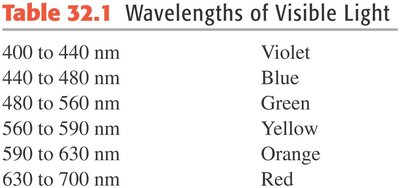
Summary Table: Wavelengths of Visible Light
Wavelength (nm) | Color |
|---|---|
400–440 | Violet |
440–480 | Blue |
480–560 | Green |
560–590 | Yellow |
590–630 | Orange |
630–700 | Red |
Additional info: This summary covers the core concepts of electromagnetic waves, geometric optics, and wave phenomena, including mathematical descriptions, physical principles, and practical applications relevant to a college-level Physics with Calculus course.
