 뒤로
Fluid Dynamics and Oscillatory Motion: Study Notes for Physics with Calculus
스터디 가이드 - 스마트 노트
 자료에 맞춘 맞춤형 노트, 핵심 정의, 예시, 맥락을 확장해 제공합니다.
Section 13.4: Fluids in Motion
The Continuity Equation
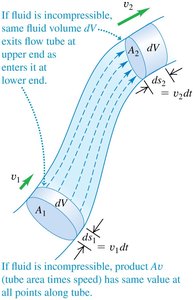
The continuity equation describes the conservation of mass in fluid flow, particularly for incompressible fluids. It states that the volume flow rate remains constant along a flow tube, even if the cross-sectional area changes.
Volume Flow Rate (Q): The rate at which fluid volume passes through a cross-section, given by where A is the area and v is the fluid speed.
Continuity Equation: For an incompressible fluid, .
Application: If the diameter of a pipe decreases, the fluid speed increases to maintain the same flow rate.
Example: Water flowing through a pipe with changing diameter; if the diameter decreases to 86% of its original value, the speed increases accordingly.
Section 13.5: Fluid Dynamics
Bernoulli’s Equation
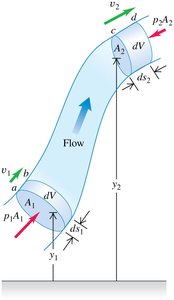
Bernoulli’s equation relates the pressure, velocity, and height at different points in a flowing fluid. It is derived from the conservation of energy principle for fluids and is valid for ideal, incompressible, non-viscous flows.
Bernoulli’s Equation:
Terms: is pressure, is fluid density, is velocity, is gravitational acceleration, is height.
Physical Meaning: The sum of pressure energy, kinetic energy per unit volume, and potential energy per unit volume is constant along a streamline.
Applications: Used to solve problems involving pressure changes, speed, and height in fluid systems (e.g., pipes, valves).
Chapter 14: Oscillations
Section 14.1: Equilibrium and Oscillation
Oscillatory motion occurs when a system is displaced from equilibrium and experiences a restoring force. The interplay between this force and inertia leads to periodic motion.
Restoring Force: A force that acts to return the system to equilibrium.
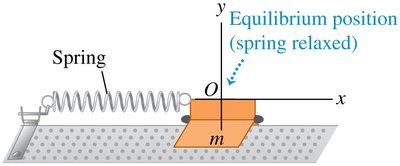
Equilibrium Position: The position where the net force is zero and the system is at rest.
Example: A mass attached to a spring oscillates when displaced from equilibrium.
What Causes Periodic Motion?
Periodic motion is caused by the restoring force acting on a displaced object. When the object is at equilibrium, the force is zero; when displaced, the force acts to return it to equilibrium.
Hooke’s Law: where is the spring constant and is displacement.
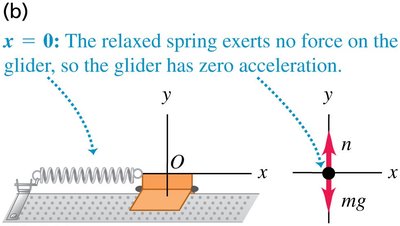
Equilibrium: At , .
Restoring Force and Hooke’s Law
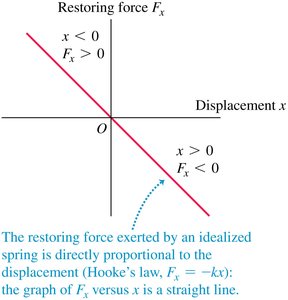
The restoring force in a spring is directly proportional to the displacement from equilibrium, as described by Hooke’s law.
Graph: The force vs. displacement graph is a straight line with negative slope.
Equation:
Simple Harmonic Motion (SHM)
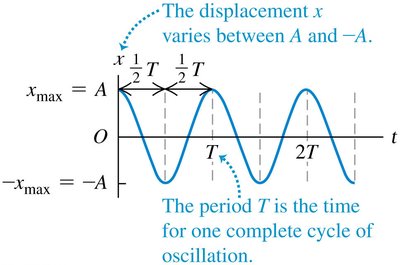
SHM occurs when the restoring force is proportional to displacement. The motion is sinusoidal and characterized by amplitude, frequency, and period.
Displacement Equation:
Amplitude (A): Maximum displacement from equilibrium.
Angular Frequency ():
Period (T):
Characteristics of Periodic Motion
Periodic motion is defined by its amplitude, frequency, period, and angular frequency.
Frequency (f): Number of cycles per unit time,
Period (T): Time for one cycle,
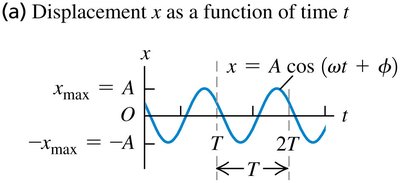
Displacement:
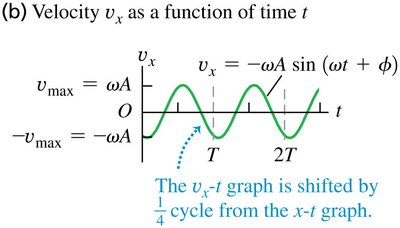
Velocity:
Acceleration:
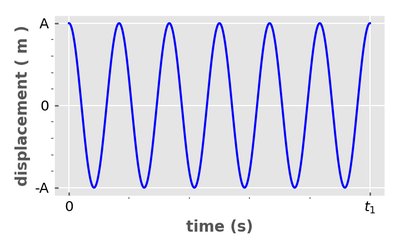
Time-Displacement Graphs and Frequency
The frequency of oscillation can be determined from the time-displacement graph by counting the number of cycles in a given time interval.
Frequency Calculation:
Energy in Simple Harmonic Motion
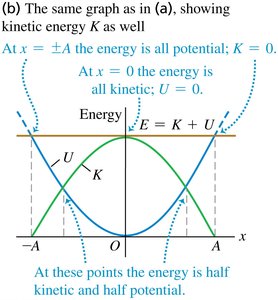
In SHM, mechanical energy is conserved and alternates between kinetic and potential forms.
Elastic Potential Energy:
Kinetic Energy:
Total Mechanical Energy:
Energy Distribution: At maximum displacement, all energy is potential; at equilibrium, all energy is kinetic.
Section 14.5: Pendulum Motion
Simple Pendulum
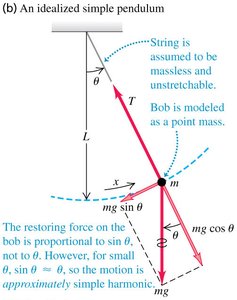
A simple pendulum consists of a point mass suspended by a massless string. For small amplitudes, its motion is approximately simple harmonic.
Period:
Frequency:
Angular Frequency:
Restoring Force: for small
Physical Pendulum
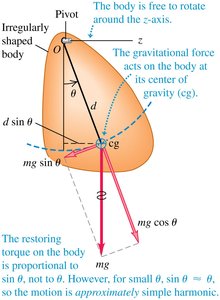
A physical pendulum is any real pendulum with mass distributed over its volume. For small amplitudes, its motion is also simple harmonic.
Period: where is the moment of inertia and is the distance from the pivot to the center of mass.
Restoring Torque: for small
Additional info: These notes cover the main concepts, equations, and applications for fluid dynamics and oscillatory motion, including the continuity equation, Bernoulli’s equation, simple harmonic motion, and pendulum motion. All images included directly reinforce the explanations and equations provided.
