 뒤로
뒤로Force and Newton's Laws: Applications and Problem Solving
스터디 가이드 - 스마트 노트
 자료에 맞춘 맞춤형 노트, 핵심 정의, 예시, 맥락을 확장해 제공합니다.
Force and Newton's Laws of Motion
Introduction to Forces
Forces are fundamental to understanding motion in physics. A force is a push or pull that can cause an object to accelerate, change direction, or deform. Newton's Laws of Motion provide the framework for analyzing forces and predicting the resulting motion.
Definition: A force is any interaction that, when unopposed, will change the motion of an object.
Units: The SI unit of force is the Newton (N).
Types of Forces: Common forces include gravity, friction, normal force, tension, and applied forces.
Example: In a tug-of-war, each team applies a force to the rope, and the net force determines the motion of the rope.

Free-Body Diagrams (FBD)
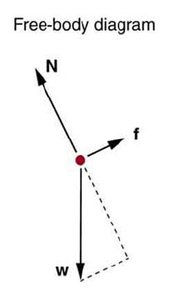
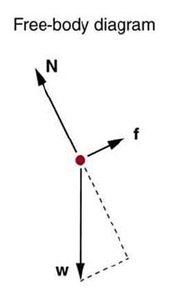
Free-body diagrams are essential tools for visualizing and analyzing the forces acting on a single object. They help break down complex problems into manageable parts by representing all forces as vectors.
Key Elements: Each force is represented by an arrow pointing in the direction of the force.
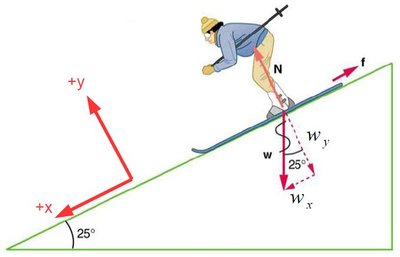
Application: For a skier on a slope, the FBD includes gravity, normal force, and friction.
Coordinate Axes: Axes are often chosen to align with the incline for easier calculations.
Applying Newton's Second Law
Newton's Second Law in Two Dimensions
Newton's Second Law states that the net force on an object is equal to the mass of the object multiplied by its acceleration. In problems involving inclined planes, forces are often resolved into components parallel and perpendicular to the surface.
Equation:
Component Form: ,
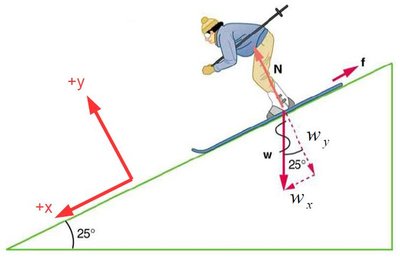
Example: For a skier, the x-direction is along the slope, and the y-direction is perpendicular to the slope.
Identifying Zero Acceleration Components
In many inclined plane problems, the acceleration perpendicular to the surface (y-direction) is zero because the object does not move away from the surface. This allows us to solve for the normal force.
Key Point: implies
Application: The normal force balances the perpendicular component of gravity.
Calculating Net Forces
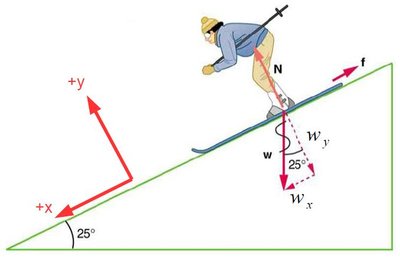
To solve for acceleration and other quantities, it is necessary to calculate the net force in each direction. The net force in the y-direction determines the normal force, while the net force in the x-direction determines the acceleration down the slope.
Y-direction:
X-direction:
Friction:
Resolving Forces on an Inclined Plane
Force Components Using Trigonometry
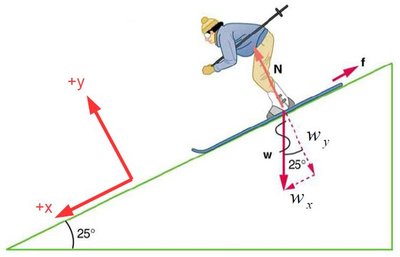
For an object on an inclined plane, the weight (gravity) is resolved into two components: one parallel to the slope () and one perpendicular (). Trigonometric relationships are used to find these components.
Parallel Component:
Perpendicular Component:
Where: is the weight, is the angle of the slope.
Summary of Equations for the Skier Problem
Combining the above results, we obtain two key equations for the skier's motion:
Normal Force:
Acceleration Down the Slope:
Substitution:
Hooke's Law and Spring Forces
Hooke's Law
Hooke's Law describes the relationship between the force exerted by a spring and its displacement from equilibrium. The force is proportional to the displacement, with the spring constant as the proportionality factor.
Equation:
Where: is the force, is the spring constant, is the displacement.
Example: For a spring with , .
Application: Used in problems involving elastic forces and oscillations.
Spring Constant (k) | Force Equation |
|---|---|
100 | |
500 |
Summary Table: Forces on an Inclined Plane
This table summarizes the key forces and equations for an object on an inclined plane:
Force | Equation | Description |
|---|---|---|
Weight | Total gravitational force | |
Parallel Component | Causes motion down the slope | |
Perpendicular Component | Balanced by normal force | |
Normal Force | Force from the surface | |
Kinetic Friction | Opposes motion | |
Net Force (x) | Determines acceleration | |
Acceleration | Rate of change of velocity |
Additional info: These notes expand on the lecture slides by providing full academic context, definitions, and step-by-step explanations for solving inclined plane and spring force problems using Newton's Laws and Hooke's Law.
