 뒤로
Gauss’s Law and Electric Flux: Concepts, Applications, and Symmetry
스터디 가이드 - 스마트 노트
 자료에 맞춘 맞춤형 노트, 핵심 정의, 예시, 맥락을 확장해 제공합니다.
Gauss’s Law and Electric Flux
Electric Flux
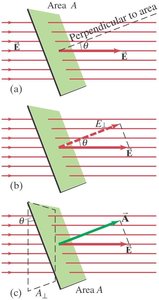
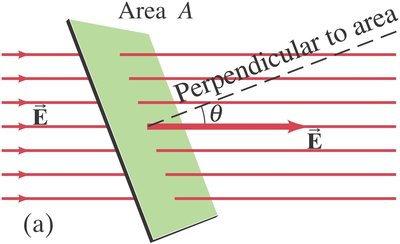
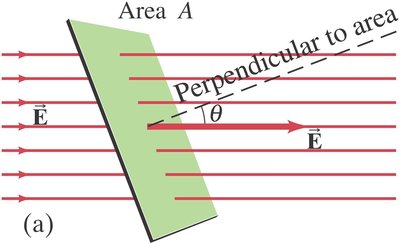
Electric flux is a measure of the number of electric field lines passing through a given surface. It quantifies the interaction between the electric field and the surface area, and is fundamental to understanding Gauss’s law.
Definition: Electric flux (\( \Phi_E \)) through a surface is proportional to the total number of electric field lines crossing the area.
Formula for Uniform Field: For a uniform electric field \( \vec{E} \) and a flat surface of area \( A \) at an angle \( \theta \) to the field:
Unit: The SI unit of electric flux is \( \text{N} \cdot \text{m}^2 / \text{C} $.
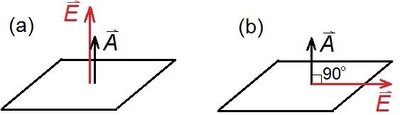
Maximum Flux: When \( \theta = 0^\circ \), \( \Phi_E = E A $ (field perpendicular to surface).
Minimum Flux: When \( \theta = 90^\circ \), \( \Phi_E = 0 $ (field parallel to surface).
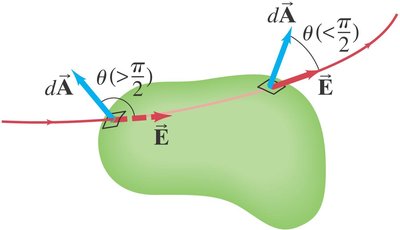
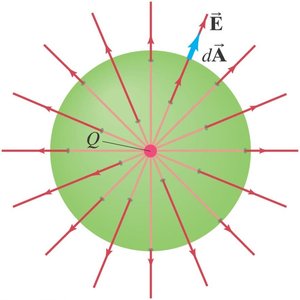
General Case: For non-uniform fields or curved surfaces:
Example: Calculate the electric flux through a rectangle (10 cm × 20 cm) in a uniform field of 200 N/C at 30°:
Gauss’s Law
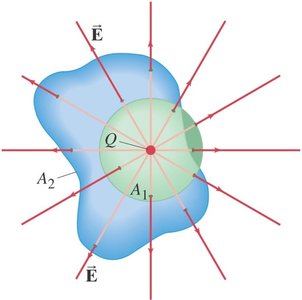
Gauss’s law relates the net electric flux through a closed surface to the charge enclosed by that surface. It is a fundamental law in electromagnetism and is especially useful for calculating electric fields in symmetric situations.
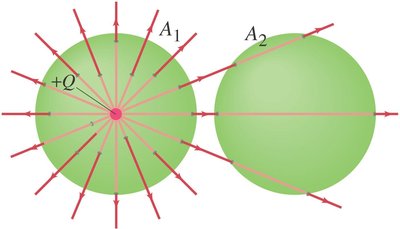
Statement: The net electric flux through any closed surface is proportional to the total charge enclosed:
\( \varepsilon_0 \): Permittivity of free space, \( \varepsilon_0 = 8.85 \times 10^{-12}\ \text{C}^2/\text{N} \cdot \text{m}^2 $
Applicability: Valid for any closed surface, regardless of shape.
Superposition Principle: For multiple point charges inside the surface:
Charges Outside: Charges outside the surface do not contribute to the net flux.
Applications of Gauss’s Law
Gauss’s law is most useful in situations with high symmetry, such as spherical, cylindrical, or planar symmetry. It allows for straightforward calculation of electric fields.
Spherical Conductor
Outside the Shell: (same as a point charge)
Inside the Shell: (no field inside a conducting shell)
Solid Sphere: Same results as above; charge resides on the surface.
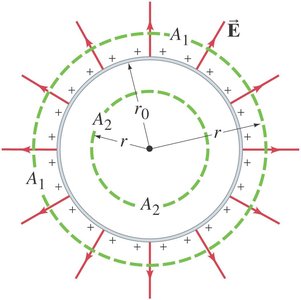
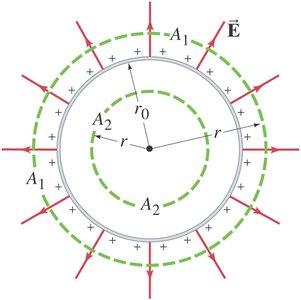
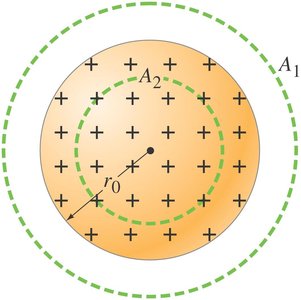
Solid Sphere of Charge (Nonconducting)
Outside the Sphere (r > r0):
Inside the Sphere (r < r0): (field increases linearly with r)
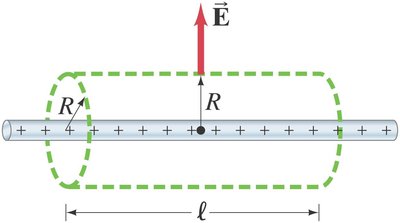
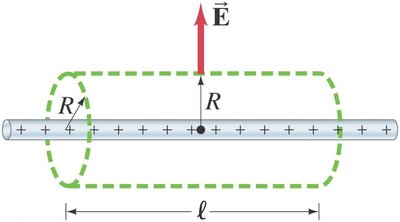
Long Uniform Line of Charge
Charge per unit length:
Field outside the wire: (R = radial distance from wire)
Gaussian Surface: Cylinder concentric with wire.
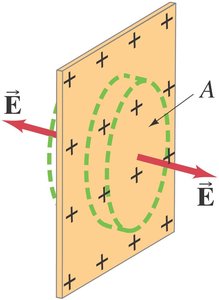
Infinite Plane of Charge
Surface charge density:
Field near the plane: (nonconducting plane)
Conducting Plane: (field just outside surface)
Difference: Conducting plane has charge density \( \sigma \) on each side, doubling the field compared to a nonconducting plane.
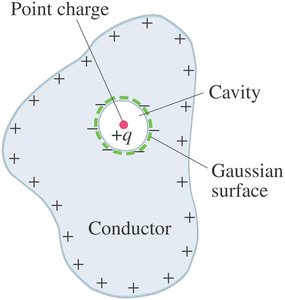
Conductor with Charge Inside a Cavity
Inner Surface: Induced charge equal and opposite to the charge inside the cavity.
Outer Surface: Remaining charge resides on the outer surface.
Procedure for Solving Gauss’s Law Problems
Identify the symmetry and choose a Gaussian surface accordingly.
Draw the surface.
Use symmetry to determine the direction of \( \vec{E} \).
Evaluate the flux by integrating.
Calculate the enclosed charge.
Solve for the electric field.
Experimental Basis of Gauss’s and Coulomb’s Laws
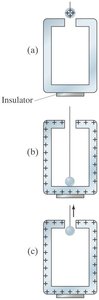
Experiments confirm that charge resides on the surface of conductors and that Gauss’s law accurately predicts the behavior of electric fields and flux.
Summary of Key Equations
Electric Flux:
Gauss’s Law:
