 뒤로
Gauss’s Law and Electric Flux: Study Notes for Physics with Calculus
스터디 가이드 - 스마트 노트
 자료에 맞춘 맞춤형 노트, 핵심 정의, 예시, 맥락을 확장해 제공합니다.
Gauss’s Law and Electric Flux
Introduction to Gauss’s Law
Gauss’s law is a fundamental principle in electromagnetism that relates the electric flux passing through a closed surface to the net electric charge enclosed within that surface. It is especially useful for calculating electric fields in situations with high symmetry.
Electric flux is a measure of the number of electric field lines passing through a surface.
Gauss’s law provides a powerful alternative to Coulomb’s law for finding electric fields, particularly when symmetry simplifies the mathematics.
Symmetry properties are crucial for applying Gauss’s law effectively.

Concept of Electric Flux
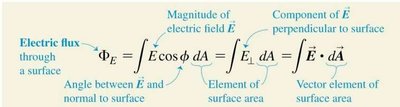
Electric flux quantifies the flow of the electric field through a given area. It depends on the strength of the electric field, the size of the area, and the orientation of the area relative to the field.
Definition: The electric flux through a surface is given by the surface integral of the electric field over that surface.
Formula:
The SI unit for electric flux is newton-meter squared per coulomb (N·m2/C).
Calculating Electric Flux
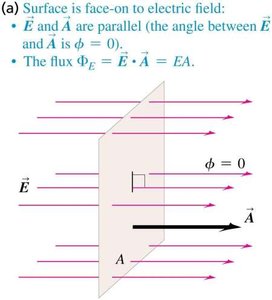
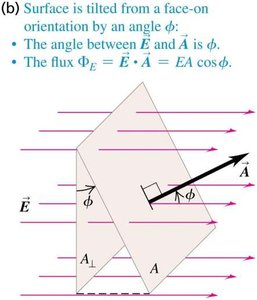
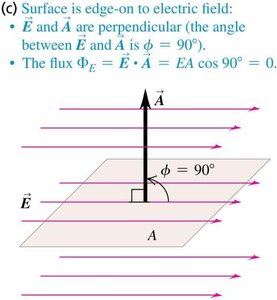
The calculation of electric flux depends on the orientation of the surface relative to the electric field:
If the surface is perpendicular to the field, all field lines pass through, maximizing flux.
If the surface is tilted, only the component of the area perpendicular to the field contributes to the flux.
If the surface is parallel (edge-on) to the field, the flux is zero.
Gauss’s Law Statement
Gauss’s law relates the net electric flux through a closed surface to the net charge enclosed by that surface:
Mathematical form:
Where is the total charge enclosed and is the permittivity of free space ( C2/N·m2).
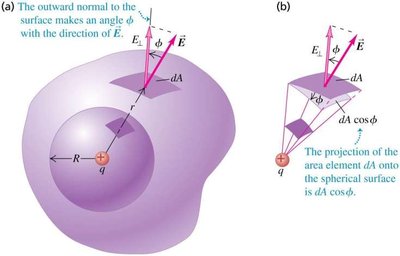
Gauss’s law is valid for any closed surface, regardless of shape.
Physical Interpretation of Gauss’s Law
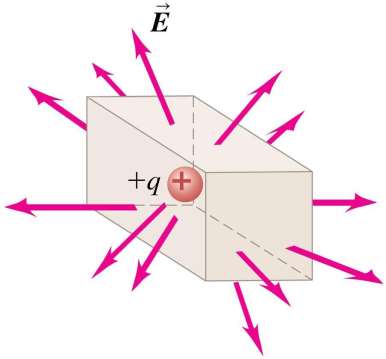
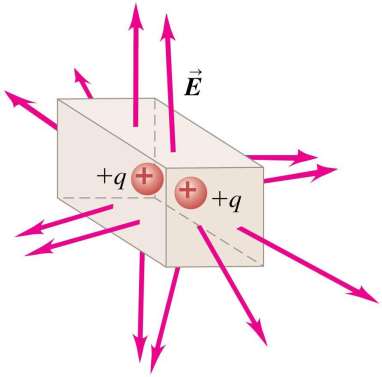
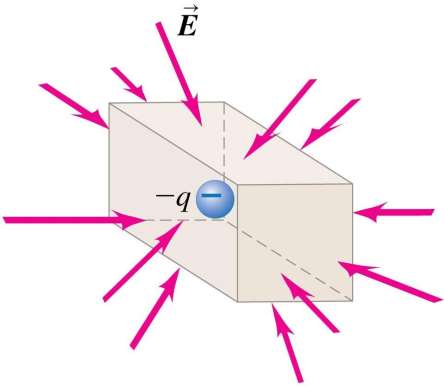
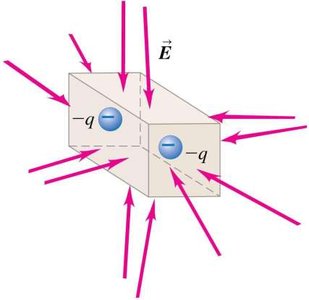
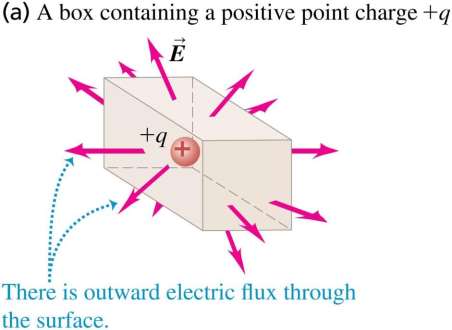
Gauss’s law can be visualized by considering the electric field lines entering and leaving a closed surface:
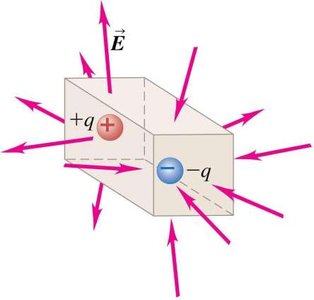
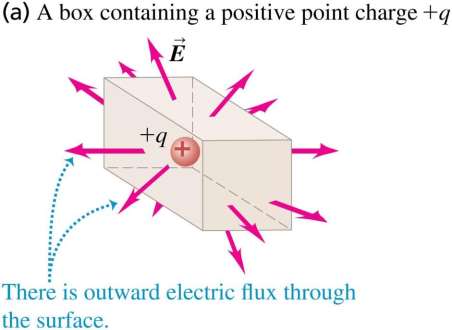
Positive charges produce outward electric flux; negative charges produce inward flux.
If the net charge inside the surface is zero, the net electric flux is also zero.
Cases of Zero Net Charge
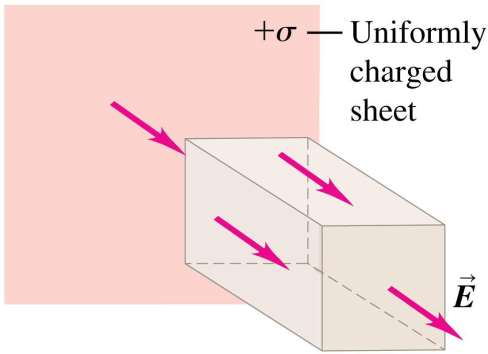
When there is no net charge inside a closed surface, the net electric flux through the surface is zero, even if there is an electric field present due to charges outside the surface.
If the box is empty and the electric field is zero everywhere, the flux is zero.
If the box contains equal positive and negative charges, the net flux is zero.
If the box encloses no charge but is in an external field, the net flux is still zero.
Dependence of Electric Flux
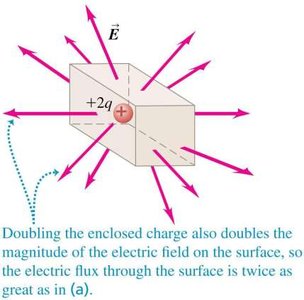
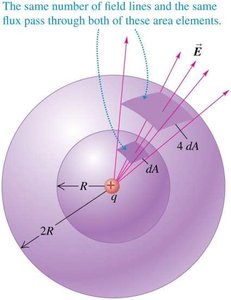
The net electric flux through a closed surface depends only on the net charge enclosed, not on the size or shape of the surface.
Doubling the enclosed charge doubles the electric flux.
The flux is independent of the surface’s size or geometry.
Gaussian Surfaces
A Gaussian surface is an imaginary closed surface chosen to exploit symmetry and simplify the calculation of electric fields using Gauss’s law.
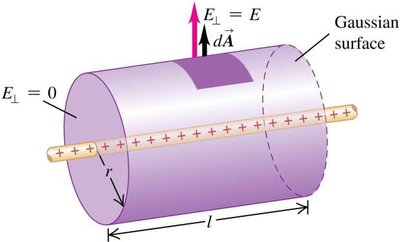
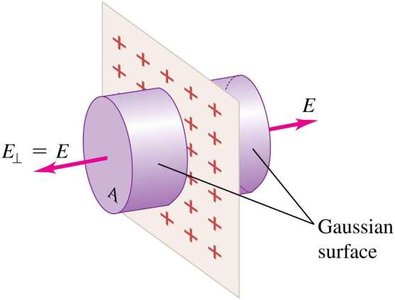
Common Gaussian surfaces: spheres (for point charges), cylinders (for line charges), and planes (for sheet charges).
The choice of surface depends on the symmetry of the charge distribution.
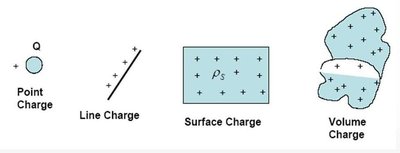
Charge Density
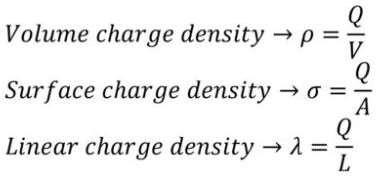
Charge density describes how charge is distributed in space and is used to express the total charge enclosed by a Gaussian surface.
Volume charge density:
Surface charge density:
Linear charge density:
Applications of Gauss’s Law
Gauss’s law is especially useful for calculating electric fields in cases with high symmetry:
Field of a point charge: The electric field at a distance r from a point charge q is:
Field of a uniformly charged line: For an infinite line with linear charge density :
Field of an infinite plane sheet: For a sheet with surface charge density :
Conductors and Gauss’s Law
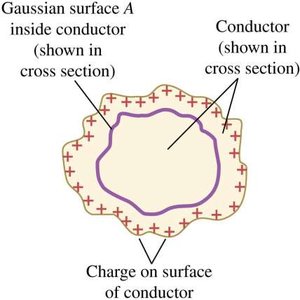
Gauss’s law explains several important properties of conductors in electrostatic equilibrium:
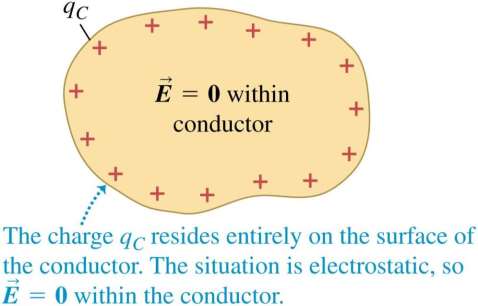
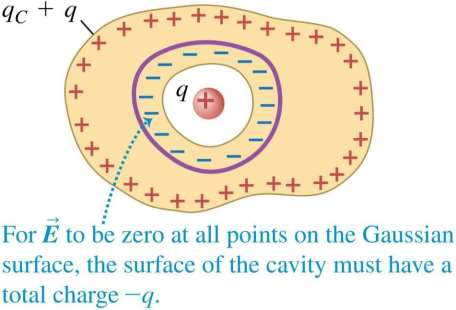
The electric field inside a conductor is zero.
Any excess charge resides entirely on the surface of the conductor.
The electric field just outside a charged conductor is perpendicular to the surface and proportional to the surface charge density.
Electrostatic Shielding and Faraday Cages
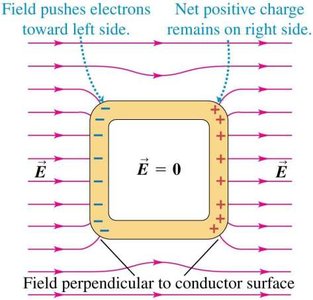
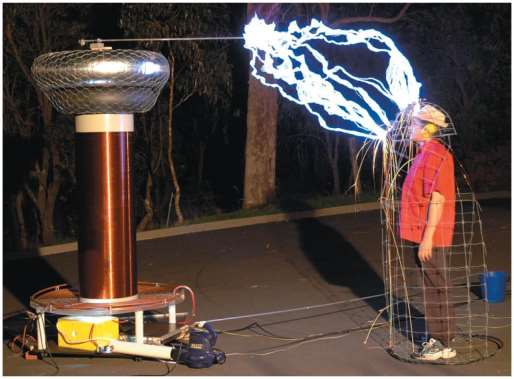
Electrostatic shielding is the phenomenon where a conducting enclosure blocks external static electric fields. This is the principle behind a Faraday cage.
When an object is placed inside a conducting shell, the electric field inside is zero.
Faraday cages are used to protect sensitive equipment and people from external electric fields.
Worked Example: Electric Flux Through a Tilted Disk
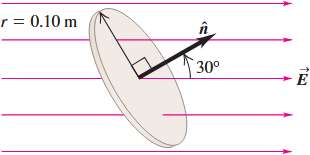
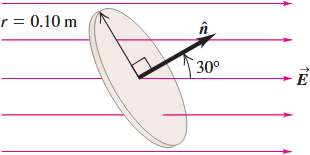
Consider a disk of radius 0.10 m in a uniform electric field of N/C, with the disk’s normal making a 30° angle with the field.
Area of disk: m2
Electric flux: N·m2/C
Summary Table: Types of Charge Distributions
Type | Symbol | Formula | Units |
|---|---|---|---|
Volume charge density | \( \rho \) | C/m3 | |
Surface charge density | \( \sigma \) | C/m2 | |
Linear charge density | \( \lambda \) | C/m |
Key Takeaways
Gauss’s law is a powerful tool for relating electric fields and charge distributions, especially in symmetric situations.
Electric flux is a measure of the field passing through a surface and is central to applying Gauss’s law.
Conductors in electrostatic equilibrium have zero internal field and all excess charge on their surfaces.
Faraday cages provide electrostatic shielding by redistributing charges on their surfaces to cancel internal fields.
