 뒤로
Graphing Position and Velocity: The Velocity-Position Relationship
스터디 가이드 - 스마트 노트
 자료에 맞춘 맞춤형 노트, 핵심 정의, 예시, 맥락을 확장해 제공합니다.
Motion Along a Straight Line
Position, Displacement, and Average Velocity
Understanding motion along a straight line begins with the concepts of position, displacement, and velocity. The position of an object is its location along a coordinate axis at a given time. Displacement is the change in position over a time interval, and average velocity is defined as the displacement divided by the elapsed time.
Displacement:
Average Velocity:
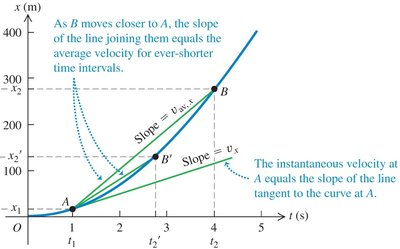
On a position vs. time graph, the average velocity over an interval is the slope of the straight line connecting the initial and final points.
Instantaneous Velocity and Calculus Connection
The instantaneous velocity at a specific time is the rate of change of position as the time interval approaches zero. In calculus terms, it is the derivative of position with respect to time:
Instantaneous Velocity:
Graphically, the instantaneous velocity at a point is the slope of the tangent to the position vs. time curve at that point.
Interpreting Position vs. Time Graphs
Qualitative Analysis of Motion
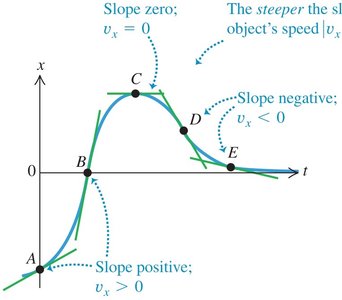
By examining the slope of a position vs. time graph, we can infer the velocity and motion characteristics of an object:
Positive Slope: Object moves in the positive direction ().
Negative Slope: Object moves in the negative direction ().
Zero Slope: Object is momentarily at rest ().
Steepness: The steeper the slope, the greater the speed (magnitude of velocity).
Velocity vs. Time Sketches
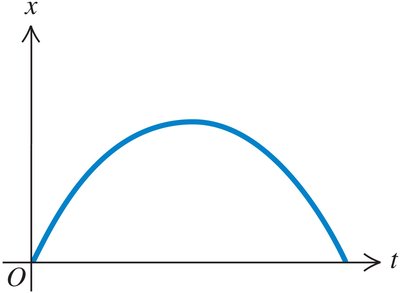
Given a position vs. time graph, a velocity vs. time graph can be constructed by plotting the slope (velocity) at each instant. For example, at points where the position graph is flat, velocity is zero; where the graph is steepest, velocity is at a maximum (positive or negative).
Examples and Applications
Example: If the position graph is a straight line with positive slope, velocity is constant and positive.
Example: If the position graph is a parabola opening downward, velocity decreases, becomes zero at the vertex, then becomes negative.
Velocity-Position Relationship: Summary and Calculus
Key Relationships
At all times , velocity is the slope of the vs. graph.
Over any interval , displacement is the net area under the vs. graph.
To find position , you need the initial position and the displacement: .
Calculus Formulation:
Velocity as derivative:
Displacement as integral:
Review and Conceptual Questions
Analyzing Position vs. Time Graphs
Consider the following conceptual questions based on position vs. time graphs:
Direction Reversal: The object reverses direction where the slope changes sign (e.g., from positive to negative).
Returning to Starting Position: The object returns to its starting position when equals its initial value.
Object at Rest: The object is at rest where the slope is zero (horizontal tangent).
Speed Changes: The speed increases or decreases depending on the steepness of the slope.
Comparing Multiple Objects
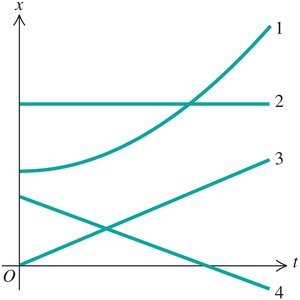
When analyzing multiple objects on the same position vs. time graph:
The object with the steepest slope at any instant has the greatest speed.
Objects are at rest where their graph is flat (horizontal).
Objects reverse direction where their graph changes from increasing to decreasing or vice versa.
Objects have the same velocity where their slopes are equal at the same time.
Summary Table: Position, Velocity, and Graphical Interpretation
Graph Feature | Physical Meaning | Velocity |
|---|---|---|
Positive Slope | Moving in +x direction | Positive |
Negative Slope | Moving in -x direction | Negative |
Zero Slope | At rest | Zero |
Steep Slope | High speed | Large magnitude |
Key Equations
Average velocity:
Instantaneous velocity:
Displacement from velocity:
Additional info: These notes cover the core calculus-based relationships between position, velocity, and their graphical interpretations, as required for introductory college physics with calculus. The included images directly illustrate the mathematical and conceptual connections between position, velocity, and their graphical representations.
