 뒤로
Introduction to Physics: Fundamental Concepts, Measurement, and Problem Solving
스터디 가이드 - 스마트 노트
 자료에 맞춘 맞춤형 노트, 핵심 정의, 예시, 맥락을 확장해 제공합니다.
Introduction to Physics
What is Physics?
Physics is the study of the fundamental laws of nature, describing how the universe behaves. These laws are often expressed in the form of mathematical equations, allowing for precise predictions and explanations of physical phenomena.
Kinematics: The study of the laws that describe motion.
Mechanics: The study of motion and its causes.
Dynamics: The study of the causes of motion.
Fundamental Physical Quantities and SI Units
Physics relies on three fundamental physical quantities in mechanics: mass, length, and time. Each has a specific dimension and SI unit:
Quantity | Dimension | SI Unit | Abbreviation |
|---|---|---|---|
Length | [L] | Meter | m |
Mass | [M] | Kilogram | kg |
Time | [T] | Second | s |
Common Prefixes in Physics
Standard prefixes are used to designate common multiples in powers of ten, making it easier to express very large or very small quantities.

Mass vs. Weight
Mass: The amount of matter comprising an object. It is an intrinsic property and does not change with location.
Weight: The force of gravity acting on an object. It depends on both the mass of the object and the gravitational field strength.
Dimensional Analysis
Dimensions and Dimensional Consistency
Each physical quantity has a dimension, denoted by square brackets (e.g., [L] for length). Dimensional analysis ensures that equations are physically meaningful by requiring that all terms in an equation have the same dimensions.
Example: Distance measured in kilometers has the dimension [L].
Example: Time measured in minutes has the dimension [T].
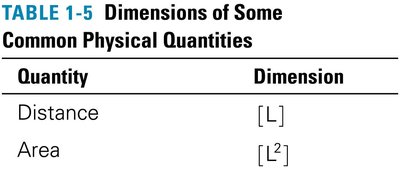
Dimensions of Common Physical Quantities
Quantity | Dimension |
|---|---|
Distance | [L] |
Area | [L^2] |
Volume | [L^3] |
Velocity | [L]/[T] |
Acceleration | [L]/[T^2] |
Energy | [M][L^2]/[T^2] |
Checking Dimensional Consistency
Example 1:
Dimensions: [L] = [L] + [L] (since and both have dimensions of length)
Conclusion: The equation is dimensionally consistent.
Example 2:
Dimensions:
Conclusion: The equation is dimensionally consistent.
Significant Figures and Scientific Notation
Uncertainty and Significant Figures
All measurements have an associated uncertainty, which indicates the accuracy of the measurement. The number of significant figures in a value reflects this uncertainty.
Percentage Uncertainty:
Example: cm has a percentage uncertainty of .
Rules for Significant Figures
Multiplication/Division: The result should have as many significant figures as the least accurately known quantity.
Addition/Subtraction: The result should have as many decimal places as the term with the fewest decimal places.
Scientific Notation
Scientific notation is used to clearly indicate the number of significant figures and to simplify the representation of very large or small numbers.
Example: (4 significant figures)
Example: (3 significant figures)
Example: (2 significant figures) or (4 significant figures)
Unit Conversion
Using Conversion Factors
To convert between units, multiply by the appropriate conversion factor so that unwanted units cancel and desired units remain.
Example:
Example:
Example:
Order of Magnitude Calculations
Estimating Physical Quantities
Order of magnitude calculations provide rough estimates, accurate within a factor of about 10. These are useful for checking the plausibility of answers and for quick approximations.
Example: Estimating the number of heartbeats in a lifetime or the number of grains of sand on a beach.
Scalars and Vectors
Definitions and Examples
Physical quantities can be classified as scalars or vectors:
Scalar: A quantity described by a magnitude (number and units) only. Examples: distance, speed, temperature.
Vector: A quantity described by both magnitude and direction. Examples: displacement, velocity, acceleration.
Vectors in One Dimension
In one-dimensional motion, vectors have only two possible directions (e.g., left/right or up/down), typically represented by positive and negative signs.
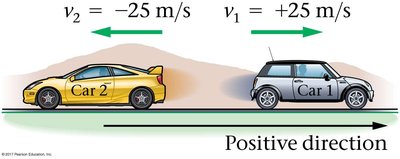
Example: Two cars moving in opposite directions at the same speed. Assigning right as positive and left as negative:
Car 1: (right)
Car 2: (left)
The speed is the magnitude of velocity, always a positive value.
Physics Problem Solving
Approach to Solving Problems
Effective problem solving in physics involves understanding the problem, identifying known and unknown quantities, applying relevant principles and equations, and checking the final answer for reasonableness (including order of magnitude estimates).
Read the problem carefully and identify what is being asked.
List known and unknown quantities, including units.
Choose appropriate equations and principles.
Solve algebraically before substituting numbers.
Check units and significant figures in the final answer.
Compare with an order of magnitude estimate if possible.
