 뒤로
Kinematics in One Dimension: Structured Study Notes
스터디 가이드 - 스마트 노트
 자료에 맞춘 맞춤형 노트, 핵심 정의, 예시, 맥락을 확장해 제공합니다.
Describing Motion: Kinematics in One Dimension
Reference Frames and Displacement
Understanding motion requires specifying a reference frame, which is the perspective from which measurements of position, distance, and speed are made. The choice of reference frame affects how motion is described.
Reference Frame: The coordinate system or viewpoint used to measure motion. For example, a person walking inside a moving train has a different speed relative to the train than to the ground.
Displacement: The straight-line distance from the starting point to the ending point, including direction. It is a vector quantity.
Distance: The total length of the path traveled, regardless of direction. It is a scalar quantity.
Sign of Displacement: Displacement is positive when moving to the left (in a chosen coordinate system), and negative when moving to the right.
Example: If a person walks 5 meters east and then 3 meters west, their displacement is 2 meters east, but their distance traveled is 8 meters.
Average Velocity
Average velocity is the displacement divided by the time interval. Unlike speed, velocity includes direction.
Speed: How far an object travels in a given time interval (scalar).
Velocity: Displacement per unit time, including direction (vector).
Formula:
Example: If a car moves 100 meters north in 20 seconds, its average velocity is north.
Instantaneous Velocity
Instantaneous velocity is the velocity at a specific moment, defined as the limit of average velocity as the time interval approaches zero.
Formula:
Graphical Representation: The slope of the position vs. time ( vs. ) curve at a point gives the instantaneous velocity.
Example: For an object moving with constant velocity, the vs. graph is a straight line.
Acceleration
Acceleration is the rate of change of velocity with respect to time. It is a vector quantity, but in one-dimensional motion, only the sign is needed to indicate direction.
Formula:
Instantaneous Acceleration:
Positive Acceleration: Velocity increases in the positive direction.
Negative Acceleration: Velocity increases in the negative direction.
Deceleration: Acceleration is opposite to the direction of velocity.
Example: A car slowing down while moving forward experiences deceleration.
Motion at Constant Acceleration
When acceleration is constant, several key equations describe the motion of an object. These equations relate position, velocity, acceleration, and time.
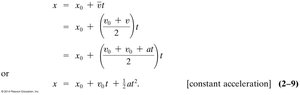
Average Velocity:
Position as a function of time:
Equations:
Example: If an object starts from rest () and accelerates at for $3x = \frac{1}{2} \times 2 \times 3^2 = 9\ \text{m}$.
Solving Kinematics Problems
Solving physics problems involves a systematic approach to ensure accuracy and understanding.
Read the problem carefully and identify the objects and time intervals involved.
Draw a diagram and choose coordinate axes.
List known and unknown quantities.
Determine which physics principles and equations apply.
Solve algebraically, check units and significant figures, and assess if the result is reasonable.
Example: For a ball thrown upward, use and to find its position and velocity at any time.
Freely Falling Objects
Objects near Earth's surface experience a constant acceleration due to gravity, denoted as .
Acceleration due to gravity: downward.
All objects fall with the same acceleration in the absence of air resistance.
Example: A dropped object accelerates downward at .
Graphical Analysis of Linear Motion
Graphs are useful tools for analyzing motion. The slope of a position vs. time graph gives velocity, and the slope of a velocity vs. time graph gives acceleration.
x vs. t graph: Slope represents velocity.
v vs. t graph: Slope represents acceleration.
Example: For constant velocity, the vs. graph is a straight line; for constant acceleration, the vs. graph is a straight line.
Summary of Key Concepts
Kinematics: The study of motion without considering its causes.
Displacement: Change in position.
Average speed: Distance divided by time.
Average velocity: Displacement divided by time.
Instantaneous velocity: Velocity at a specific instant.
Acceleration: Rate of change of velocity.
