 뒤로
뒤로Kinematics in Two and Three Dimensions: Vectors and Projectile Motion
스터디 가이드 - 스마트 노트
 자료에 맞춘 맞춤형 노트, 핵심 정의, 예시, 맥락을 확장해 제공합니다.
Chapter 03: Kinematics in 2D & 3D – Vectors and Projectile Motion
Vector Position and Displacement
In two and three dimensions, the position of an object is described by a position vector \( \vec{r} \), which points from the origin to the object's location. The displacement vector \( \Delta \vec{r} \) represents the change in position over a time interval.
Magnitude: The length of the vector, calculated using the Pythagorean theorem in 2D or 3D.
Angle with x-axis: The direction of the vector, often given by \( \theta = \tan^{-1}(y/x) \) in 2D.
Example: If a rabbit moves from (2 m, 3 m) to (5 m, 7 m), the displacement is \( \Delta \vec{r} = (5-2)\hat{i} + (7-3)\hat{j} = 3\hat{i} + 4\hat{j} \) meters.
Average and Instantaneous Velocity
Velocity is a vector quantity describing the rate of change of position. In 2D and 3D, velocity has both magnitude and direction.
Average velocity: \( \vec{v}_{avg} = \frac{\Delta \vec{r}}{\Delta t} \)
Instantaneous velocity: \( \vec{v} = \lim_{\Delta t \to 0} \frac{\Delta \vec{r}}{\Delta t} = \frac{d\vec{r}}{dt} \)
Direction: The instantaneous velocity vector is always tangent to the object's trajectory.
Example: For a rabbit with position \( \vec{r}(t) = x(t)\hat{i} + y(t)\hat{j} \), the velocity at \( t = 15 \) s is \( \vec{v}(15) = \frac{dx}{dt}\bigg|_{t=15}\hat{i} + \frac{dy}{dt}\bigg|_{t=15}\hat{j} \).
Average and Instantaneous Acceleration
Acceleration is the rate of change of velocity. Like velocity, it is a vector and can be described as average or instantaneous.
Average acceleration: \( \vec{a}_{avg} = \frac{\Delta \vec{v}}{\Delta t} \)
Instantaneous acceleration: \( \vec{a} = \lim_{\Delta t \to 0} \frac{\Delta \vec{v}}{\Delta t} = \frac{d\vec{v}}{dt} \)
Example: For the rabbit, \( \vec{a}(15) = \frac{d^2x}{dt^2}\bigg|_{t=15}\hat{i} + \frac{d^2y}{dt^2}\bigg|_{t=15}\hat{j} \).
Summary: 1D vs. 2D/3D Motion
1D motion: All vectors reduce to scalars; direction is indicated by sign (+/-).
2D/3D motion: Vectors must be resolved into components; direction is crucial and described by angles or unit vectors.
Projectile Motion
Projectile motion is a special case of 2D motion where an object moves under the influence of gravity alone, after an initial launch. The path (trajectory) is typically a parabola.
Horizontal motion: Constant velocity (no horizontal acceleration if air resistance is neglected).
Vertical motion: Constant acceleration due to gravity (\( g = 9.8 \ \mathrm{m/s^2} \) downward).
Equations of motion:
Maximum height: The highest point in the trajectory, where \( v_y = 0 \).
Range (R): The horizontal distance traveled when the projectile returns to its original vertical position.
Angle for maximum range: \( 45^\circ \) (when launch and landing heights are equal).
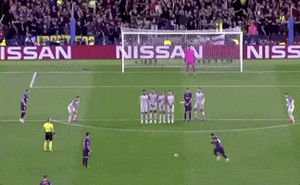
Applications: Sports (kicking a ball), fountains, and launching objects all involve projectile motion.

Analyzing Projectile Motion
To solve projectile motion problems:
Resolve the initial velocity into horizontal and vertical components: \( v_{0x} = v_0 \cos \theta \), \( v_{0y} = v_0 \sin \theta \).
Use kinematic equations for each direction separately.
Combine results to find position, velocity, maximum height, and range.
Example: A ball is launched at 20 m/s at a 30° angle. Find the range and maximum height.
\( v_{0x} = 20 \cos 30^\circ = 17.32 \ \mathrm{m/s} \)
\( v_{0y} = 20 \sin 30^\circ = 10 \ \mathrm{m/s} \)
Time to reach max height: \( t_{up} = \frac{v_{0y}}{g} = \frac{10}{9.8} = 1.02 \ \mathrm{s} \)
Max height: \( h = v_{0y} t_{up} - \frac{1}{2} g t_{up}^2 = 10 \times 1.02 - 0.5 \times 9.8 \times (1.02)^2 = 5.1 \ \mathrm{m} \)
Total time of flight: \( t_{total} = 2 t_{up} = 2.04 \ \mathrm{s} \)
Range: \( R = v_{0x} t_{total} = 17.32 \times 2.04 = 35.3 \ \mathrm{m} \)
Summary Table: Key Quantities in Projectile Motion
Quantity | Symbol | Equation |
|---|---|---|
Horizontal position | \( x(t) \) | |
Vertical position | \( y(t) \) | |
Horizontal velocity | \( v_x \) | |
Vertical velocity | \( v_y \) | |
Maximum height | \( h_{max} \) | |
Range | \( R \) |
Additional info: Projectile motion assumes no air resistance and a constant gravitational field. Real-world deviations (e.g., air drag, wind) can alter the trajectory.
