 뒤로
Kinematics in Two Dimensions: Motion in a Plane, Projectile and Circular Motion
스터디 가이드 - 스마트 노트
 자료에 맞춘 맞춤형 노트, 핵심 정의, 예시, 맥락을 확장해 제공합니다.
Chapter 4: Kinematics in Two Dimensions
Introduction to Two-Dimensional Motion
Two-dimensional kinematics extends the concepts of motion in one dimension to motion in a plane. This includes analyzing the position, velocity, and acceleration of objects moving along curved paths, such as projectiles and objects in circular motion.
Position, Displacement, and Velocity in Two Dimensions
Position and Displacement Vectors
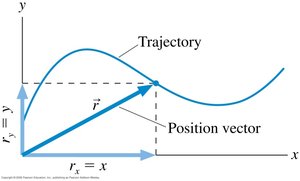
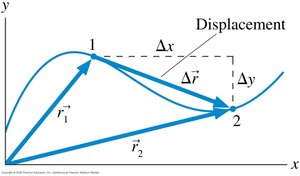
The position vector \( \vec{r} \) locates an object in the plane relative to an origin. The displacement vector \( \Delta \vec{r} \) connects the initial and final positions of the object.
Position vector: \( \vec{r} = x \hat{i} + y \hat{j} \)
Displacement: \( \Delta \vec{r} = \vec{r}_2 - \vec{r}_1 = \Delta x \hat{i} + \Delta y \hat{j} \)
Average and Instantaneous Velocity
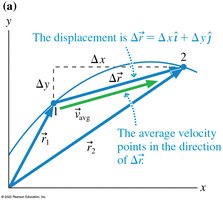
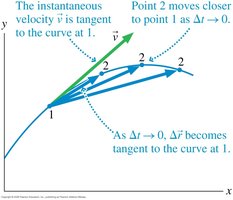
The average velocity is the displacement divided by the time interval. The instantaneous velocity is tangent to the object's path at any point and is found as the derivative of the position vector with respect to time.
Average velocity: \( \vec{v}_{avg} = \frac{\Delta \vec{r}}{\Delta t} \)
Instantaneous velocity: \( \vec{v} = \frac{d\vec{r}}{dt} \)
Kinematics Equations in Two Dimensions
Component Form of Motion
Motion in two dimensions can be analyzed by breaking vectors into x and y components. The kinematic equations for each direction are analogous to those in one dimension, with time as the common variable.
\( x = x_0 + v_{x0} t + \frac{1}{2} a_x t^2 \)
\( y = y_0 + v_{y0} t + \frac{1}{2} a_y t^2 \)
\( v_x = v_{x0} + a_x t \)
\( v_y = v_{y0} + a_y t \)
Key Point: The x- and y-components are treated independently, but share the same time interval \( t \).
Projectile Motion
Definition and Characteristics
A projectile is any object launched into motion and then influenced only by gravity. Its path is a parabola, and its motion can be decomposed into independent horizontal and vertical components.
Horizontal motion: Constant velocity (\( a_x = 0 \))
Vertical motion: Constant acceleration (\( a_y = -g \))
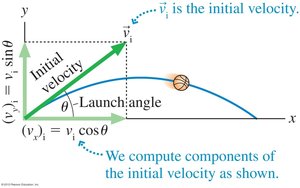
Initial Velocity Components
The initial velocity \( v_i \) at an angle \( \theta \) above the horizontal is resolved into:
\( v_{ix} = v_i \cos \theta \)
\( v_{iy} = v_i \sin \theta \)
Kinematic Equations for Projectile Motion
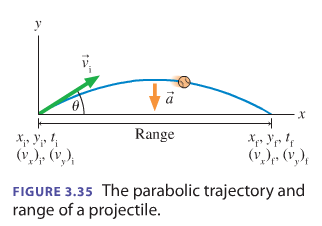
Horizontal position: \( x = x_i + (v_{ix}) t \)
Vertical position: \( y = y_i + (v_{iy}) t - \frac{1}{2} g t^2 \)
Horizontal velocity: \( v_x = v_{ix} \)
Vertical velocity: \( v_y = v_{iy} - g t \)
The time of flight, maximum height, and range can be found using these equations.
Range and Maximum Height
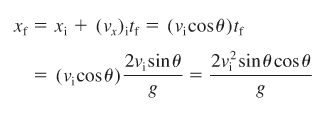
Range (level ground): \( R = \frac{v_i^2 \sin 2\theta}{g} \)
Maximum height: \( H = \frac{v_i^2 \sin^2 \theta}{2g} \)
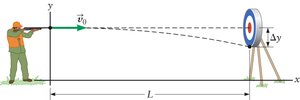
Example: Shooting at a Target
When a projectile is fired horizontally, it falls below the target due to gravity. To hit the target, the shooter must aim above it, compensating for the vertical drop during flight.
Relative Motion
Reference Frames and Relative Velocity
Relative motion describes how the velocity of an object depends on the observer's frame of reference. The Galilean transformation relates velocities in different frames:
\( \vec{v}_{CB} = \vec{v}_{CA} + \vec{v}_{AB} \)
Where \( \vec{v}_{CB} \) is the velocity of C relative to B, \( \vec{v}_{CA} \) is the velocity of C relative to A, and \( \vec{v}_{AB} \) is the velocity of A relative to B.
Example: A boat crossing a river, an airplane flying with wind, or a runner on a moving walkway all require vector addition to find the resultant velocity relative to the ground.
Circular Motion
Uniform Circular Motion
Uniform circular motion occurs when an object moves in a circle at constant speed. The velocity vector is always tangent to the circle, while the acceleration vector (centripetal acceleration) points toward the center.
Centripetal acceleration: \( a_c = \frac{v^2}{r} = \omega^2 r \)
Period: \( T = \frac{2\pi r}{v} \)
Angular velocity: \( \omega = \frac{2\pi}{T} \)
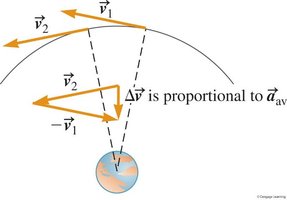
Nonuniform Circular Motion and Angular Acceleration
When the speed of an object in circular motion changes, it experiences angular acceleration \( \alpha \). The tangential component of acceleration changes the speed, while the radial (centripetal) component changes the direction.
Angular acceleration: \( \alpha = \frac{d\omega}{dt} \)
Tangential acceleration: \( a_t = r \alpha \)
Summary Table: Kinematic Equations for Constant Acceleration
Equation | Description |
|---|---|
Velocity as a function of time (x-direction) | |
Displacement (x-direction) | |
Position as a function of time (x-direction) | |
Position as a function of time (y-direction) | |
Velocity as a function of time (y-direction) | |
Velocity-displacement relation (x-direction) | |
Velocity-displacement relation (y-direction) |
Key Concepts and Problem-Solving Tips
Always resolve vectors into components before applying kinematic equations.
Time is the common variable linking x and y motions.
Draw diagrams to visualize vectors and trajectories.
For projectile motion, horizontal and vertical motions are independent except for sharing the same time interval.
In circular motion, acceleration is always directed toward the center (centripetal).
Relative velocity problems require careful attention to reference frames and vector addition.
