 뒤로
Kinematics: Motion in One Dimension – Study Notes
스터디 가이드 - 스마트 노트
 자료에 맞춘 맞춤형 노트, 핵심 정의, 예시, 맥락을 확장해 제공합니다.
Describing Motion
Position, Speed, Direction, and Acceleration
Motion is a fundamental concept in physics, describing how objects change their position over time. The motion of an object can be characterized by its position, speed, direction, and acceleration. Understanding these quantities allows us to analyze and predict the behavior of moving objects.


Motion Is Relative
Reference Frames and Relative Motion
All motion is measured relative to a chosen reference point or frame. An object is considered to be moving if its position changes with respect to a fixed point. For example, a book at rest on a table is moving at about 30 km/s relative to the sun, and even faster relative to the center of our galaxy. The concept of relative motion is crucial in physics, as it clarifies that motion is not absolute but depends on the observer's frame of reference.
Reference Frame: The perspective from which motion is observed and measured.
Relative Motion: The movement of an object as described with respect to another object.
Unless otherwise stated, speeds are measured relative to Earth's surface.

Speed
Definition and Calculation
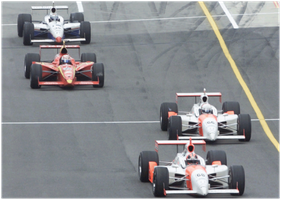
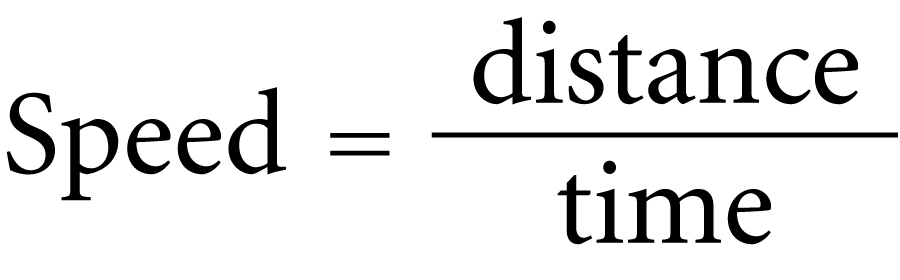
Speed is a measure of how fast an object is moving, defined as the distance covered per unit time. Galileo was the first to formalize this concept mathematically. Speed can be expressed in various units, such as meters per second (m/s), kilometers per hour (km/h), or miles per hour (mi/h).
Formula:
Common units: m/s, km/h, mi/h
Examples of Speed
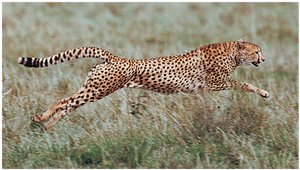
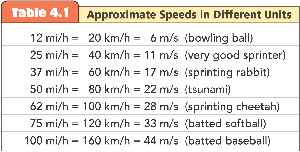
Different objects and animals move at characteristic speeds. For instance, a cheetah can reach speeds up to 100 km/h over short distances.
mi/h | km/h | m/s | Example |
|---|---|---|---|
12 | 20 | 6 | Bowling ball |
25 | 40 | 11 | Very good sprinter |
37 | 60 | 17 | Sprinting rabbit |
50 | 80 | 22 | Tsunami |
62 | 100 | 28 | Sprinting cheetah |
75 | 120 | 33 | Batted softball |
100 | 160 | 44 | Batted baseball |
Instantaneous and Average Speed
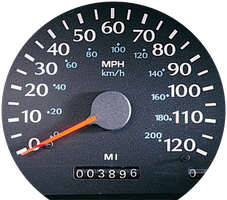
Instantaneous speed is the speed at any given moment, as shown by a speedometer. Average speed is the total distance traveled divided by the total time taken.
Instantaneous Speed: The speed at a specific instant.
Average Speed:


Velocity
Definition and Vector Nature
Velocity is speed in a specified direction. It is a vector quantity, meaning it has both magnitude and direction, unlike speed, which is a scalar and only has magnitude. For example, 60 km/h north is a velocity, while 60 km/h is just a speed.
Vector Quantity: Has both magnitude and direction (e.g., velocity, force).
Scalar Quantity: Has only magnitude (e.g., speed, mass).
Constant and Changing Velocity
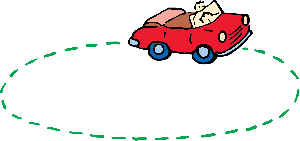
Constant velocity means moving in a straight line at a constant speed. If either the speed or the direction changes, the velocity changes. An object moving in a circle at constant speed does not have constant velocity because its direction is continuously changing.
Acceleration
Definition and Calculation
Acceleration is the rate at which velocity changes with time. It can result from changes in speed, direction, or both. Acceleration is also a vector quantity.
Formula:
Units: m/s2 (meters per second squared)

Examples and Applications
Acceleration occurs whenever an object speeds up, slows down, or changes direction. In a car, the gas pedal, brakes, and steering wheel all control acceleration.
Types of Acceleration
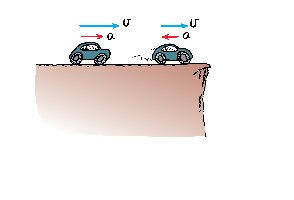
Positive Acceleration: Speeding up in the direction of motion.
Negative Acceleration (Deceleration): Slowing down, or accelerating against the direction of motion.
Changing Direction: Acceleration at an angle to velocity changes the direction of motion.
Free Fall
Acceleration Due to Gravity
Objects in free fall experience a constant acceleration due to gravity, denoted as g. Near Earth's surface, (often approximated as for calculations). The velocity of a freely falling object increases by about 10 m/s each second.
Velocity after time t:
Distance fallen after time t:
Summary Table: Key Kinematic Quantities
Quantity | Definition | Formula | Units |
|---|---|---|---|
Speed | Distance per unit time | m/s | |
Velocity | Speed with direction | m/s | |
Acceleration | Change in velocity per unit time | m/s2 |
Key Concepts and Applications
Motion is always described relative to a reference frame.
Speed is a scalar; velocity and acceleration are vectors.
Constant velocity requires both constant speed and direction.
Acceleration can result from changes in speed, direction, or both.
In free fall, all objects accelerate downward at the same rate (ignoring air resistance).
