 뒤로
뒤로Motion Along a Straight Line: Displacement, Velocity, and Acceleration
스터디 가이드 - 스마트 노트
 자료에 맞춘 맞춤형 노트, 핵심 정의, 예시, 맥락을 확장해 제공합니다.
Motion Along a Straight Line
Displacement and Position Vectors
In physics, displacement is a vector quantity that refers to the change in position of an object. It is defined as the difference between the final and initial position vectors.
Position Vector (\( \vec{x} \)): Specifies the location of an object in space relative to an origin.
Initial Position (\( \vec{x}_i \)): The starting point of the object.
Final Position (\( \vec{x}_f \)): The ending point of the object.
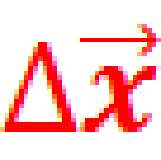
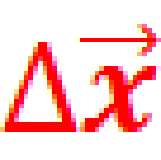
Displacement (\( \Delta \vec{x} \)): The vector difference between final and initial positions.
The formula for displacement is:

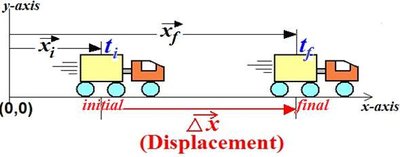
Example: If a truck moves from an initial position \( \vec{x}_i = 0 \) m to a final position \( \vec{x}_f = 50 \) m, the displacement is \( 50 \) m in the positive x-direction.
Distance vs. Displacement
Distance is a scalar quantity representing the total path length traveled, regardless of direction. Displacement is a vector and only considers the straight-line change from start to finish.
Distance: Total length of the path traveled.
Displacement: Straight-line vector from initial to final position.
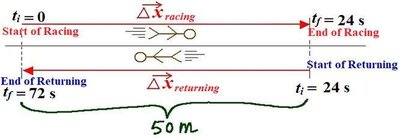
Example: If a runner goes 50 m east and returns 50 m west, the total distance is 100 m, but the displacement is 0 m.
Average Velocity and Average Speed
Average velocity is a vector defined as the displacement divided by the time interval. Average speed is a scalar, defined as the total distance divided by the time interval.
Average Velocity (\( \vec{v}_{avg} \)):
Average Speed:
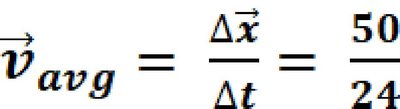
Example: If a car travels 50 m in 24 s, the average velocity is m/s in the direction of motion.
Round Trip Motion: Zero Displacement
When an object returns to its starting point, the displacement is zero, but the distance is not. In this case, the average velocity is zero, but the average speed is not.

Example: A runner goes 50 m out and 50 m back in 72 s. Displacement is 0 m, so average velocity is 0. Average speed is m/s.
Position-Time and Velocity-Time Graphs
Graphs are useful tools for visualizing motion. The slope of a position-time graph gives velocity, while the slope of a velocity-time graph gives acceleration.
Position-Time Graph: Shows how position changes with time.
Velocity-Time Graph: Shows how velocity changes with time.
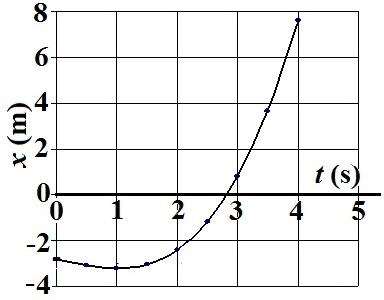
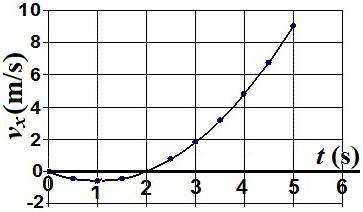
Example: A curve on a position-time graph indicates changing velocity (acceleration).
Motion with Constant Acceleration
When acceleration is constant, the equations of motion can be used to predict position and velocity at any time.
Constant Acceleration (\( a \)): The rate of change of velocity is constant.
Equations of Motion:
Example: If a cat starts from rest and accelerates to 20.11 m/s in 2 s, you can use the equations above to find the acceleration and displacement.
Relative Motion and Multiple Objects
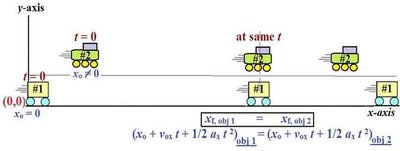
When analyzing the motion of multiple objects, their positions as functions of time can be set equal to find when and where they meet.
Example: Two trucks starting from different positions and/or velocities can be analyzed using their equations of motion to determine when they are at the same position.
Piecewise Motion
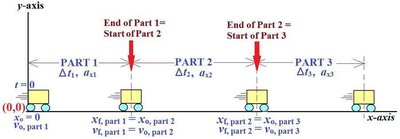
Sometimes, motion occurs in segments with different accelerations or velocities. Each segment is analyzed separately, and the final state of one segment is the initial state of the next.
Example: A truck moves with different accelerations in three parts; calculate position and velocity at the end of each part using the equations of motion.
Vertical Motion Under Gravity
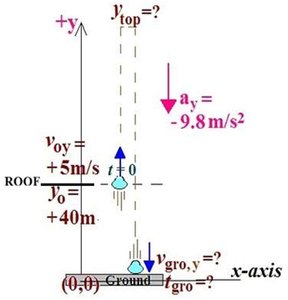
Objects moving vertically under gravity experience constant acceleration downward (\( a_y = -9.8 \) m/s2). The same equations of motion apply, with appropriate signs for direction.
Example: A ball thrown upward from a roof with initial velocity 5 m/s and initial height 40 m; use equations to find maximum height and time to hit the ground.
Quantity | Vector/Scalar | Formula |
|---|---|---|
Displacement (\( \Delta \vec{x} \)) | Vector | |
Distance | Scalar | Sum of path lengths |
Average Velocity (\( \vec{v}_{avg} \)) | Vector | |
Average Speed | Scalar | |
Acceleration (\( a \)) | Vector |
