 뒤로
Ch 4: Newton’s Laws of Motion
스터디 가이드 - 스마트 노트
 자료에 맞춘 맞춤형 노트, 핵심 정의, 예시, 맥락을 확장해 제공합니다.
Newton’s Laws of Motion
Introduction to Dynamics
Dynamics is the branch of physics that studies the relationship between motion and the forces that cause it. Newton’s laws of motion, formulated by Sir Isaac Newton, provide the foundational principles for understanding how and why objects move.
Properties and Types of Forces
What Is a Force?
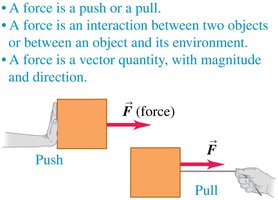
A force is a push or a pull that arises from the interaction between two objects or between an object and its environment. Forces are vector quantities, meaning they have both magnitude and direction.
Definition: A force is an interaction that can change the motion of an object.
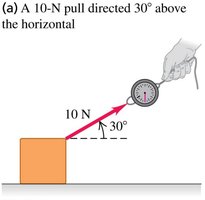
Vector Nature: Forces are represented by arrows; the length indicates magnitude, and the direction shows the way the force acts.
Examples: Pushing a box, pulling a rope.
Common Types of Forces
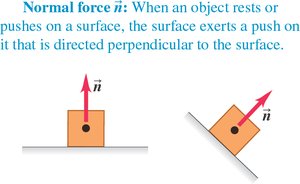
Normal Force (n): The force exerted by a surface perpendicular to the object resting or pushing on it.
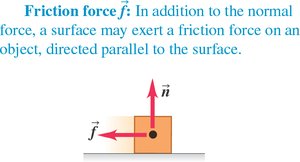
Friction Force (f): The force exerted parallel to the surface, opposing motion.
Tension (T): The force transmitted through a string, rope, or cable when it is pulled tight.
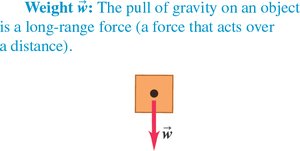
Weight (w): The gravitational force acting on an object, directed toward the center of the Earth.
Magnitude and Measurement of Forces
The SI unit of force is the newton (N). Typical force magnitudes can range from a few newtons (for small objects) to thousands of newtons (for large objects).
Drawing Force Vectors
Force vectors are drawn to represent both the magnitude and direction of the force applied to an object. The longer the vector, the greater the force.
Superposition and Decomposition of Forces
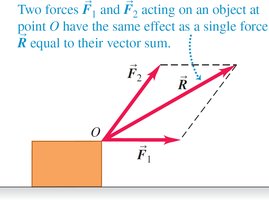
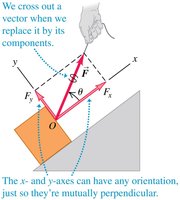
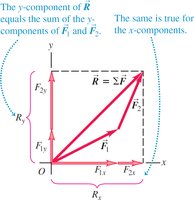
When multiple forces act on an object, their combined effect is given by the vector sum (resultant) of all forces. Forces can also be decomposed into components along perpendicular axes (usually x and y).
Superposition Principle: The net force is the vector sum of all individual forces.
Component Vectors: Use trigonometry to resolve a force into x and y components:
Newton’s First Law of Motion
Law of Inertia and Equilibrium
Newton’s first law states that an object at rest or moving with constant velocity remains in that state unless acted upon by a net external force. This is known as the law of inertia.
Equilibrium: An object is in equilibrium if the net force is zero.
Mathematical Expression:

Force and Acceleration
If a net force acts on an object, it will accelerate in the direction of the net force. If the net force is zero, the object does not accelerate.
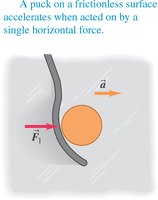
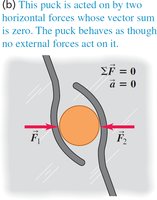
Example: Sledding and Equilibrium
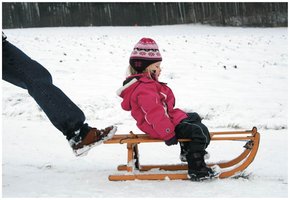
When a child and sled are pushed forward, the forces of gravity, normal force, and friction balance out, resulting in no net external force and constant velocity.
Inertial Frames of Reference
Newton’s first law is valid only in inertial frames—reference frames that are not accelerating. Non-inertial frames (such as a speeding bus) can give the illusion of forces acting when none exist.
Crash Test Dummies and Inertia
When a car stops suddenly, crash test dummies continue moving forward due to inertia, illustrating Newton’s first law.

Uniform Circular Motion
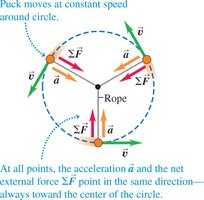
An object moving in a circle at constant speed is always accelerated toward the center. The net external force must also point toward the center.
Newton’s Second Law of Motion
Force, Mass, and Acceleration
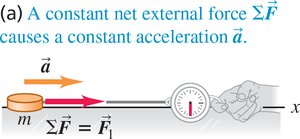
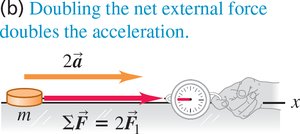
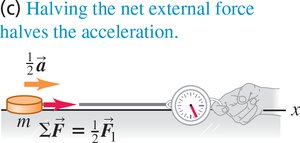
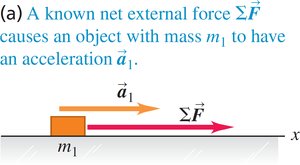
Newton’s second law quantifies the relationship between force, mass, and acceleration. The acceleration of an object is directly proportional to the net external force and inversely proportional to its mass.
Mathematical Expression:
SI Unit: Newton (N), where
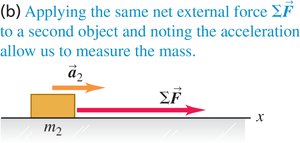
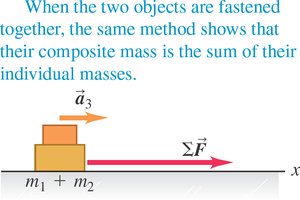

Mass and Weight
Relationship Between Mass and Weight
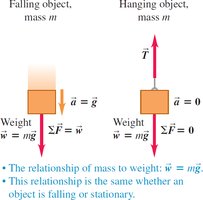
Mass is a measure of an object’s inertia, while weight is the gravitational force exerted on the object. On Earth, weight is given by:
Formula:
g: Acceleration due to gravity (approximately on Earth)
Weight varies: The value of changes with altitude and planetary body.
Newton’s Third Law of Motion
Action and Reaction
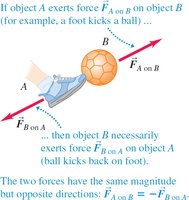
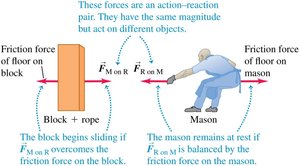
Newton’s third law states that for every action, there is an equal and opposite reaction. If object A exerts a force on object B, then object B exerts a force of equal magnitude and opposite direction on object A.
Mathematical Expression:
Action-Reaction Pairs: Forces always come in pairs, acting on different objects.
Applications: Walking and Motion
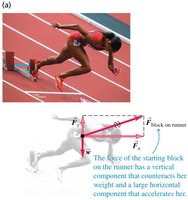
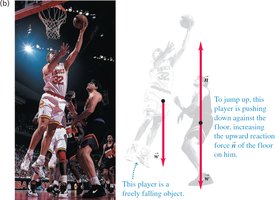
Walking depends on Newton’s third law. When you push backward on the ground, the ground pushes forward on you, propelling you forward.

Free-Body Diagrams
Constructing Free-Body Diagrams
A free-body diagram is a graphical representation used to visualize the forces acting on a single object. It helps in analyzing the net force and predicting the resulting motion.
Steps:
Isolate the object of interest.
Draw all forces acting on the object as vectors.
Label each force clearly.
Purpose: To simplify problem-solving in dynamics by focusing on the relevant forces.
Summary Table: Types of Forces
Type of Force | Direction | Nature | Example |
|---|---|---|---|
Normal | Perpendicular to surface | Contact | Box on table |
Friction | Parallel to surface | Contact | Sliding block |
Tension | Along string/rope | Contact | Pulling rope |
Weight | Toward Earth’s center | Long-range | Falling object |
Key Equations
Net Force:
Newton’s First Law:
Newton’s Second Law:
Weight:
Newton’s Third Law:
Conclusion
Newton’s laws of motion provide the essential framework for understanding the relationship between forces and motion. Mastery of these concepts is fundamental for further study in physics, engineering, and related fields.
