 뒤로
One-Dimensional Kinematics: Physics with Calculus Study Notes
스터디 가이드 - 스마트 노트
 자료에 맞춘 맞춤형 노트, 핵심 정의, 예시, 맥락을 확장해 제공합니다.
One-Dimensional Kinematics
Position, Distance, and Displacement
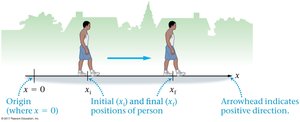
To describe motion in one dimension, a coordinate system must be established, including an origin and a positive direction. Position refers to the location of an object relative to the origin. Distance is the total length of the path traveled, regardless of direction, while displacement is the change in position, which includes direction and can be positive or negative.
Position (x): The location of an object on a coordinate axis.
Distance: The total path length traveled by an object.
Displacement (Δx): The difference between the final and initial positions; can be negative if motion is in the negative direction.
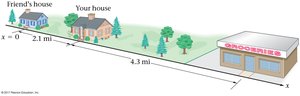
Example: Driving from your house to the grocery store and then to a friend's house covers a distance of 10.7 mi, but the displacement is -2.1 mi (to the left).
Average Speed and Velocity
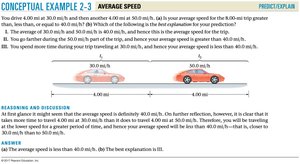
Average speed is the total distance traveled divided by the elapsed time, while average velocity is the displacement divided by the elapsed time. If an object returns to its starting point, its average velocity is zero, but its average speed is not.
Average Speed:
Average Velocity:
Example: Driving 4.0 mi at 30.0 mi/h and then another 4.6 mi at 50.0 mi/h results in an average speed less than 40.0 mi/h.
Graphical Interpretation of Average Velocity
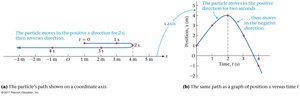
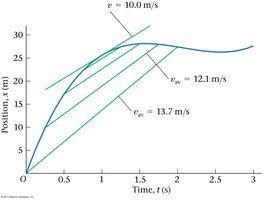
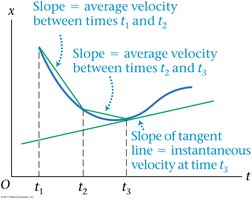
Motion can be represented graphically using position-time (x-t) graphs. The slope of the line connecting two points on the graph gives the average velocity between those points.
Key Point: The slope of the x-t graph between two points is the average velocity.
Example: A particle moves in the positive x direction for 2 s, then reverses direction.
Instantaneous Velocity
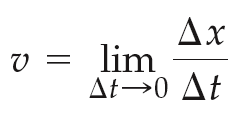
Instantaneous velocity is the velocity of an object at a specific moment in time. It is defined as the limit of the average velocity as the time interval approaches zero.
Definition:
Graphical Interpretation: The instantaneous velocity is the slope of the tangent to the position-time curve at a given point.
Acceleration
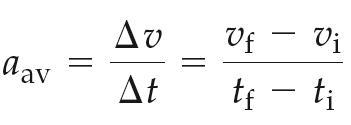
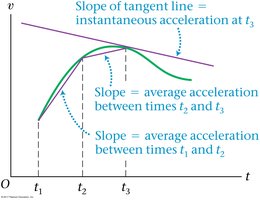
Acceleration is the rate of change of velocity with respect to time. Average acceleration is calculated over a finite time interval, while instantaneous acceleration is the acceleration at a specific instant.
Average Acceleration:
Instantaneous Acceleration: The slope of the tangent to the velocity-time curve at a given point.
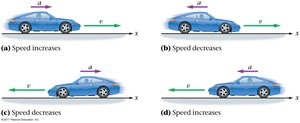
Deceleration: Occurs when velocity and acceleration have opposite signs.
Motion with Constant Acceleration
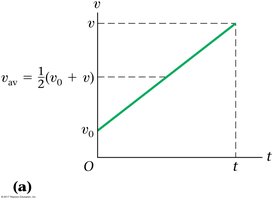
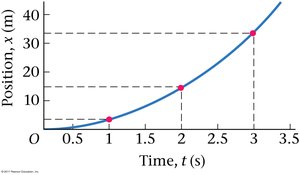
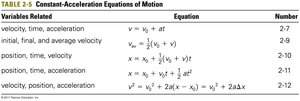
When acceleration is constant, the equations of motion relate position, velocity, acceleration, and time. The velocity changes linearly, and the position changes quadratically with time.
Velocity as a function of time:
Average velocity:
Position as a function of time:
Velocity as a function of position:
Constant-Acceleration Equations of Motion
Variables Related | Equation | Number |
|---|---|---|
velocity, time, acceleration | 2-7 | |
initial, final, and average velocity | 2-9 | |
position, time, velocity | 2-10 | |
position, time, acceleration | 2-11 | |
velocity, position, acceleration | 2-12 |
Applications of the Equations of Motion
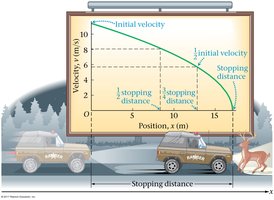
The equations of motion are used to solve practical problems, such as determining stopping distances when braking a vehicle.
Example: Calculating the stopping distance of a car given its initial velocity and acceleration.
Freely Falling Objects
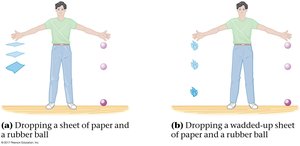
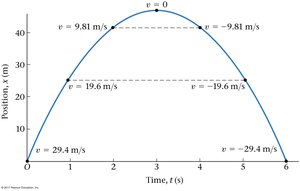
Free fall describes the motion of an object under the influence of gravity alone, with a constant acceleration near Earth's surface. Air resistance can affect the motion, making it not truly free fall.
Acceleration due to gravity (g):
Example: Dropping a sheet of paper and a rubber ball; the ball falls faster due to less air resistance.
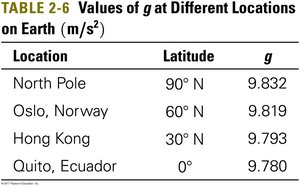
Values of g at Different Locations
Location | Latitude | g (m/s2) |
|---|---|---|
North Pole | 90° N | 9.832 |
Oslo, Norway | 60° N | 9.819 |
Hong Kong | 30° N | 9.793 |
Quito, Ecuador | 0° | 9.780 |
Summary of Key Concepts
Distance: Total length of travel.
Displacement: Change in position.
Average speed: Distance divided by time.
Average velocity: Displacement divided by time.
Instantaneous velocity: Velocity at a specific instant, tangent to the position-time curve.
Instantaneous acceleration: Acceleration at a specific instant, tangent to the velocity-time curve.
Deceleration: Velocity and acceleration have opposite signs.
Constant acceleration: Equations of motion relate position, velocity, acceleration, and time.
Freely falling objects: Constant downward acceleration of .
