 뒤로
Patterns of Motion and Equilibrium: Foundations of Physics with Calculus
스터디 가이드 - 스마트 노트
 자료에 맞춘 맞춤형 노트, 핵심 정의, 예시, 맥락을 확장해 제공합니다.
Patterns of Motion and Equilibrium
History of Motion
The study of motion has evolved from ancient philosophical ideas to modern scientific theories. Early concepts, such as Aristotle's theory of Natural and Violent Motion, were replaced by Galileo's development of inertial motion, which laid the groundwork for Newtonian mechanics.
Natural Motion: Objects move toward their 'natural place' (e.g., stones fall, smoke rises).
Violent Motion: Motion imposed by external forces (e.g., pushing a cart).
Inertial Motion: Galileo proposed that objects continue in motion unless acted upon by a net force.
Example: A ball rolling on a frictionless surface will keep moving unless stopped.
Inertia and Net Force
Understanding the distinction between mass and weight is fundamental in physics. Mass is a scalar quantity representing the amount of matter and resistance to motion change, while weight is the force of gravity acting on that mass.
Mass: Measured in kilograms (kg), does not change with location.
Weight: Measured in newtons (N), calculated as .
Net Force: The vector sum of all forces acting on an object. If multiple forces act, use vector addition to find the resultant force.
Example: A 6 kg box weighs 60 N on Earth (), but only 10 N on the Moon.
Equilibrium
Equilibrium occurs when the net force on an object is zero. This can be static (at rest) or dynamic (moving at constant velocity). The mathematical expression for equilibrium is or .
Static Equilibrium: Object at rest, no net force.
Dynamic Equilibrium: Object moving at constant velocity, no net force.
Balanced Forces: Forces cancel each other, resulting in zero net force.
Example: A book resting on a table experiences equal upward and downward forces.
The Support Force (Normal Force)
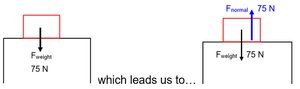
When an object rests on a surface, the surface provides an upward support force called the normal force, which balances the downward force of gravity. The normal force is always perpendicular to the surface.
Normal Force: Upward force exerted by a surface to support an object.
Equilibrium Condition: when at rest.
Example: A 75 N box at rest on a table experiences a 75 N normal force upward and 75 N weight downward.
Friction
Friction is a force that opposes motion between two surfaces in contact. It depends on the roughness of the surfaces and the normal force pressing them together. There are two main types: static friction (when at rest) and kinetic friction (when moving).
Static Friction: Prevents motion up to a maximum value.
Kinetic Friction: Acts when objects are moving; always less than static friction.
Coefficient of Friction (μ): Ratio of frictional force to normal force, .
Surface Area: Friction does not depend on contact area if weight is constant.
Example: If maximum static friction is 15 N, applying 20 N results in 5 N net force and acceleration.
Describing Motion: Speed and Velocity
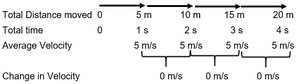
Motion is described by changes in position over time. Speed is the rate of change of position, while velocity includes direction. Galileo defined speed as or . For straight-line motion, velocity can be used interchangeably.
Average Speed: Total distance divided by total time.
Instantaneous Speed: Speed at a specific moment.
Constant Velocity: No change in speed or direction.
Accelerated Motion: Change in speed or direction.
Example: Driving 450 miles in 9 hours gives an average speed of 50 mph.
Relative Motion and Reference Frames
Motion is always described relative to a reference point. Einstein's theory of relative motion emphasizes that the characteristics of motion depend on the observer's perspective.
Reference Frame: The default is Earth unless specified otherwise.
Example: A man sitting in a moving bus is at rest relative to the bus, but moving relative to a person on the street.
Acceleration
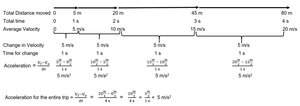
Acceleration is the rate of change of velocity. It tells how quickly speed changes, not the total change. For constant acceleration, the velocity increases by equal amounts each second.
Definition:
Constant Acceleration: Distance and velocity increase each second.
Example: A car accelerating at 5 m/s2 increases its velocity by 5 m/s every second.
Free Fall and Acceleration Due to Gravity
Free fall occurs when only gravity acts on an object. The acceleration due to gravity on Earth is (rounded to 10 m/s2 for convenience). The velocity and distance equations for free fall are:
Velocity:
Distance:
Example: After 3 seconds, , .
Time of Fall (s) | Velocity Acquired (m/s) | Distance Fallen (m) |
|---|---|---|
0 | 0 | 0 |
1 | 10 | 5 |
2 | 20 | 20 |
3 | 30 | 45 |
4 | 40 | 80 |
5 | 50 | 125 |
Summary Table: Types of Motion
Type | Net Force | Equilibrium | Motion |
|---|---|---|---|
Static | 0 | Yes | At rest |
Dynamic | 0 | Yes | Constant velocity |
Accelerated | ≠ 0 | No | Changing velocity |
Additional info: Academic context was added to clarify the distinction between mass and weight, the role of the normal force, and the mathematical treatment of friction and acceleration. Tables and diagrams were recreated for clarity and completeness.
