 뒤로
뒤로Physics with Calculus: 1D and 2D Motion Study Guide
스터디 가이드 - 스마트 노트
 자료에 맞춘 맞춤형 노트, 핵심 정의, 예시, 맥락을 확장해 제공합니다.
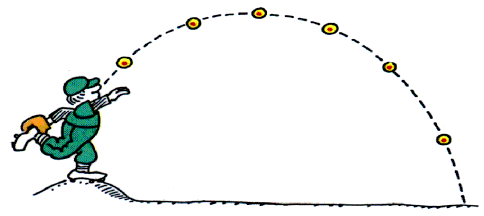
Q5. What can we know about a projectile’s motion as shown at right:
Background
Topic: Projectile Motion
This question is testing your understanding of the kinematics of projectile motion, specifically how acceleration and velocity change at different points along the trajectory.
Key Terms and Formulas:
Projectile motion: The motion of an object thrown or projected into the air, subject only to gravity.
Acceleration due to gravity: (downward)
Horizontal acceleration: (no horizontal force acting)
Velocity at apex: The vertical component of velocity is zero at the highest point.
Step-by-Step Guidance
Examine the diagram: The ball follows a curved, parabolic path typical of projectile motion.
Recall that gravity acts downward throughout the motion, so the vertical acceleration is constant and negative ().
Compare the acceleration at different positions: At the first, third, and fifth positions, the vertical acceleration remains the same because gravity is constant.
At the apex (highest point), the vertical velocity is zero, but the acceleration due to gravity is still present.
For the time to return to the ground: If it takes 2 s to reach the apex, consider the symmetry of projectile motion to determine the total time in the air.
Try solving on your own before revealing the answer!
Final Answer:
a) The acceleration at the first, third, and fifth positions is the same: downward, .
b) At the apex, the vertical velocity is zero, but the vertical acceleration is still downward. The horizontal velocity remains constant.
c) If it takes 2 s to reach the apex, it will take another 2 s to return to the ground, so the total time in the air is 4 s.
This is because projectile motion is symmetric: the time to rise equals the time to fall.
