 뒤로
Physics with Calculus: Electric Current, Circuits, and Capacitance – Visual Study Guide
스터디 가이드 - 스마트 노트
 자료에 맞춘 맞춤형 노트, 핵심 정의, 예시, 맥락을 확장해 제공합니다.
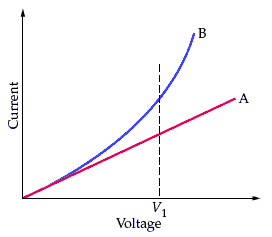
Q1. The figure shows a plot of current versus voltage for two different materials, A and B. At a particular voltage , which material has the greater resistance? Explain your reasoning.
Background
Topic: Ohm's Law and Resistance
This question tests your understanding of how to interpret current-voltage (I-V) graphs for different materials, and how resistance is related to the slope of these graphs. It also explores the concept of Ohmic and non-Ohmic materials.
Key Terms and Formulas
Ohm's Law:
Resistance ():
Ohmic Material: A material that has a linear I-V relationship (constant resistance).
Non-Ohmic Material: A material with a nonlinear I-V relationship (resistance changes with voltage/current).
Step-by-Step Guidance
At voltage , draw a horizontal line to the curves for both materials A and B. Note the current values for each material at this voltage.
Recall that resistance at a given point is . For the same voltage , compare the currents and for materials A and B.
If a material has a lower current at the same voltage, its resistance is higher (since increases as decreases for fixed ).
Examine the slopes of the I-V curves at . For a linear (Ohmic) material, the slope is constant; for a nonlinear (non-Ohmic) material, the slope changes.
Set up the ratio and , and determine which is greater based on the current values at .
Try solving on your own before revealing the answer!
Final Answer:
At voltage , material A has the greater resistance. This is because, at , the current through A () is less than the current through B (), so is greater than . The slope of the I-V curve for A is less steep than for B at , indicating higher resistance. Material A is Ohmic (linear), while B is non-Ohmic (nonlinear).
This analysis shows how to use I-V graphs to compare resistances and recognize Ohmic vs. non-Ohmic behavior.
