 뒤로
Exam 1 - Study Guide B
스터디 가이드 - 스마트 노트
 자료에 맞춘 맞춤형 노트, 핵심 정의, 예시, 맥락을 확장해 제공합니다.
Q1. Which of the following statements, regarding the exam directions on the first page, is true?
Background
Topic: Exam Procedures and Academic Integrity
This question tests your careful reading and understanding of exam instructions, which is important for following procedures and avoiding mistakes during assessments.
Key Terms:
Exam number: The unique identifier for your test form.
Scantron: The answer sheet where you bubble in responses.
Signature: Your written name to confirm academic honesty.
Step-by-Step Guidance
Carefully review each statement (I, II, III) and compare them to the directions provided at the start of the exam.
Check if the directions mention bubbling the 5-digit exam number in lines 76–80 of the scantron.
Look for any statement about what materials you are allowed to take home after the exam (exam questions, scantron, scratch paper, etc.).
Verify if the directions require you to print and sign your name at the top of the exam’s front page.
Determine which combination of statements (I, II, III) is correct based on your findings.
Try solving on your own before revealing the answer!
Final Answer: (1) I and III only
According to the directions, you must bubble in the 5-digit exam number (I) and print/sign your name (III). You are not allowed to take home the exam questions or scantron (II is false).
Q2. Simone Biles is 4 ft. 7 inches tall. Twelve inches equals one foot and one meter equals 3.28084 feet. Her height in meters to 3 sig. figs. is:
Background
Topic: Unit Conversion and Significant Figures
This question tests your ability to convert between imperial and metric units and to round your answer to the correct number of significant figures.
Key Terms and Formulas:
1 foot = 12 inches
1 meter = 3.28084 feet
Significant figures: The number of meaningful digits in a value.
Step-by-Step Guidance
Convert Simone's height to inches: .
Convert the total inches to feet by dividing by 12.
Convert the height in feet to meters using .
Round your answer to 3 significant figures as required.
Try solving on your own before revealing the answer!
Final Answer: 1.40 m
After converting 4 ft 7 in to meters and rounding to 3 significant figures, Simone Biles' height is approximately 1.40 m.
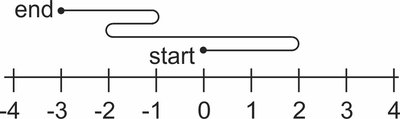
Q3. A robot vacuum moves along one direction, turning around at random times. The figure shows its path (axis values in meters). Its distance traveled and displacement for this excursion are respectively, in that order (in m):
Background
Topic: Kinematics – Distance vs. Displacement
This question tests your understanding of the difference between total distance traveled (the path length) and displacement (the straight-line change in position).
Key Terms and Formulas:
Distance: The total length of the path traveled, regardless of direction.
Displacement: The straight-line vector from the starting point to the ending point.
Step-by-Step Guidance
Trace the robot's path on the figure, noting each segment and its direction.
Add up the absolute values of each segment to find the total distance traveled.
Find the starting and ending positions on the axis to determine the displacement (final position minus initial position).
Remember that displacement can be negative or positive, depending on direction.
Try solving on your own before revealing the answer!
Final Answer: (1) 9, -3
The total distance traveled is 9 m (sum of all segments), and the displacement is -3 m (final position minus initial position).
Q4. John starts at the origin and walks 2.0 km due east. He then walks 30° north of east for 8.0 km. What is his distance from the origin (in km)?
Background
Topic: Vector Addition and the Law of Cosines
This question tests your ability to add vectors using trigonometry to find the resultant displacement.
Key Terms and Formulas:
Vector addition: Combining two or more vectors to find a resultant.
Law of cosines: , where is the angle between the vectors.
Step-by-Step Guidance
Draw a diagram showing the two legs of John's walk: 2.0 km east, then 8.0 km at 30° north of east.
Use the law of cosines to find the straight-line distance from the origin to his final position.
Plug in the values: km, km, .
Calculate .
Try solving on your own before revealing the answer!
Final Answer: 7.2 km
Using the law of cosines, John's distance from the origin is approximately 7.2 km.
Q5. In meters, vector \( \vec{A} = (3, 0) \), and vector \( \vec{B} = (0, 3) \). The magnitude of vector \( \vec{C} = \vec{A} - 2\vec{B} \) (in m) is:
Background
Topic: Vector Operations and Magnitude
This question tests your ability to perform vector subtraction and scalar multiplication, then find the magnitude of the resulting vector.
Key Terms and Formulas:
Vector subtraction: means subtracting twice vector from .
Magnitude of a vector: .
Step-by-Step Guidance
Write out the components of and .
Multiply by 2 and subtract from to get .
Calculate the and components of .
Use the magnitude formula to set up the calculation for .
Try solving on your own before revealing the answer!
Final Answer: 6.7 m
The magnitude of is approximately 6.7 meters after performing the vector operations and applying the Pythagorean theorem.
Q6. A car has an initial velocity \( \vec{v} = (-34 \text{ m/s}, 0) \). The driver slams on the brakes and the car comes to a stop in 10 s. Assuming constant acceleration, what were the car’s displacement (in m) and acceleration (in m/s²), in that order?
Background
Topic: Kinematics with Constant Acceleration
This question tests your ability to use kinematic equations to solve for displacement and acceleration when initial velocity, final velocity, and time are known.
Key Terms and Formulas:
Initial velocity: m/s
Final velocity: m/s (since the car stops)
Time: s
Displacement:
Acceleration:
Step-by-Step Guidance
Write down the known values: , , .
Use the acceleration formula to set up the calculation for .
Plug the values into the displacement formula to set up the calculation for .
Be careful with the signs (negative velocity means the car is moving in the negative direction).
Try solving on your own before revealing the answer!
Final Answer: (1) -170, 3.4
The car's displacement is -170 m (it moves 170 m in the negative direction), and the acceleration is 3.4 m/s² (positive because it is in the direction opposite to the initial velocity).
Q7. A pop-up fly ball goes straight up leaving the bat with a speed of 42.0 m/s. The catcher catches it at the same height from which it left the bat. Ignoring air resistance, how long was the ball in the air (in s)?
Background
Topic: Projectile Motion – Vertical Launch
This question tests your understanding of motion under gravity, specifically the time for an object to return to its original height after being launched vertically.
Key Terms and Formulas:
Initial velocity: m/s
Acceleration due to gravity: m/s² (downward)
Time to reach maximum height:
Total time in air:
Step-by-Step Guidance
Calculate the time to reach the maximum height using .
Double this time to get the total time in the air (up and down).
Set up the calculation for .
Try solving on your own before revealing the answer!
Final Answer: 8.6 s
The ball is in the air for approximately 8.6 seconds.
Q8. A football is kicked at 35 m/s at an angle of 33° with respect to the horizontal. For the same launch speed and ignoring air resistance, what other angle with respect to the horizontal results in the ball having the same horizontal range?
Background
Topic: Projectile Motion – Range Symmetry
This question tests your understanding of the symmetry of projectile motion: for a given speed, two launch angles add up to 90° to give the same range.
Key Terms and Formulas:
Range formula:
Complementary angles: for the same range.
Step-by-Step Guidance
Recall that for a given speed, the range is the same for angles and .
Subtract the given angle from 90° to find the complementary angle.
Set up the calculation for the other angle.
Try solving on your own before revealing the answer!
Final Answer: 57°
The other angle is 57°, since 33° + 57° = 90°.
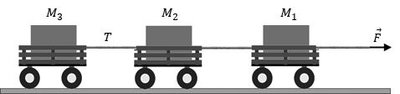
Q9. Three carts of mass (including their loads) of M1, M2, and M3, respectively, are connected by flexible ropes and pulled to the right with force F. Assuming negligible friction, what is the magnitude of the tension in the rope pulling the 3rd cart?
Background
Topic: Newton's Second Law and Tension in Connected Objects
This question tests your ability to analyze forces in a system of connected masses and determine the tension in a specific rope.
Key Terms and Formulas:
Newton's Second Law:
Tension: The force transmitted through a rope or cable.
System acceleration:
Step-by-Step Guidance
Draw a free-body diagram for the third cart (M3) and identify the forces acting on it.
Recognize that the tension in the rope pulling M3 must accelerate only M3, but the system's acceleration is determined by the total mass.
Set up the equation for the tension in terms of F and the masses.
Express the tension as a fraction of the total force F.
Try solving on your own before revealing the answer!
Final Answer: (1) \( \frac{M_3 F}{M_1 + M_2 + M_3} \)
The tension in the rope pulling the third cart is the fraction of the total force corresponding to M3's mass.
Q10. A crate of mass 4.5 kg is placed on an inclined plane at 30° with the horizontal. The crate is at rest. What is the force of friction acting on the crate that keeps it from sliding down the incline?
Background
Topic: Static Friction and Forces on an Incline
This question tests your understanding of the forces acting on an object at rest on an inclined plane, specifically the role of static friction.
Key Terms and Formulas:
Static friction: The force that prevents an object from moving.
Component of gravity down the incline:
Static friction force: (if the crate is at rest and not moving)
Step-by-Step Guidance
Draw a free-body diagram of the crate on the incline.
Identify the component of the gravitational force acting down the incline.
Since the crate is at rest, static friction must balance this component.
Set up the equation for the static friction force.
Try solving on your own before revealing the answer!
Final Answer: 22 N
The force of friction is 22 N, which balances the component of gravity down the incline.
Q11. A 9 kg bucket of water is being lifted by a rope through the air out of a deep well with an acceleration of 1.3 m/s². Ignoring air resistance, what is the tension in the rope (in N, to 2 sig. figs.)?
Background
Topic: Newton's Second Law – Tension with Acceleration
This question tests your ability to calculate the tension in a rope when lifting an object with upward acceleration.
Key Terms and Formulas:
Newton's Second Law:
Weight:
Tension: (since the bucket is accelerating upward)
Step-by-Step Guidance
Write down the mass of the bucket and the acceleration.
Calculate the weight of the bucket ().
Calculate the additional force needed for the upward acceleration ().
Add these two forces to set up the equation for tension.
Try solving on your own before revealing the answer!
Final Answer: 100 N
The tension in the rope is 100 N, accounting for both the weight and the upward acceleration of the bucket.
