 뒤로
Exam 1 - Study Guide A
스터디 가이드 - 스마트 노트
 자료에 맞춘 맞춤형 노트, 핵심 정의, 예시, 맥락을 확장해 제공합니다.
Q1. Which of the following statements are consistent with the exam directions on the first page?
Background
Topic: Exam Procedures and Academic Integrity
This question tests your ability to carefully read and interpret exam instructions, focusing on procedural details and rules for academic honesty.
Key Terms:
Exam number: The unique identifier for your test form.
Scantron: The answer sheet where you bubble in responses.
Academic integrity: Following rules and not cheating.
Step-by-Step Guidance
Carefully reread the exam directions to identify which statements are explicitly mentioned.
For statement I, check if the directions specify bubbling the exam number in lines 76–80.
For statement II, verify whether the directions allow students to take home both the exam questions and scantron.
For statement III, confirm if students are required to print and sign their names at the top of the exam’s front page.
Compare each statement to the directions and select the answer that includes all consistent statements and excludes any that are not.
Try solving on your own before revealing the answer!
Final Answer: (1) I and III only
Statements I and III are consistent with the exam directions, while statement II is not (students may only take home the scratch paper and formula sheet).
Q2. The number of milliseconds (ms) in one day is:
Background
Topic: Unit Conversion
This question tests your ability to convert between units, specifically from days to milliseconds.
Key Terms and Formulas:
Milliseconds (ms):
Seconds in a day:
Step-by-Step Guidance
Calculate the total number of seconds in one day using .
Convert seconds to milliseconds by multiplying the result by .
Express the answer in scientific notation to match the answer choices.
Try solving on your own before revealing the answer!
Final Answer: (3) 3.11 × 10⁸
There are 86,400 seconds in a day, so milliseconds. The closest answer is 3.11 × 10⁸ ms.
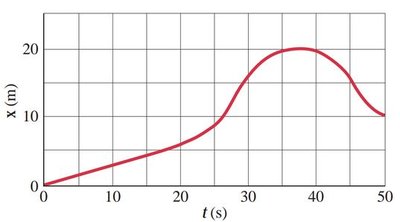
Q3. The curved line in the Figure shows the position of a rabbit moving along a tunnel as a function of time. In which time interval is the rabbit going towards negative x and slowing down?
Background
Topic: Kinematics – Position, Velocity, and Acceleration
This question tests your ability to interpret position vs. time graphs and understand motion direction and changes in speed.
Key Terms and Formulas:
Position (): The location of the rabbit at a given time.
Velocity (): The slope of the position vs. time graph, .
Acceleration (): The rate of change of velocity, .
Step-by-Step Guidance
Examine the graph to identify intervals where the position () is decreasing, indicating motion toward negative .
Determine where the slope (velocity) is negative and whether the magnitude of the slope is decreasing (slowing down).
Look for the interval where the curve is moving downward and becoming less steep.
Compare the intervals given in the answer choices to the graph and select the one that matches these criteria.
Try solving on your own before revealing the answer!
Final Answer: (1) 45 to 50 s
During 45 to 50 s, the position decreases and the slope becomes less steep, indicating the rabbit is moving toward negative and slowing down.
Q4. In her skiff Amy sails 3.0 km due west. If she then sails 30° north of east for 8.0 km, the distance from her starting point (in km) is:
Background
Topic: Vector Addition and Displacement
This question tests your ability to use vector addition to find the resultant displacement.
Key Terms and Formulas:
Displacement: The straight-line distance from the starting point to the final position.
Vector addition: Combine vectors using components.
Law of cosines:
Step-by-Step Guidance
Draw a diagram showing Amy’s two legs of travel: 3.0 km west and 8.0 km at 30° north of east.
Break the second leg into components: east and north.
Calculate the total displacement vector by adding the components.
Set up the formula for the magnitude of the displacement using the law of cosines or Pythagorean theorem as appropriate.
Try solving on your own before revealing the answer!
Final Answer: (2) 6.1 km
Using vector addition and the law of cosines, the distance from the starting point is approximately 6.1 km.
Q5. A hot air balloon is ascending at a rate of 10 m/s and is 75 m above the ground when a package is dropped over the side. How long does it take for the package to reach the ground (in s)?
Background
Topic: Kinematics – Free Fall with Initial Velocity
This question tests your ability to solve kinematics problems involving vertical motion with an initial velocity.
Key Terms and Formulas:
Initial velocity (): The velocity at which the package is dropped (10 m/s upward).
Displacement (): The vertical distance to the ground (75 m).
Kinematic equation:
Acceleration (): m/s2 (downward).
Step-by-Step Guidance
Set up the kinematic equation for vertical motion: .
Plug in the values: m (downward), m/s (upward), m/s2.
Rearrange the equation to solve for (time to reach the ground).
Set up the quadratic equation and prepare to solve for using the quadratic formula.
Try solving on your own before revealing the answer!
Final Answer: (1) 5.1 s
Solving the quadratic equation gives the time for the package to reach the ground as approximately 5.1 seconds.
Q6. The Piper J3 Cub is a vintage 2-seat, light airplane. Starting from rest it attains its lift off speed of 57.60 km/h after traveling a mere 113.0 m. What acceleration (assumed constant in m/s2) does it have during that take-off?
Background
Topic: Kinematics – Constant Acceleration
This question tests your ability to use kinematic equations to solve for acceleration.
Key Terms and Formulas:
Initial velocity (): 0 m/s (starting from rest).
Final velocity (): 57.60 km/h (convert to m/s).
Displacement (): 113.0 m.
Kinematic equation:
Step-by-Step Guidance
Convert the final velocity from km/h to m/s.
Set up the kinematic equation: .
Plug in the known values: , m, (in m/s).
Rearrange the equation to solve for (acceleration).
Try solving on your own before revealing the answer!
Final Answer: (1) 1.133 m/s2
After converting units and plugging into the kinematic equation, the acceleration is approximately 1.133 m/s2.
Q7. A pop-up fly ball goes straight up leaving the bat with a speed of 30.0 m/s. The catcher catches it at the same height from which it left the bat. Ignoring air resistance how long was the ball in the air (in s)?
Background
Topic: Kinematics – Vertical Motion
This question tests your ability to analyze projectile motion with symmetric ascent and descent.
Key Terms and Formulas:
Initial velocity (): 30.0 m/s (upward).
Acceleration (): m/s2 (downward).
Time to reach maximum height:
Total time in air:
Step-by-Step Guidance
Calculate the time for the ball to reach its maximum height using .
Double this time to get the total time in the air (up and down).
Plug in the values for and .
Try solving on your own before revealing the answer!
Final Answer: (1) 6.1 s
The total time in the air is approximately 6.1 seconds, using the formula .
Q8. An empty elevator of mass 430 kg arriving at the ground floor from an upper story decelerates with a magnitude of 1.80 m/s2. The tension in its single supporting cable (in N) must therefore be:
Background
Topic: Newton’s Second Law – Forces and Tension
This question tests your ability to analyze forces acting on a mass during acceleration or deceleration.
Key Terms and Formulas:
Mass (): 430 kg.
Acceleration (): 1.80 m/s2 (deceleration).
Gravity (): 9.8 m/s2.
Tension (): (since decelerating downward).
Step-by-Step Guidance
Identify the forces acting on the elevator: gravity (downward) and tension (upward).
Set up Newton’s second law: (since acceleration is upward relative to gravity).
Rearrange to solve for tension: .
Plug in the values for , , and .
Try solving on your own before revealing the answer!
Final Answer: (2) 4210 N
The tension in the cable is approximately 4210 N, using .
Q9. Five identical candy boxes each of mass 1.0 kg are stacked vertically one above the other on a tray table on a train moving at a constant speed of 11 m/s. The net force acting on the middle box (i.e. the 3rd box from the top), in N, is (hint: what does Newton’s 1st law say?):
Background
Topic: Newton’s First Law – Inertia
This question tests your understanding of net force when an object moves at constant velocity.
Key Terms and Formulas:
Net force (): The sum of all forces acting on an object.
Newton’s First Law: if velocity is constant.
Step-by-Step Guidance
Recall that constant speed means no acceleration.
Apply Newton’s First Law: If there is no acceleration, the net force must be zero.
Consider the forces acting on the middle box: gravity and normal force, which balance each other.
Try solving on your own before revealing the answer!
Final Answer: (1) 0 N
Since the box moves at constant speed, the net force is zero according to Newton’s First Law.
Q10. A 4.0 kg block of ice slides with negligible friction down a plank inclined at 36° from the horizontal. Its acceleration, in m/s2, is:
Background
Topic: Newton’s Second Law – Inclined Plane
This question tests your ability to resolve forces and calculate acceleration on an inclined plane.
Key Terms and Formulas:
Inclined plane angle (): 36°.
Gravity (): 9.8 m/s2.
Acceleration (): (no friction).
Step-by-Step Guidance
Identify the component of gravity parallel to the incline: .
Set up the formula for acceleration: .
Plug in the values for and .
Try solving on your own before revealing the answer!
Final Answer: (3) 4.9 m/s2
The acceleration is m/s2.
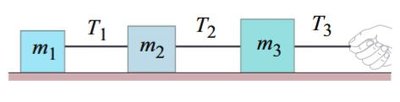
Q11. Three connected blocks are pulled to the right on a horizontal frictionless table by a force T3 = 201 N as shown in the sketch. If m1 = 12 kg, m2 = 24 kg, and m3 = 31 kg, calculate the magnitude of the tension T1.
Background
Topic: Newton’s Second Law – Systems of Connected Masses
This question tests your ability to analyze forces in a system of connected objects.
Key Terms and Formulas:
Tension (): The force in the string connecting and .
Newton’s Second Law: .
Acceleration (): All blocks accelerate together.
Step-by-Step Guidance
Calculate the total mass: .
Use to find the acceleration: .
Find by considering the force needed to accelerate and together: .
Set up the formula for and prepare to plug in the values.
Try solving on your own before revealing the answer!
Final Answer: (1) 36 N
Using the calculated acceleration and the combined mass of and , is approximately 36 N.
