 뒤로
Physics with Calculus: Friction, Circular Motion, and Dynamics Study Guide
스터디 가이드 - 스마트 노트
 자료에 맞춘 맞춤형 노트, 핵심 정의, 예시, 맥락을 확장해 제공합니다.
Q2. A force of 35.0 N is required to start a 6.0-kg box moving across a horizontal concrete floor. (a) What is the coefficient of static friction between the box and the floor? (b) If the 35.0-N force continues, the box accelerates at 0.60 m/s². What is the coefficient of kinetic friction?
Background
Topic: Friction and Newton's Laws
This question tests your understanding of static and kinetic friction, and how to use Newton's second law to relate forces, mass, and acceleration.
Key Terms and Formulas:
Static friction force:
Kinetic friction force:
Normal force on a horizontal surface:
Newton's second law:
Step-by-Step Guidance
For part (a), recognize that the force required to start the box moving is equal to the maximum static friction force: .
Write the equation for maximum static friction: , where for a horizontal surface.
Set up the equation and solve for .
For part (b), use Newton's second law: to relate the applied force, kinetic friction, and acceleration.
Express the kinetic friction force as and substitute .
Set up the equation and solve for .
Try solving on your own before revealing the answer!
Final Answer:
(a)
(b)
We used the definitions of static and kinetic friction, and applied Newton's second law to solve for the coefficients. The static coefficient is higher, as expected, since it takes more force to start moving than to keep moving.
Q13. A 1280-kg car pulls a 350-kg trailer. The car exerts a horizontal force of N against the ground in order to accelerate. What force does the car exert on the trailer? Assume an effective friction coefficient of 0.15 for the trailer.
Background
Topic: Newton's Laws, Friction, and Tension
This question tests your ability to analyze forces in a system with friction and to apply Newton's second law to connected objects.
Key Terms and Formulas:
Friction force:
Newton's second law:
System analysis: Consider the car and trailer as a system, and then focus on the trailer alone.
Step-by-Step Guidance
Calculate the total mass of the system: kg.
Find the acceleration of the system using , where is the net force applied by the car minus friction on the trailer.
Calculate the friction force on the trailer: .
Draw a free-body diagram for the trailer and write Newton's second law for the trailer alone: .
Substitute the acceleration found earlier and solve for the force that the car exerts on the trailer.
Try solving on your own before revealing the answer!
Final Answer:
The force the car exerts on the trailer is N.
This is found by calculating the acceleration of the system and then applying Newton's second law to the trailer, accounting for friction.
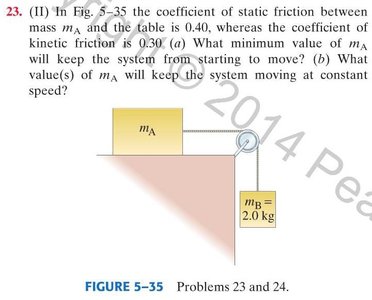
Q23. In Fig. 5–35, the coefficient of static friction between mass and the table is 0.40, whereas the coefficient of kinetic friction is 0.30. (a) What minimum value of $m_A$ will keep the system from starting to move? (b) What value(s) of $m_A$ will keep the system moving at constant speed?
Background
Topic: Friction, Equilibrium, and Dynamics of Connected Objects
This question tests your understanding of static and kinetic friction, and how to analyze forces in a two-mass pulley system.
Key Terms and Formulas:
Static friction:
Kinetic friction:
Equilibrium: Forces balance when the system is at rest or moves at constant speed.
Newton's second law for each mass.
Step-by-Step Guidance
For part (a), set up the force balance for the system just before it moves: the maximum static friction force equals the weight of .
Write the equation: and solve for .
For part (b), set up the force balance for constant speed: the kinetic friction force equals the weight of .
Write the equation: and solve for .
Try solving on your own before revealing the answer!
Final Answer:
(a) kg (minimum to prevent motion)
(b) kg (to move at constant speed)
We set the friction force equal to the hanging weight and solved for the required mass on the table.
Q34. What is the maximum speed with which a 1200-kg car can round a turn of radius 80.0 m on a flat road if the coefficient of friction between tires and road is 0.65? Is this result independent of the mass of the car?
Background
Topic: Circular Motion and Friction
This question tests your understanding of centripetal force and how friction provides the necessary force for circular motion on a flat surface.
Key Terms and Formulas:
Centripetal force:
Friction force:
Maximum speed occurs when friction force equals required centripetal force.
Step-by-Step Guidance
Set the maximum friction force equal to the required centripetal force: .
Notice that the mass cancels out, so the result does not depend on the car's mass.
Solve for : .
Plug in the values for , , and to find the maximum speed.
Try solving on your own before revealing the answer!
Final Answer:
The maximum speed is m/s, and this result is independent of the mass of the car because mass cancels out in the equation.
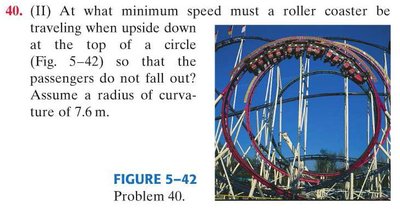
Q40. At what minimum speed must a roller coaster be traveling when upside down at the top of a circle (radius 7.6 m) so that the passengers do not fall out?
Background
Topic: Circular Motion and Apparent Weightlessness
This question tests your understanding of centripetal force and the conditions for maintaining contact at the top of a vertical loop.
Key Terms and Formulas:
Centripetal force:
At the minimum speed, the normal force is zero and gravity provides all the centripetal force.
Set and solve for .
Step-by-Step Guidance
At the top of the circle, set the gravitational force equal to the required centripetal force for minimum speed: .
Notice that mass cancels out, so the minimum speed depends only on and .
Solve for : .
Plug in m/s² and m to find the minimum speed.
Try solving on your own before revealing the answer!
Final Answer:
The minimum speed is m/s. This ensures that gravity alone provides the necessary centripetal force to keep passengers in their seats at the top of the loop.
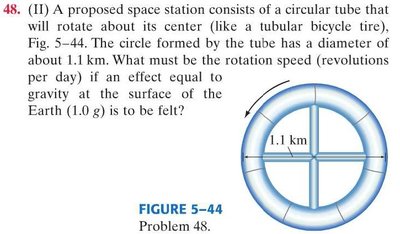
Q48. A proposed space station consists of a circular tube that will rotate about its center (like a tubular bicycle tire), diameter 1.1 km. What must be the rotation speed (revolutions per day) if an effect equal to gravity at the surface of the Earth (1.0 g) is to be felt?
Background
Topic: Artificial Gravity and Circular Motion
This question tests your understanding of how centripetal acceleration can simulate gravity in a rotating space station.
Key Terms and Formulas:
Centripetal acceleration:
Relationship between angular speed and revolutions per day:
Set to solve for the required angular speed.
Step-by-Step Guidance
Convert the diameter to radius: km m.
Set the centripetal acceleration equal to : .
Solve for : .
Convert (in rad/s) to revolutions per day using and then multiply by the number of seconds in a day.
Try solving on your own before revealing the answer!
Final Answer:
The required rotation speed is approximately 13 revolutions per day. This provides an artificial gravity equal to Earth's gravity at the station's rim.
Q53. A 975-kg sports car (including driver) crosses the rounded top of a hill (radius = 88.0 m) at 12.0 m/s. (a) Determine the normal force exerted by the road on the car. (b) The normal force exerted by the car on the 72.0-kg driver. (c) The car speed at which the normal force on the driver equals zero.
Background
Topic: Circular Motion and Apparent Weight
This question tests your understanding of normal force in circular motion, especially at the top of a hill, and the concept of apparent weightlessness.
Key Terms and Formulas:
Normal force: (at the top of a hill)
Set to find the speed for apparent weightlessness.
Step-by-Step Guidance
For (a), use for the car at the top of the hill.
For (b), apply the same formula for the driver: .
For (c), set and solve for : , so .
Try solving on your own before revealing the answer!
Final Answer:
(a) N
(b) N
(c) m/s for zero normal force (apparent weightlessness)
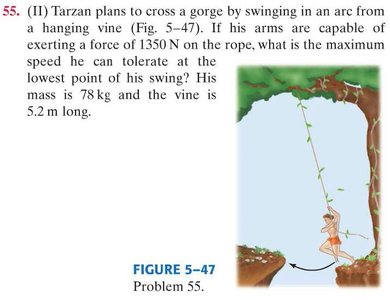
Q55. Tarzan plans to cross a gorge by swinging in an arc from a hanging vine (length 5.2 m). If his arms are capable of exerting a force of 1350 N on the rope, what is the maximum speed he can tolerate at the lowest point of his swing? His mass is 78 kg.
Background
Topic: Circular Motion and Tension
This question tests your understanding of the forces acting on a body in circular motion, specifically the tension in the rope at the lowest point of the swing.
Key Terms and Formulas:
Tension at the lowest point:
Set N and solve for .
Step-by-Step Guidance
Write the equation for the forces at the lowest point: .
Substitute the given values for , , , and (length of vine).
Rearrange to solve for and then for .
Try solving on your own before revealing the answer!
Final Answer:
The maximum speed Tarzan can tolerate at the lowest point is m/s.
This is found by setting the maximum tension equal to the sum of his weight and the required centripetal force.
Q82. In a "Rotor-ride" at a carnival, people rotate in a vertical cylindrically walled room. If the room radius was 5.5 m, and the rotation frequency 0.50 revolutions per second when the floor drops out, what minimum coefficient of static friction keeps the people from slipping down? Is there really an outward force pressing them against the wall? If so, what is its source? If not, what is the proper description of their situation (besides nausea)?
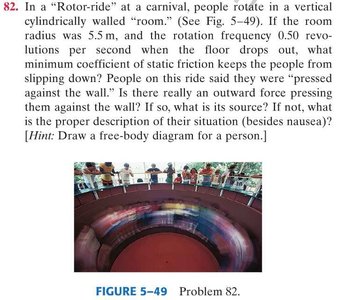
Background
Topic: Circular Motion, Friction, and Non-inertial Reference Frames
This question tests your understanding of how friction provides the upward force to prevent slipping, and the nature of forces in rotating frames.
Key Terms and Formulas:
Centripetal force:
Static friction:
Normal force is provided by the wall, friction acts upward to balance weight.
Frequency to angular speed:
Step-by-Step Guidance
Calculate the angular speed: .
Find the normal force: (centripetal force provided by the wall).
Set the maximum static friction force equal to the person's weight: .
Solve for : .
Consider the nature of the forces: Is there an outward force? Discuss the role of the normal force and the rotating frame.
Try solving on your own before revealing the answer!
Final Answer:
The minimum coefficient of static friction is .
There is no real outward force; the normal force from the wall provides the centripetal force, and friction prevents slipping. The sensation of an outward force is due to the non-inertial (rotating) reference frame.
