 뒤로
Physics with Calculus: Friction, Forces, and Inclined Planes Study Guidance
스터디 가이드 - 스마트 노트
 자료에 맞춘 맞춤형 노트, 핵심 정의, 예시, 맥락을 확장해 제공합니다.
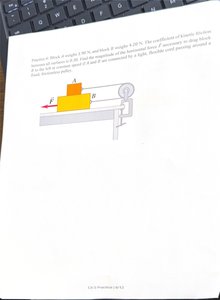
Q1. Block A weighs 1.0 kg, and block B weighs 2.0 kg. The coefficient of kinetic friction between all surfaces is 0.20. Find the amount of the horizontal force F necessary to drag block A at constant speed if block B of 2.0 kg is connected by a light, flexible cord passing around a fixed, frictionless pulley.
Background
Topic: Newton's Laws, Friction, and Pulley Systems
This question tests your understanding of forces, friction, and the application of Newton's second law in a system involving a pulley and two connected masses.
Key Terms and Formulas
Newton's Second Law:
Kinetic Friction Force:
Weight:
Normal Force: For horizontal surfaces,
System is at constant speed, so (forces are balanced)
Step-by-Step Guidance
Identify all forces acting on both blocks. For block A: applied force , friction force, tension from the cord. For block B: weight, tension from the cord.
Write force balance equations for each block. For block A, consider horizontal forces; for block B, consider vertical forces.
Express the friction force for each block using . For block A, ; for block B, (if relevant).
Set up the equations for constant speed (net force = 0) and relate the tension in the cord to the forces acting on both blocks.
Combine the equations to solve for the required horizontal force . Stop here and set up the final formula for the student to plug in values.
Try solving on your own before revealing the answer!
Final Answer:
Using force balance and friction calculations, the horizontal force required is .
Plugging in values: .
This ensures both blocks move at constant speed, overcoming friction and the weight of block B.
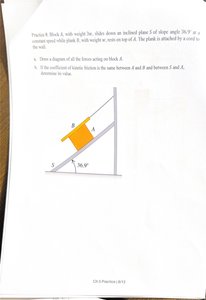
Q2. Block A, with weight 3N, slides down an inclined plane S of slope angle 36.9° at a constant speed while plank B, with weight w, rests on top of A. The plank is attached by a cord to the wall.
Background
Topic: Forces on Inclined Planes, Friction, and Free-Body Diagrams
This question tests your ability to analyze forces on an inclined plane, including friction, normal force, and tension, and to draw a free-body diagram.
Key Terms and Formulas
Inclined Plane Forces: , ,
Component of weight down the slope:
Constant speed implies net force along the slope is zero
Free-body diagram: shows all forces acting on block A
Step-by-Step Guidance
Draw a free-body diagram for block A, showing weight, normal force, friction, and tension from the cord.
Resolve the weight of block A into components parallel and perpendicular to the inclined plane.
Write the force balance equation along the slope: (where is tension, is friction).
Express the normal force as and friction as .
Set up the equation to solve for the coefficient of kinetic friction using the given values and relationships. Stop here and let the student complete the calculation.
Try solving on your own before revealing the answer!
Final Answer:
By balancing forces along the slope and using the given angle, the coefficient of kinetic friction is .
This value ensures block A slides at constant speed, with friction exactly balancing the downslope component of gravity.
