 뒤로
뒤로Physics with Calculus: Kinematics, Dynamics, and Work-Energy Principles
스터디 가이드 - 스마트 노트
 자료에 맞춘 맞춤형 노트, 핵심 정의, 예시, 맥락을 확장해 제공합니다.
Kinematics in One and Multiple Dimensions
Describing Motion: Position, Displacement, and Trajectory
Kinematics is the study of motion without considering its causes. It involves describing the position, displacement, and trajectory of objects in one or more dimensions.
Position (x): The location of an object relative to a reference point, typically measured in meters (m). Position is a vector, requiring both magnitude and direction.
Displacement (Δx): The change in position of an object, calculated as . Displacement is also a vector.
Trajectory: The actual path taken by an object during its motion.
Average and Instantaneous Velocity
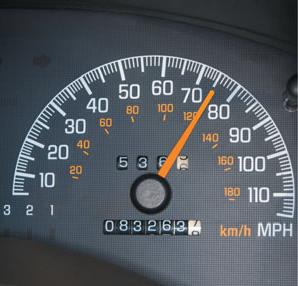
Velocity describes how quickly and in what direction an object's position changes.
Average velocity (vavg):
Instantaneous velocity (v):
Velocity is a vector; its direction is determined by the sign of the displacement.
Average and Instantaneous Acceleration
Acceleration measures how quickly velocity changes with time.
Average acceleration (aavg):
Instantaneous acceleration (a):
Acceleration is a vector; its direction is determined by the change in velocity.
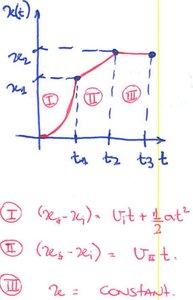
Kinematic Equations for Constant Acceleration
For motion with constant acceleration, the following equations are fundamental:
Kinematics in Two and Three Dimensions
Vector Representation of Position, Velocity, and Acceleration
In two or three dimensions, position, velocity, and acceleration are described using vectors:
Position vector:
Displacement vector:
Velocity vector:
Acceleration vector:
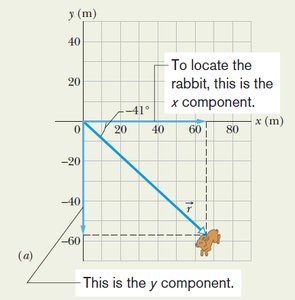
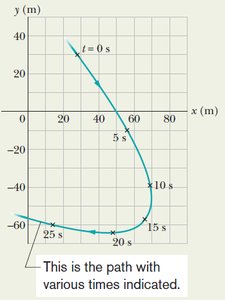
Example: Rabbit's Position and Velocity
Given and as functions of time, the position and velocity vectors can be found by evaluating and differentiating these functions at a specific time.
Position at s: m
Magnitude: m
Angle:
Projectile Motion
Definition and Characteristics
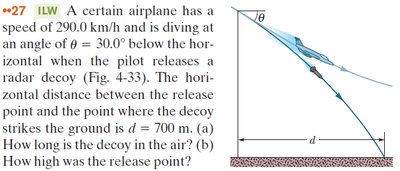
Projectile motion describes the two-dimensional motion of an object under the influence of gravity, assuming air resistance is negligible. The horizontal and vertical motions are independent except for the time variable.
Horizontal motion: Constant velocity,
Vertical motion: Constant acceleration,
Equations:



Range and Maximum Height
Range (R):
Maximum height (H):
The trajectory is a parabola.
Newton's Laws of Motion
First Law (Law of Inertia)
An object remains at rest or in uniform motion unless acted upon by a net external force.
Inertia: The tendency of an object to resist changes in its state of motion.
Second Law (Law of Acceleration)
The acceleration of an object is directly proportional to the net force acting on it and inversely proportional to its mass.
Force is measured in newtons (N):
Third Law (Action-Reaction)
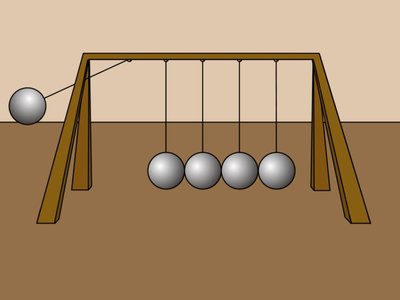
For every action, there is an equal and opposite reaction. Forces always occur in pairs acting on different objects.
If object A exerts a force on object B, then B exerts an equal and opposite force on A.
Types of Forces
Gravitational Force
The attractive force between two masses, described by Newton's law of universal gravitation:
On Earth's surface:

Normal Force
The support force exerted by a surface perpendicular to the object in contact with it.
On a flat surface:
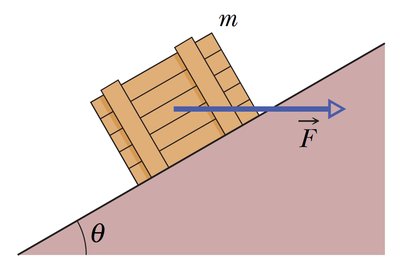
On an incline:
Tension
The pulling force transmitted through a string, rope, or cable when it is pulled tight by forces acting from opposite ends.

Friction
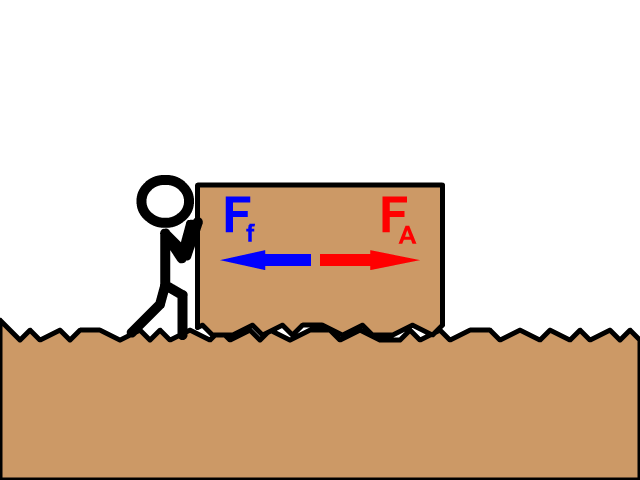
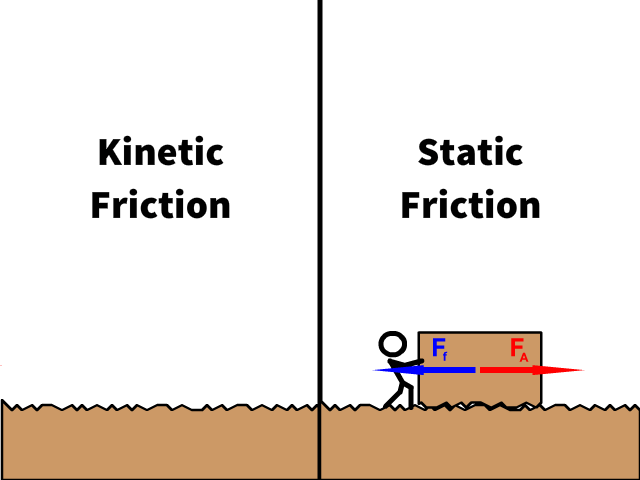
Friction is a resistive force that opposes the relative motion of two surfaces in contact. There are two main types:
Static friction (fs): Prevents motion up to a maximum value
Kinetic friction (fk): Opposes motion once it has started,
Typically,
Circular Motion and Centripetal Force
Circular Motion
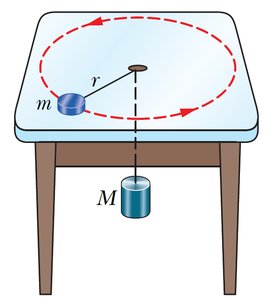
When an object moves in a circle at constant speed, it experiences a centripetal acceleration directed toward the center of the circle.
Centripetal acceleration:
Centripetal force:

Work and Energy
Work
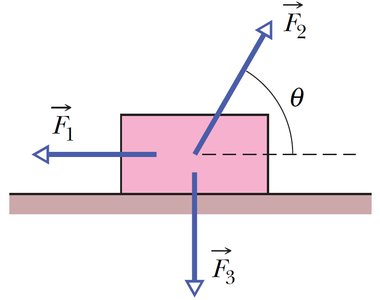
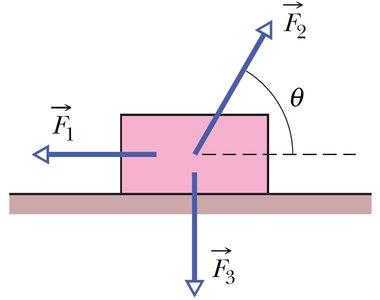
Work is the energy transferred to or from an object via the application of force along a displacement.
Definition:
Work is a scalar quantity measured in joules (J).
Kinetic Energy and the Work-Energy Theorem
Kinetic energy is the energy of motion. The work-energy theorem states that the net work done on an object is equal to its change in kinetic energy.
Kinetic energy:
Work-energy theorem:
Potential Energy
Potential energy is the energy stored due to an object's position or configuration.
Gravitational potential energy:
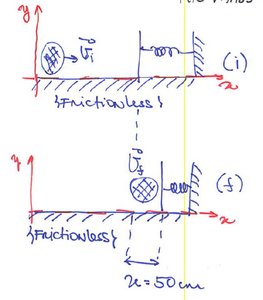
Elastic (spring) potential energy:
Conservation of Mechanical Energy
If only conservative forces (like gravity and spring force) act on a system, the total mechanical energy (kinetic + potential) remains constant:
Summary Table: Types of Forces
Force Type | Formula | Direction |
|---|---|---|
Gravitational | Downward (toward Earth) | |
Normal | Perpendicular to surface | |
Tension | Depends on system | Along rope/string |
Friction (kinetic) | Opposes motion | |
Friction (static) | Opposes impending motion | |
Centripetal | Toward center of circle |
Additional info: This guide covers the foundational concepts of kinematics, dynamics, and work-energy principles, including vector analysis, projectile motion, Newton's laws, types of forces, and energy conservation. It is suitable for college-level Physics with Calculus students preparing for exams or seeking a comprehensive summary of these topics.
