 뒤로
Physics with Calculus: Motion, Kinematics, and Dynamics Study Guidance
스터디 가이드 - 스마트 노트
 자료에 맞춘 맞춤형 노트, 핵심 정의, 예시, 맥락을 확장해 제공합니다.
Q1. Which position-versus-time graph best describes the motion diagram below?

Background
Topic: Kinematics – Motion Diagrams and Position-Time Graphs
This question tests your ability to interpret a motion diagram and relate it to a position-versus-time graph. The diagram shows the positions of an object at equal time intervals, with arrows indicating direction and speed.
Key Terms and Concepts:
Motion diagram: A sequence of images showing an object's position at equal time intervals.
Position-versus-time graph: A plot of an object's position (x) as a function of time (t).
Constant velocity: Equal spacing between positions means the object moves at a constant speed.
Step-by-Step Guidance
Observe the motion diagram: The object moves to the right, and the spacing between each dot is equal, indicating constant velocity.
Recall that constant velocity means the position changes by equal amounts in equal time intervals.
On a position-versus-time graph, constant velocity is represented by a straight line with a constant slope.
Think about the direction: If the object moves right, the slope is positive; if left, the slope is negative.
Try solving on your own before revealing the answer!
Final Answer: The correct graph is a straight line with positive slope.
The motion diagram shows constant velocity to the right, so the position-versus-time graph should be a straight line with a positive slope, indicating uniform motion in the positive direction.
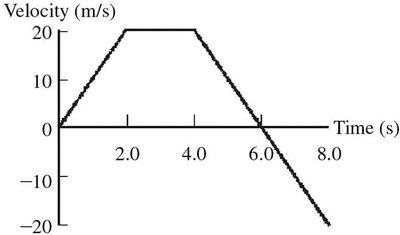
Q2. The figure shows a graph of the velocity of an object as a function of time. What is the displacement (in meters) of the object from 0 s to 6.0 s?
Background
Topic: Kinematics – Area Under Velocity-Time Graph
This question tests your ability to calculate displacement by finding the area under a velocity-time graph.
Key Terms and Formulas:
Displacement: The change in position of an object.
Velocity-time graph: The area under the curve between two times gives the displacement.
Area calculation: For straight-line segments, use geometric shapes (rectangles, triangles).
Step-by-Step Guidance
Identify the time interval: 0 s to 6.0 s.
Break the graph into simple shapes: triangle (0–2 s), rectangle (2–4 s), triangle (4–6 s).
Calculate the area of each shape:
Sum the areas to find the total displacement.
Try solving on your own before revealing the answer!
Final Answer: 80 meters
The total displacement is the sum of the areas under the velocity-time graph: 20 m (triangle) + 40 m (rectangle) + 20 m (triangle) = 80 m.
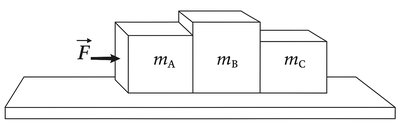
Q14. Three blocks with mass mA = 1.5 kg, mB = 2.5 kg, and mC = 4.0 kg are lined up in a row on a frictionless horizontal surface. A horizontal force of F = 16 N is applied to the mA block, pushing all three forward. What is the magnitude of the force (in N) that the mB block exerts on the mC block?
Background
Topic: Newton's Laws – Forces in Systems of Connected Objects
This question tests your understanding of how forces are transmitted through a system of connected masses.
Key Terms and Formulas:
Newton's Second Law:
System acceleration:
Force between blocks: The force mB exerts on mC is
Step-by-Step Guidance
Calculate the total mass:
Find the acceleration of the system:
Determine the force that mB exerts on mC:
Set up the calculation for using the values above.
Try solving on your own before revealing the answer!
Final Answer: 8.0 N
The force mB exerts on mC is N, where the system acceleration is 2.0 m/s².
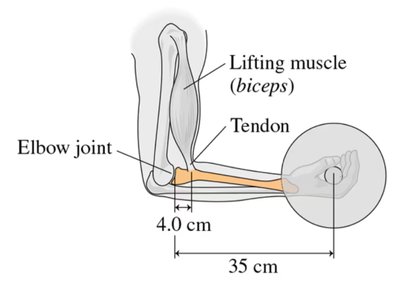
Q18. A person holds a 5-kg weight in one hand with the forearm horizontal, as shown in the figure. The distance from the elbow joint to the hand is 35 cm, and the biceps tendon attaches to the forearm 4.0 cm from the elbow joint. Assume the forearm and hand have negligible mass, and the system is in static equilibrium. If the biceps muscle pulls straight upward on the forearm, what is the tension (in newtons) in the biceps?
Background
Topic: Statics – Torque and Equilibrium
This question tests your ability to apply the concept of torque and equilibrium to a biological system.
Key Terms and Formulas:
Torque:
Static equilibrium: The sum of torques about the elbow joint must be zero.
Biceps tension:
Step-by-Step Guidance
Identify the forces: weight of the 5-kg mass and the tension in the biceps.
Set up the torque equation about the elbow joint:
Plug in the values: m, m, kg, m/s².
Rearrange to solve for .
Try solving on your own before revealing the answer!
Final Answer: 429 N
The tension in the biceps is N.
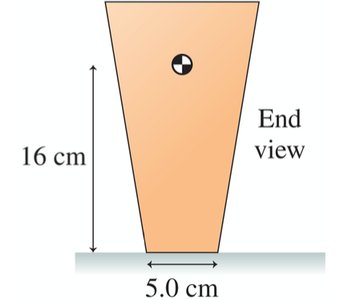
Q19. The object in the figure has a center of gravity 16 cm above the floor. Through what maximum angle can the object be tilted without falling over?
Background
Topic: Statics – Stability and Tipping
This question tests your understanding of stability and the conditions for tipping based on the center of gravity.
Key Terms and Formulas:
Center of gravity: The point where the object's weight is considered to act.
Tipping condition: The object tips when the line through the center of gravity passes outside the base.
Maximum angle:
Step-by-Step Guidance
Find the half-width of the base: cm.
Use the formula:
Calculate using the arctangent function.
Set up the calculation for the maximum angle.
Try solving on your own before revealing the answer!
Final Answer: 8.9°
The maximum angle is .
Q29. A 2.5 kg bucket is attached to the end of a rope. The rope wraps around a cylinder of mass 5 kg and radius 0.6 m. The cylinder rotates on an axle through its center. The bucket is released from rest to fall downward. What is the acceleration (in m/s²) of the bucket?
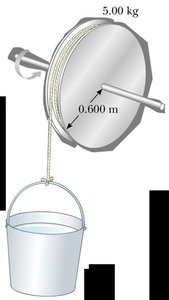
Background
Topic: Rotational Dynamics – Coupled Translational and Rotational Motion
This question tests your ability to analyze a system where linear and rotational motion are coupled, using Newton's laws and moment of inertia.
Key Terms and Formulas:
Moment of inertia (cylinder):
Newton's second law (for bucket):
Torque and angular acceleration: ,
Combined equation:
Step-by-Step Guidance
Calculate the moment of inertia for the cylinder:
Find and add to the mass of the bucket.
Set up the equation for acceleration:
Plug in the values for , , , and .
Try solving on your own before revealing the answer!
Final Answer: 4.9 m/s²
The acceleration of the bucket is m/s².
Q40. As shown in the figure, a 4.0-kg block is moving at 5.0 m/s along a horizontal frictionless surface toward an ideal spring that is attached to a wall. After the block collides with the spring, the spring is compressed a maximum distance of 0.68 m. What is the speed (in m/s) of the block when the spring is compressed to only one-half of the maximum distance?
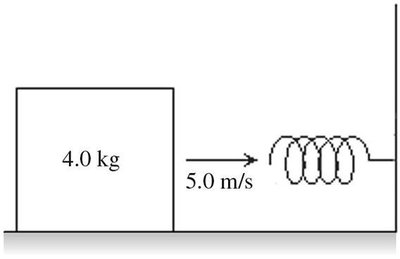
Background
Topic: Energy Conservation – Kinetic and Potential Energy in Spring Systems
This question tests your ability to apply energy conservation to a block-spring system.
Key Terms and Formulas:
Kinetic energy:
Spring potential energy:
Energy conservation: at maximum compression
At half compression:
Step-by-Step Guidance
Set up the energy conservation equation:
At half compression, use
Express in terms of
Set up the equation for and solve for it.
Try solving on your own before revealing the answer!
Final Answer: 4.3 m/s
At half the maximum compression, the block's speed is m/s.
Q42. The figure below shows one 2-kg block at different times during its motion. The block is initially moving to the right with a velocity v = 4.0 m/s at Position A. It then descends a ramp of height h = 1 m, and continues moving towards Position B. The track (including the ramp) between A and B is smooth with negligible friction. After passing Position B, the block enters a rough horizontal section, where the coefficient of kinetic friction between the block and the rough surface is μk = 0.26. In this rough section, the block slows down due to friction and eventually comes to rest at Position C. Air resistance is negligible. What is the distance (in meters) between B and C?
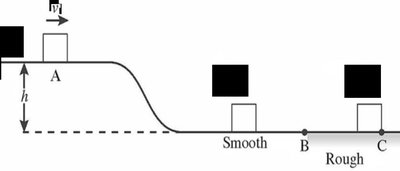
Background
Topic: Work-Energy Principle – Energy Dissipation by Friction
This question tests your ability to use energy conservation and the work done by friction to determine the stopping distance.
Key Terms and Formulas:
Kinetic energy:
Potential energy:
Work by friction:
Energy conservation: ;
Step-by-Step Guidance
Calculate the speed at B using energy conservation:
Find the kinetic energy at B:
Set up the equation:
Rearrange to solve for .
Try solving on your own before revealing the answer!
Final Answer: 7 meters
The distance between B and C is meters.
Q43. A bead is moving with a speed of 20 m/s at position A on the track shown in the figure. This track is friction-free, and there is no appreciable air resistance. What is the speed of the bead at point C?
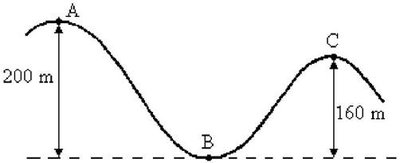
Background
Topic: Energy Conservation – Mechanical Energy in Frictionless Systems
This question tests your ability to use conservation of mechanical energy to find the speed at a different height.
Key Terms and Formulas:
Conservation of energy:
Kinetic energy:
Potential energy:
Speed at C:
Step-by-Step Guidance
Write the energy conservation equation between points A and C.
Plug in the values for , , and .
Set up the equation for .
Prepare to solve for .
Try solving on your own before revealing the answer!
Final Answer: 34 m/s
The speed at point C is m/s.
