 뒤로
Physics with Calculus: Sound, Vibrations, and Wave Motion
스터디 가이드 - 스마트 노트
 자료에 맞춘 맞춤형 노트, 핵심 정의, 예시, 맥락을 확장해 제공합니다.
Air Pressure and Properties of the Medium
What is Air Pressure?
Air pressure is the force exerted by the weight of air molecules surrounding an object. It is directly related to the number of air molecules and their average kinetic energy (speed of motion). The Earth's atmosphere consists of layers of molecules that, despite their small size, exert measurable pressure on objects at the surface.
Definition: Air pressure is the weight of air per unit area above a surface.
Standard Atmospheric Pressure: Pascals (Pa) at sea level.
Dependence: Air pressure increases with the number of molecules and their velocity.
Example: The tympanic membrane (eardrum) experiences atmospheric pressure from the surrounding air.

Properties of the Transmitting Medium
The medium through which sound travels (typically air) has specific properties that affect sound transmission:
Density: Air has a density of approximately .
Brownian Motion: Air molecules move randomly at high speeds (about ), but their average velocity is zero due to equal movement in all directions.
Pressure: Air molecules exert atmospheric pressure on objects.
Threshold of Hearing: Air velocity at the threshold of human hearing is .
Mass, Density, and Pressure
Understanding the concepts of mass, density, and pressure is fundamental to the study of sound and waves:
Mass (m): The amount of matter in an object (measured in kg or lbs).
Density (\( \rho \)): Mass per unit volume ().
Pressure (P): Force per unit area ( or Pa).
Gravity: Causes air pressure and density to increase toward the Earth's surface.

Elasticity
Elasticity is the property of matter that enables it to resist and recover from distortion. When a force is applied to a material, it deforms, but elasticity provides a restoring force that returns it to its original shape or volume.
Elastic Force: The restoring force proportional to the displacement from equilibrium.
Formula: (Hooke's Law), where is the stiffness and is the displacement.
Example: Air molecules compressed by a sound wave tend to return to their original positions due to elasticity.

Properties of the Sound Source
Vibration and Sound Production
Sound is produced when an object vibrates, causing systematic oscillations in the surrounding air pressure. For an object to vibrate, it must possess both mass and elasticity.
Prerequisites for Vibration: Mass and elasticity are required for vibration.
Input Force: An external force is needed to initiate vibration (e.g., striking a tuning fork).
Amplitude: The amplitude of vibration is proportional to the input force.

Newton's Laws of Motion and Vibrations
Newton's First Law (Inertia)
Newton's First Law states that an object in uniform motion remains in that state unless acted upon by an external force. This principle explains why vibrating objects (like a mass on a spring or a tuning fork) continue to oscillate about their equilibrium position.
Inertia: The tendency of an object to resist changes in its state of motion.
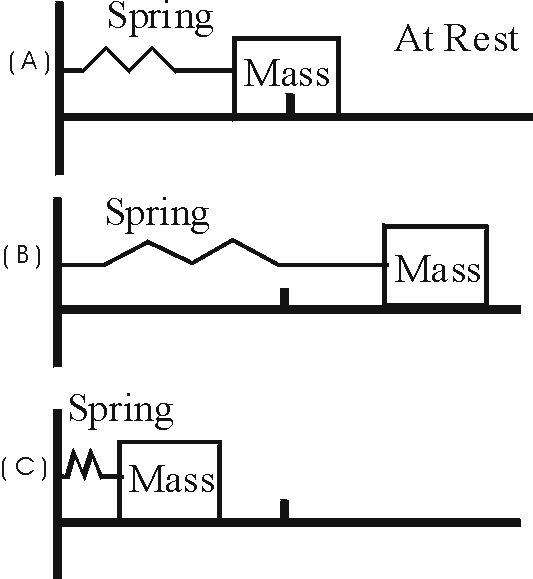
Example: A mass attached to a spring oscillates back and forth due to inertia.

Newton's Second Law (Force and Acceleration)
Newton's Second Law relates the force applied to an object, its mass, and the resulting acceleration:
Formula:
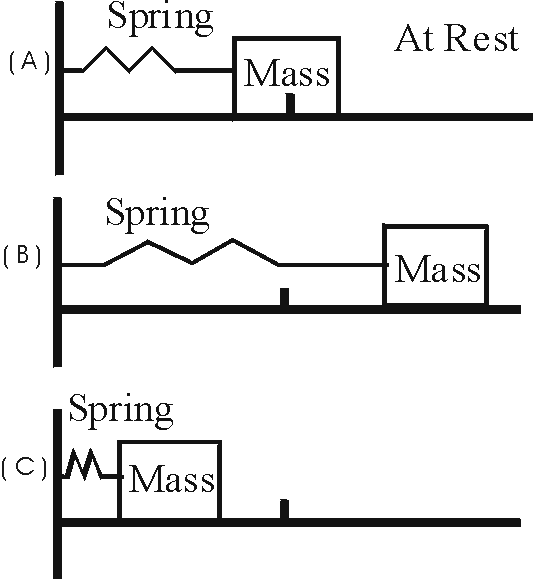
Application: The force required to move a mass on a spring is opposed by the spring's elasticity.
Elastic Force: (restoring force proportional to displacement).
Newton's Third Law (Action and Reaction)
For every action, there is an equal and opposite reaction. In vibrating systems, the input force is opposed by the restoring (elastic) force, and inertial forces cause continued motion past equilibrium.
Example: The tines of a tuning fork move past equilibrium due to inertia, then are pulled back by elasticity.

Sound Waves: Compression and Rarefaction
Transmission of Sound
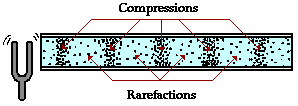
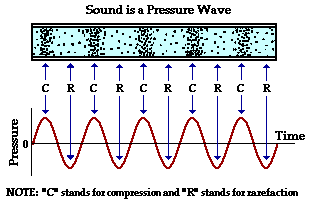
Sound is transmitted through systematic vibrations of an object, which are transferred to the surrounding air molecules. This causes local changes in air pressure, resulting in regions of compression (increased density) and rarefaction (decreased density).
Compression: Region where air molecules are pushed together.
Rarefaction: Region where air molecules are spread apart.
Energy Transfer: The oscillations in air pressure correspond to the cycles of object vibration and transfer energy through the medium.
Wave Motion
Types of Wave Motion
Waves are classified based on the direction of particle vibration relative to the direction of wave propagation:
Transverse (Shear) Waves: Particle motion is perpendicular to wave direction (e.g., light, radio waves).
Longitudinal Waves: Particle motion is parallel to wave direction (e.g., sound waves in air).
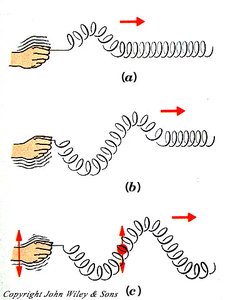


Sound Waves in Air
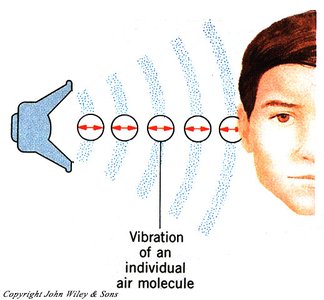
Sound waves in air are longitudinal waves, where the direction of vibration of air molecules is parallel to the direction of wave propagation. Individual air molecules oscillate back and forth but do not travel with the wave.
Example: A cork floating in water moves up and down as a wave passes, but does not travel with the wave.
Key Events: (1) Frequency: rate of air particle vibration; (2) Speed: rate at which disturbance propagates.
Energy, Work, and Sound Transmission
Law of Conservation of Energy
Energy cannot be created or destroyed, only transferred or transformed. In sound transmission, energy is transferred through the medium as the wave propagates.
Potential Energy (PE): Stored energy (e.g., in a stretched spring or raised pendulum).
Kinetic Energy (KE): Energy of motion.
Conservation: (in ideal, undamped systems).
Work
Work is the transfer of energy when a force is applied to a body, causing it to move in the direction of the force.
Formula:
Units: Joules (J), where
Application: Individual air particles are displaced (work is done), but the medium itself is not transported.
Pendulum Motion and Damping
Pendulum Motion
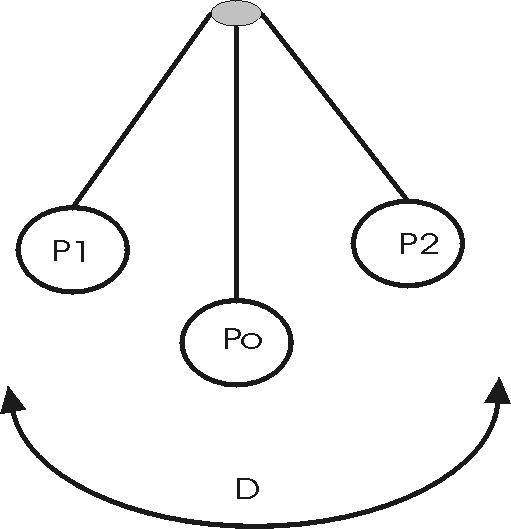
A pendulum exhibits periodic motion, converting potential energy to kinetic energy and vice versa as it swings. The total energy (PE + KE) remains constant in the absence of friction.
Momentum:
Energy Conversion: PE is maximum at the endpoints, KE is maximum at the lowest point.
Damping
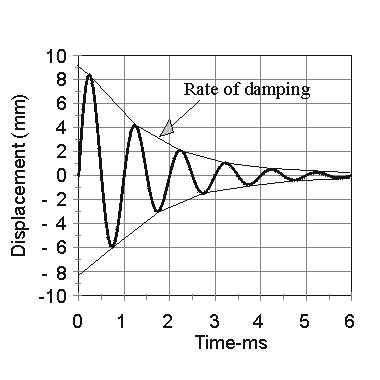
In real systems, friction opposes motion and causes the pendulum (or any oscillating system) to lose energy over time. This process is called damping, where kinetic energy is converted into thermal energy (heat) and dissipated into the medium.
Damping: The gradual reduction of amplitude in oscillatory motion due to energy loss.
Result: The pendulum eventually comes to rest as all energy is dissipated.
Summary Table: Key Properties and Equations
Property | Definition | Unit | Equation |
|---|---|---|---|
Mass (m) | Amount of matter | kg | - |
Density (\( \rho \)) | Mass per unit volume | kg/m3 | |
Pressure (P) | Force per unit area | Pa (N/m2) | |
Elastic Force (F) | Restoring force in a spring | N | |
Work (W) | Force applied over distance | J (N·m) | |
Momentum (p) | Mass times velocity | kg·m/s |
