 뒤로
Physics with Calculus: Step-by-Step Guidance for Exam Problems
스터디 가이드 - 스마트 노트
 자료에 맞춘 맞춤형 노트, 핵심 정의, 예시, 맥락을 확장해 제공합니다.
Q1. The magnitude of vector \( \vec{C} = \vec{B} - \vec{A} \) is to be found, given that the magnitude of vector \( \vec{A} \) is 16.0 units, and the magnitude of vector \( \vec{B} \) is 7.00 units. Vectors A and B start from the origin and lie in the second and third quadrants, making angles of 42.0° and 31.0° with the negative x-axis, respectively.
Background
Topic: Vector Subtraction and Magnitude
This question tests your understanding of vector components, vector subtraction, and how to calculate the magnitude of a resultant vector using trigonometry.
Key Terms and Formulas
Vector components: \( A_x = A \cos \theta_A, \; A_y = A \sin \theta_A \)
Vector subtraction: \( \vec{C} = \vec{B} - \vec{A} \)
Magnitude of a vector: \( |\vec{C}| = \sqrt{C_x^2 + C_y^2} \)
Step-by-Step Guidance
Express vectors \( \vec{A} \) and \( \vec{B} \) in terms of their x and y components using their magnitudes and angles with respect to the negative x-axis.
Calculate the x and y components for both vectors. Remember to consider the correct signs based on the quadrant each vector lies in.
Subtract the components of \( \vec{A} \) from those of \( \vec{B} \) to find the components of \( \vec{C} \): \( C_x = B_x - A_x \), \( C_y = B_y - A_y \).
Set up the formula for the magnitude of \( \vec{C} \): \( |\vec{C}| = \sqrt{C_x^2 + C_y^2} \).
Try solving on your own before revealing the answer!
Final Answer: 9.53 units
By calculating the components and applying the Pythagorean theorem, the magnitude of \( \vec{C} \) is approximately 9.53 units.
Q2. A boy throws a rock with an initial velocity of 2.15 m/s at 30.0° above the horizontal. If air resistance is negligible, how long does it take for the rock to reach the maximum height of its trajectory?
Background
Topic: Projectile Motion (Vertical Component)
This question tests your understanding of the kinematics of projectile motion, specifically the time to reach maximum height using the vertical component of velocity.
Key Terms and Formulas
Vertical velocity: \( v_{0y} = v_0 \sin \theta \)
At maximum height, vertical velocity = 0
Kinematic equation: \( v_{fy} = v_{0y} - g t \)
Step-by-Step Guidance
Calculate the initial vertical velocity component: \( v_{0y} = 2.15 \sin 30.0^\circ \).
Set the final vertical velocity at the maximum height to zero: \( v_{fy} = 0 \).
Use the kinematic equation \( v_{fy} = v_{0y} - g t \) to solve for the time to reach maximum height.
Rearrange the equation to solve for \( t \): \( t = \frac{v_{0y}}{g} \).
Try solving on your own before revealing the answer!
Final Answer: 0.110 s
The time to reach maximum height is approximately 0.110 seconds.
Q3. A projectile is fired from point O at the edge of a cliff, with initial velocity components of \( v_{0x} = 40.0 \) m/s and \( v_{0y} = 75 \) m/s. The projectile rises and then falls into the sea at point P. The time of flight is 50.0 s, and air resistance is negligible. What is the height of the cliff?
Background
Topic: Projectile Motion (Vertical Displacement)
This question tests your ability to analyze projectile motion, specifically finding the initial vertical position (height of the cliff) given the time of flight and initial velocity components.
Key Terms and Formulas
Vertical displacement: \( y = v_{0y} t - \frac{1}{2} g t^2 \)
At the end of the flight, the projectile lands at sea level (y = -h, where h is the height of the cliff).
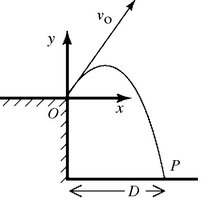
Step-by-Step Guidance
Write the equation for vertical displacement: \( y = v_{0y} t - \frac{1}{2} g t^2 \).
Since the projectile lands at sea level, set \( y = -h \) (where h is the height of the cliff).
Plug in the known values: \( v_{0y} = 75 \) m/s, \( t = 50.0 \) s, and \( g = 9.8 \) m/s².
Set up the equation: \( -h = (75)(50.0) - \frac{1}{2}(9.8)(50.0)^2 \).
Try solving on your own before revealing the answer!
Final Answer: 10,250 m
The height of the cliff is 10,250 meters.
Q4. A system consists of three blocks: a 12.0 kg block on top of a 9.0 kg block (on a smooth table), and a 5.0 kg block hanging off the edge via a pulley. The 12.0 kg block is held by a rope, and the coefficient of kinetic friction between the 12.0 kg and 9.0 kg blocks is μk = 0.30. If the 5.0 kg block accelerates downward when released, what is its acceleration?
Background
Topic: Newton's Laws, Friction, and Atwood Machine
This question tests your understanding of forces, friction, and Newton's second law in a multi-body system with pulleys.
Key Terms and Formulas
Newton's second law: \( F = m a \)
Friction force: \( f_k = \mu_k N \)
Free-body diagrams for each block
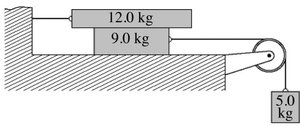
Step-by-Step Guidance
Draw free-body diagrams for each block, identifying all forces (gravity, tension, friction).
Write Newton's second law for the 5.0 kg block (downward), the 9.0 kg block (horizontal), and the 12.0 kg block (held in place).
Calculate the friction force between the 12.0 kg and 9.0 kg blocks: \( f_k = \mu_k (12.0 \text{ kg}) g \).
Set up the equations of motion for the system, accounting for the friction force acting on the 9.0 kg block.
Combine the equations to solve for the acceleration of the 5.0 kg block, but stop before plugging in the final numbers.
Try solving on your own before revealing the answer!
Final Answer: 2.1 m/s²
The acceleration of the 5.0 kg block is approximately 2.1 m/s² downward.
